Machine Learning Essentials via Podcasts
Introduction to Machine Learning
What Is Machine Learning?
Machine learning gives computers the ability to learn from data without being explicitly programmed for every single task. Instead of writing step-by-step instructions, we feed a system vast amounts of information and let it figure out the patterns on its own.
Think about how you learned to recognize a cat. No one gave you a strict set of rules like "if it has pointy ears, whiskers, and a long tail, it's a cat." You just saw many examples of cats, and eventually, your brain learned to identify them. Machine learning works in a similar way. It's a process of learning by example.
Machine Learning
noun
A field of artificial intelligence that uses statistical techniques to give computer systems the ability to "learn" from data, without being explicitly programmed.
This ability is transforming nearly every industry. When Netflix suggests a movie you might like, that's machine learning. When your email sorts a message into the spam folder, that's machine learning. Voice assistants, medical diagnoses, and fraud detection all rely on it. The core idea is to use data from the past to make predictions about the future.
The Three Main Flavors
Machine learning isn't just one single technique. It's a broad field with several different approaches. The three most common types are supervised, unsupervised, and reinforcement learning. Each is suited for different kinds of problems.
You can think of them like three ways of learning a new skill:
- Supervised: Learning with a teacher who gives you examples and tells you the right answers.
- Unsupervised: Learning by yourself, just by observing and finding patterns.
- Reinforcement: Learning through trial and error, receiving rewards for good actions and penalties for bad ones.
The type of learning an algorithm uses depends on the question you're asking and the kind of data you have.
Learning with a Teacher
Supervised learning is the most common type of machine learning. It's called "supervised" because the process is like a student learning under the guidance of a teacher. We give the algorithm a dataset where the correct answers are already known.
Imagine you want to teach a computer to identify pictures of cats and dogs. You would feed it thousands of images, each one labeled as either "cat" or "dog." The algorithm studies these labeled examples, learning the features—like ear shape, snout length, and eye placement—that distinguish one from the other. After training, you can give it a new, unlabeled picture of a cat or a dog, and it will use what it learned to predict the correct label.
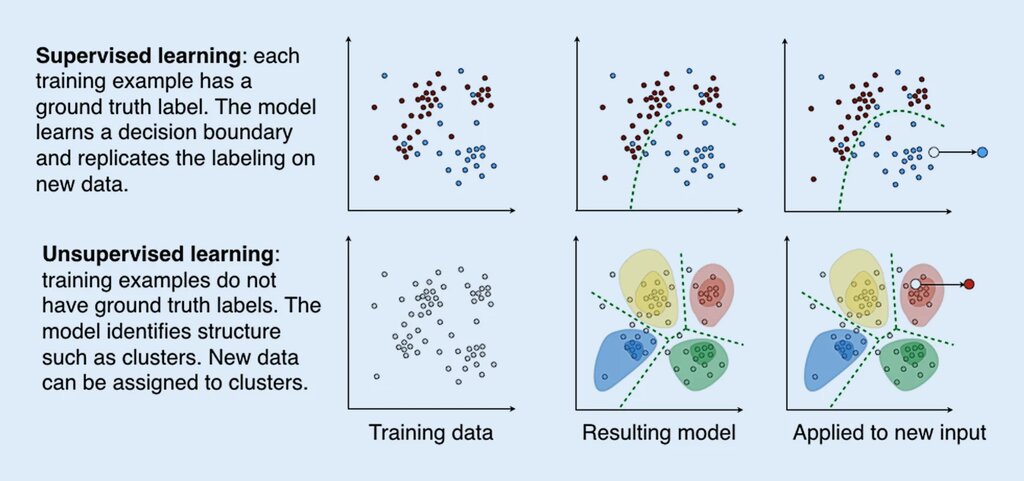
This method is great for two main kinds of problems:
Classification: When the goal is to predict a category. Is this email spam or not spam? Is this tumor malignant or benign?
Regression: When the goal is to predict a continuous value. What will the temperature be tomorrow? What is the price of this house?
Finding Patterns on Its Own
What if you don't have labeled data? That's where unsupervised learning comes in. In this approach, we give the algorithm a dataset without any explicit instructions or correct answers. Its job is to explore the data and find hidden structures or patterns all by itself.
Imagine you have a box of assorted fruits and you need to sort them. Even if you don't know the names of the fruits, you can start grouping them based on similarities like color, size, and shape. You might put all the small, red, round ones together (cherries), and all the long, yellow ones together (bananas). This is the essence of unsupervised learning.
Unsupervised learning is powerful for exploring data and discovering insights you didn't know to look for.
This is often used for:
Clustering: Grouping similar data points together. This is used in market research to segment customers into different groups based on their purchasing behavior.
Association: Discovering rules that describe large portions of your data. For example, an analysis of supermarket data might find that customers who buy diapers also tend to buy beer.
Learning from Mistakes
Reinforcement learning is about learning to make decisions. It's modeled on how humans and animals learn: through trial and error. An algorithm, called an "agent," learns to achieve a goal in a complex, uncertain environment.
The agent takes actions, and for each action, it receives feedback in the form of a reward or a penalty. The goal is to maximize the total reward over time. Think of training a dog to do a trick. When the dog performs the trick correctly, you give it a treat (a reward). When it does something else, it gets nothing. Over time, the dog learns which actions lead to a treat.
This type of learning is especially powerful for tasks where the right moves aren't obvious and long-term planning is required. It's the technology behind self-driving cars learning to navigate traffic, game-playing AIs that can defeat world champions in Chess or Go, and robotic systems learning to pick up and move objects.
Now that you have a sense of the different types of machine learning, let's test your understanding.
What is the core principle of machine learning?
A developer trains a model to identify pictures of cats and dogs by feeding it thousands of images, each one labeled with the correct animal. What type of machine learning is this?
Each of these learning methods has its own strengths and is used to solve different kinds of real-world problems. Together, they form the foundation of modern machine learning.