Machine Learning Engineering with Python and GitHub
Introduction to Machine Learning
Learning from Patterns
Machine learning teaches computers to do something remarkable: learn from data. Instead of writing explicit, step-by-step instructions for every task, we give a machine learning model examples and let it figure out the underlying patterns on its own.
Think about how you learned to identify a dog. You weren't given a long list of rules like "if it has four legs, fur, and a wagging tail, it's a dog." Instead, you saw many different dogs—big ones, small ones, fluffy ones—and your brain gradually learned to recognize the common features. Machine learning works in a similar way. It ingests data, identifies patterns, and uses those patterns to make predictions or decisions about new, unseen data.
Machine learning is a branch of artificial intelligence (AI) that focuses on developing algorithms and statistical models which allow computers to perform tasks by learning from data, instead of following strictly programmed instructions, machine learning systems identify patterns and make decisions with minimal human intervention.
Two Main Styles of Learning
Just as people learn in different ways, machine learning models have different approaches. The two most common are supervised and unsupervised learning.
Supervised Learning
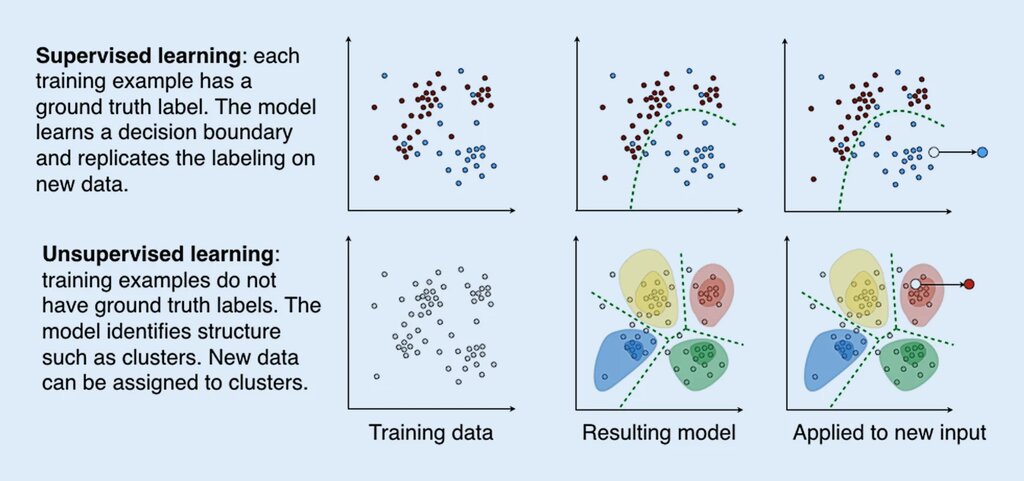
This is like learning with an answer key. The model is trained on a dataset where each example is labeled with the correct outcome. The goal is for the model to learn the relationship between the inputs and the labeled outputs so it can predict the outcome for new, unlabeled data.
Imagine training a model to identify spam emails. You would feed it thousands of emails, each one labeled as either "spam" or "not spam." The model learns the characteristics of spam (like certain keywords or sender addresses) and uses that knowledge to classify new emails as they arrive.
There are two main types of supervised learning tasks:
- Classification: The goal is to predict a category. Is this email spam or not? Is this tumor cancerous or benign?
- Regression: The goal is to predict a continuous numerical value. What will the price of this house be? How many customers will visit the store tomorrow?
Supervised learning learns from data that has been labeled with the correct answers.
Unsupervised Learning
This is like learning without an answer key. The model is given a dataset without any labels and must find patterns or structures on its own. It's about discovering the hidden organization in the data.
Suppose you have a large dataset of customer purchasing habits. An unsupervised learning model could analyze this data and automatically group customers into segments—for example, "bargain hunters," "loyal regulars," and "weekend shoppers." The model identifies these groups based on similarities in their behavior, without being told what to look for.
The most common unsupervised learning task is clustering, which involves grouping similar data points together.
Unsupervised learning finds hidden patterns in unlabeled data.
Algorithms in Action
Algorithms are the specific procedures that machine learning models use to find patterns. While there are many, a few common ones are great for understanding the basics.
| Algorithm | Type | What It Does |
|---|---|---|
| Linear Regression | Supervised | Predicts a numerical value by finding the best straight-line relationship between variables. |
| Logistic Regression | Supervised | Classifies data into one of two categories, like yes/no or true/false. |
| Decision Trees | Supervised | Makes decisions by splitting data based on a series of questions, like a flowchart. |
| k-Means Clustering | Unsupervised | Groups data into a specified number (k) of clusters, with each data point belonging to the nearest cluster center. |
These algorithms are the building blocks for countless real-world applications.
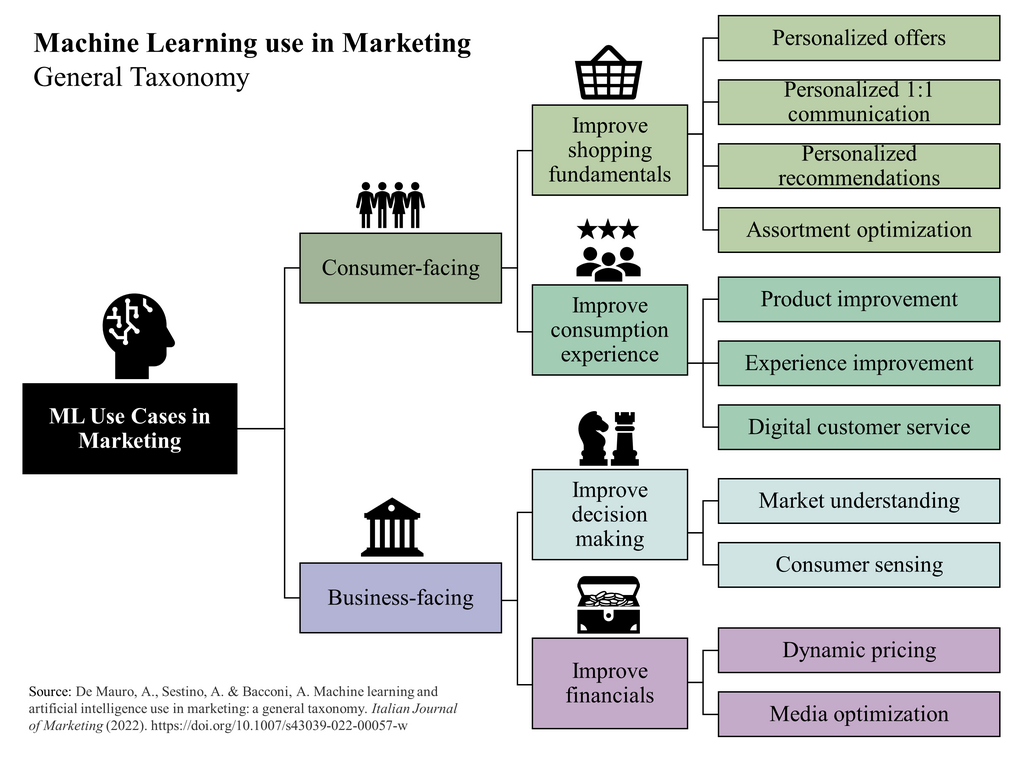
You encounter machine learning every day:
- Recommendation Engines: When Netflix suggests a movie or Amazon recommends a product, they are using algorithms to predict what you might like based on your past behavior.
- Spam Filters: Your email service uses classification to protect your inbox from unwanted messages.
- Fraud Detection: Banks analyze transaction patterns to flag suspicious activity that might indicate fraud.
- Price Prediction: Ride-sharing apps use regression models to predict demand and set prices dynamically.
- Customer Segmentation: Online retailers use clustering to understand their customer base and tailor marketing campaigns.
What is the core concept of machine learning?
A bank wants to build a model to predict whether a credit card transaction is fraudulent or not. The model will be trained on a massive dataset of past transactions, each labeled as either 'fraudulent' or 'legitimate'. What type of machine learning is this?
These examples are just the beginning. By learning from data, machine learning powers a huge range of technologies that make our lives easier and more efficient.