Machine Learning Deep Dive
Advanced Machine Learning Techniques
Beyond a Single Model
A single, well-trained machine learning model can be powerful. But what if you could combine the strengths of several models? This is the core idea behind ensemble methods. Instead of relying on one model's prediction, we ask a committee of models and aggregate their outputs. The result is often more accurate and robust than any single model could be on its own.
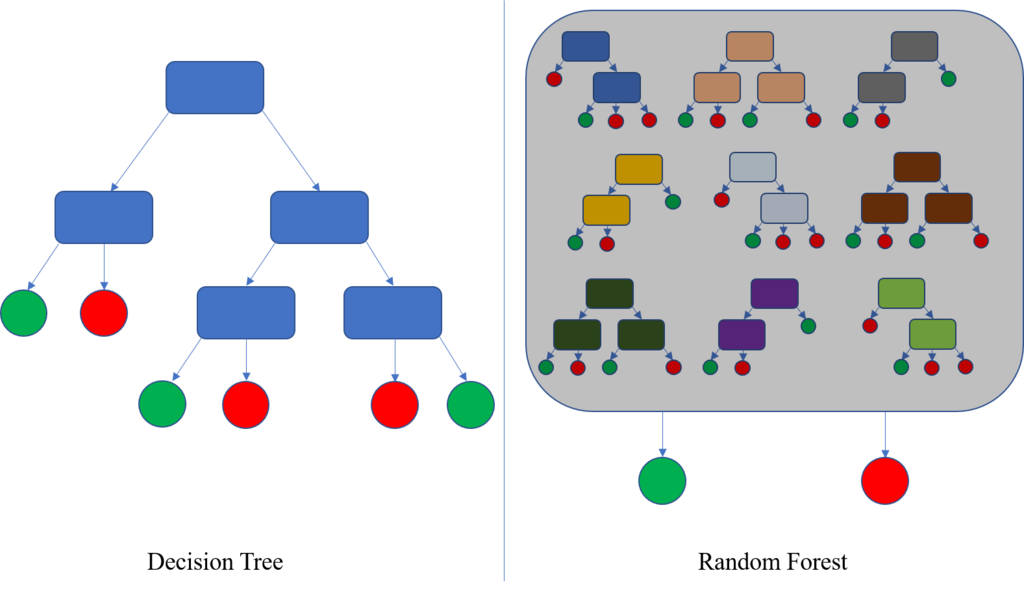
One popular ensemble technique is called bagging, which stands for bootstrap aggregating. The strategy is to create a diverse set of models by training each one on a different random subset of the data. When it's time to make a prediction, each model gets a vote. For classification, the majority wins; for regression, their predictions are averaged. The most famous example of bagging is the Random Forest, which builds an ensemble of decision trees.
Another approach is boosting. Unlike bagging, where models are trained independently, boosting builds them sequentially. Each new model is trained to fix the errors made by the previous one. It pays special attention to the data points that were misclassified, gradually building a strong, focused predictor from a series of weaker ones. This step-by-step improvement often leads to models with extremely high accuracy.
Finding the Clearest Dividing Line
Imagine you have data points from two different classes scattered on a graph. A Support Vector Machine (SVM) is a powerful algorithm for finding the line that best separates them. But it doesn't just find any line; it finds the one that creates the widest possible gap, or margin, between the two classes.
This margin is like a buffer zone. The wider the margin, the more confident the model is in its classification of new data. The data points that sit right on the edge of this margin are called "support vectors." They are the critical points that define the boundary. If you were to move any of them, the dividing line would have to change, too.
But what if the data can't be separated by a straight line? SVMs have a clever solution called the kernel trick. They project the data into a higher-dimensional space where a linear separator can be found. It’s like taking a tangled mess of points on a flat sheet of paper and lifting some of them up, making it easy to slide a clean sheet between them.
Deep Learning Architectures
While standard neural networks are versatile, specialized architectures are needed for complex data like images and sequences. These are the domain of deep learning.
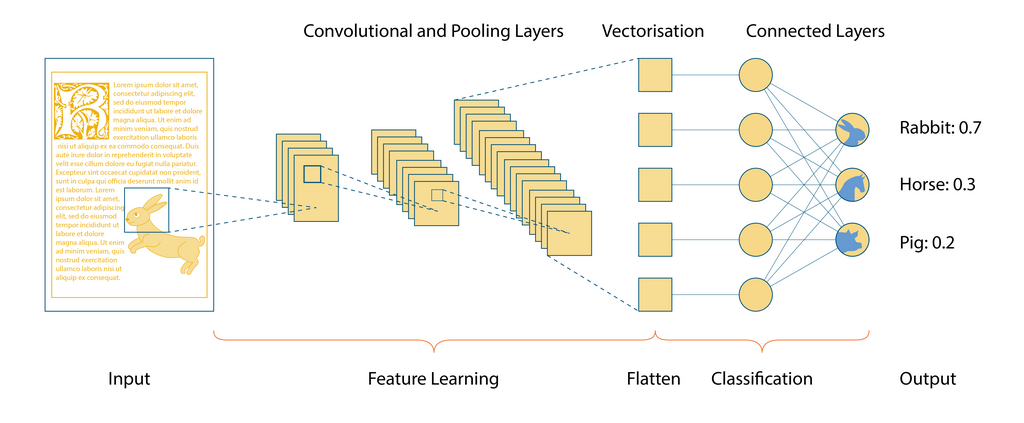
Convolutional Neural Networks (CNNs) are the masters of visual data. They work by sliding small filters, or kernels, across an image to detect specific features like edges, corners, and textures. As the data passes through the network's layers, these simple features are combined to recognize more complex objects, like eyes or wheels, until the network can identify the entire image.
Recurrent Neural Networks (RNNs) are designed to understand sequences and context. Unlike other networks, RNNs have a form of memory. As they process a sequence—be it words in a sentence or notes in a melody—they pass information from one step to the next. This allows them to understand the relationship between elements that are far apart, making them ideal for tasks like language translation and speech recognition.
Learning Through Trial and Error
How does a mouse learn to navigate a maze? It tries different paths, gets rewarded with cheese for correct turns, and avoids paths that lead to dead ends. Reinforcement Learning (RL) trains an AI agent in a similar way.
The agent exists in an environment where it can take actions. For each action, it receives a reward or a penalty. The agent's goal is to learn a policy—a strategy for choosing actions—that maximizes its total cumulative reward over time. It's a continuous cycle of action, feedback, and adaptation, perfect for training AI to play games, control robots, or manage complex systems.
Unlike supervised learning, which learns from a labeled dataset, reinforcement learning learns by interacting directly with its environment.
Don't Start from Scratch
Training a deep learning model from the ground up requires massive amounts of data and computational power. Transfer Learning offers a powerful shortcut. The idea is to take a model that has already been trained on a large, general dataset—like a CNN trained to recognize millions of images—and adapt it for a new, more specific task.
We can freeze the early layers of the pre-trained model, which have learned to recognize universal features like edges and colors, and only retrain the final layers on our new, smaller dataset. This leverages the knowledge the model has already gained, allowing us to build highly accurate models with much less data and time. It's like hiring an expert with years of general experience and giving them a quick training on the specifics of a new job.
Ready to test your knowledge on these advanced methods?
What is the primary difference between bagging and boosting ensemble methods?
In a Support Vector Machine (SVM), what is the significance of the "support vectors"?
These advanced techniques represent the cutting edge of what's possible with machine learning, enabling models that are not only more accurate but also more efficient and adaptable to a wide range of complex problems.