Machine Learning Architecture and Implementation
Model Selection Strategies
Choosing Your Algorithm
Selecting a machine learning algorithm is like choosing a tool from a toolbox. You wouldn't use a sledgehammer to hang a picture frame. Similarly, the algorithm you choose must fit the specific problem you're trying to solve. There is no single 'best' model; the optimal choice depends on the structure of your data, your performance requirements, and the ultimate business objective.
This decision process involves navigating a series of trade-offs. Should you prioritise a model that's easy to explain or one that delivers the highest possible accuracy? Does your dataset have a clear, simple structure, or is it a tangled mess of non-linear relationships? Answering these questions is the first step in building a robust and effective machine learning pipeline.
The Bias-Variance Tug of War
One of the most fundamental trade-offs in machine learning is the tension between bias and variance. Think of it like this: a high-bias model is like a stubborn expert who relies on simple, rigid assumptions. It might miss subtle nuances in the data because it oversimplifies. A high-variance model, on the other hand, is like an over-eager student who memorises every single detail of the training material. It learns the training data perfectly, including all its noise and quirks, but struggles to generalise to new, unseen examples.
The goal is to find a sweet spot: a model that is flexible enough to capture the true underlying patterns in the data (low bias) without being so flexible that it models the noise (low variance).
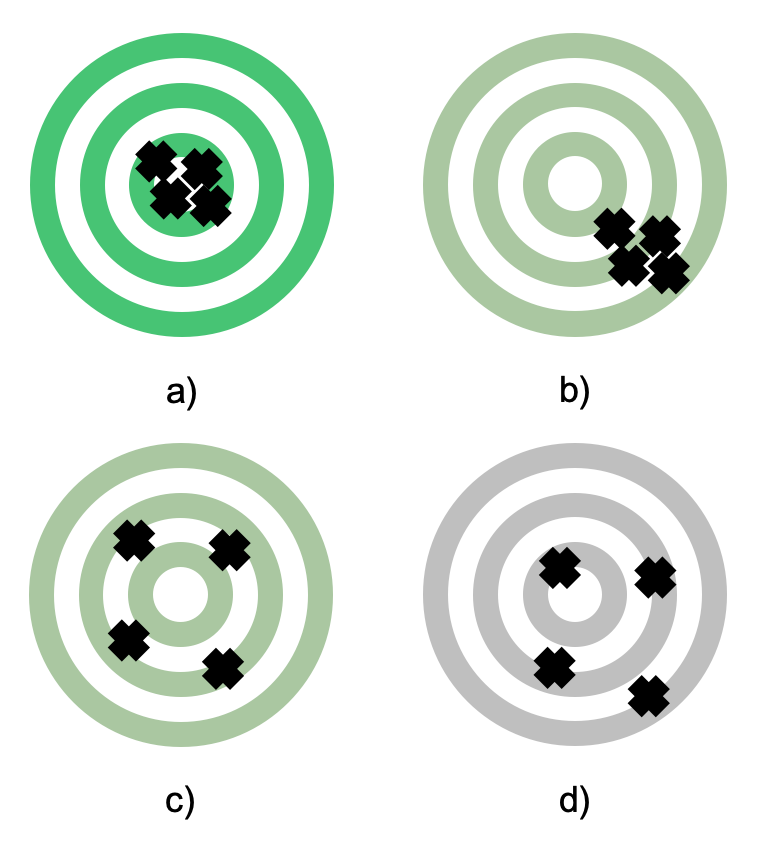
This trade-off directly influences your choice between two broad categories of models: parametric and non-parametric.
Parametric models, like Linear and Logistic Regression, make strong assumptions about the form of the data. They assume the relationship between features and the outcome can be summarised by a fixed number of parameters, regardless of the amount of data you have. This makes them fast, simple, and less prone to overfitting (low variance), but their rigid assumptions can lead to underfitting if the true relationship is complex (high bias).
Non-parametric models, such as and Decision Trees, make fewer assumptions. Their complexity grows with the amount of training data. This flexibility allows them to capture intricate patterns (low bias), but it also makes them highly susceptible to memorising noise and overfitting the training data (high variance).
The tradeoff between a model's ability to minimize bias and variance is foundational to training machine learning models, so it's worth taking the time to understand the concept.
Interpretability vs. Performance
Another critical trade-off is between a model's predictive power and its interpretability. A highly accurate model might be useless if you can't explain how it arrived at its conclusions, especially in regulated industries like finance or healthcare.
Linear models and single Decision Trees are highly interpretable. You can inspect the coefficients of a linear model to understand the influence of each feature. You can walk through the branches of a decision tree and see the exact logic it follows. This transparency builds trust and helps diagnose issues.
On the other end of the spectrum are models that often function as 'black boxes'. Ensembles of trees like Random Forests or powerful algorithms like Support Vector Machines can achieve state-of-the-art performance, but understanding their internal logic is much more difficult. When your primary goal is squeezing out every last bit of predictive accuracy, these models are excellent choices. But when you need to justify a decision to a stakeholder, a simpler, more transparent model might be the better strategic choice.
Handling Non-Linearity with Kernels
What if your data isn't separable by a straight line? This is a common problem. For example, imagine data points in a circular pattern where one class is in the centre and the other is on the outside. No single straight line can separate them.
This is where (SVMs) shine, thanks to something called the kernel trick. Instead of trying to find a line in the existing two dimensions, an SVM can use a kernel function to project the data into a higher dimension where a linear separator (a hyperplane) can be found.
This is a powerful way to apply linear methods to non-linear problems. Common kernels include the Polynomial kernel and the Radial Basis Function (RBF) kernel. While flexible, SVMs with complex kernels can be computationally expensive and less interpretable than simpler models like Decision Trees, which handle non-linearity by creating step-like decision boundaries.
What is the primary reason there is no single 'best' machine learning algorithm for all problems?
A model that performs exceptionally well on the training data but poorly on new, unseen data is likely suffering from what?
Choosing the right model is a foundational skill. It's an exercise in balancing competing priorities—simplicity versus complexity, interpretability versus power, and bias versus variance—to build a solution that is not only accurate but also practical and trustworthy.