Lunar Horizons: The Future of Manned Moon Missions
Introduction to Space Exploration
The Pull of the Cosmos
For millennia, humans have looked to the stars with a sense of wonder. We tracked their movements to mark the seasons and told stories about the constellations. For most of history, space was a realm of gods and myths, something to be observed but never touched. That all changed in the 20th century.
The invention of the rocket transformed our relationship with the cosmos. Suddenly, the sky was not the limit. This shift sparked the Space Race, a period of intense competition primarily between the United States and the Soviet Union. This rivalry accelerated technological development at an unprecedented rate, turning science fiction into reality and launching humanity's first bold steps into the void.
First Steps Into the Void
The era of space exploration began with a simple beeping sound. On 4 October 1957, the Soviet Union launched Sputnik 1, the world's first artificial satellite. It was a small, polished metal sphere, but its radio signals echoing from orbit sent shockwaves around the globe. Space was now accessible.
Less than four years later, on 12 April 1961, Soviet cosmonaut Yuri Gagarin became the first human to orbit the Earth. His 108-minute flight proved that humans could survive the rigours of space travel. This milestone set the stage for the most ambitious goal yet: landing a human on the Moon.
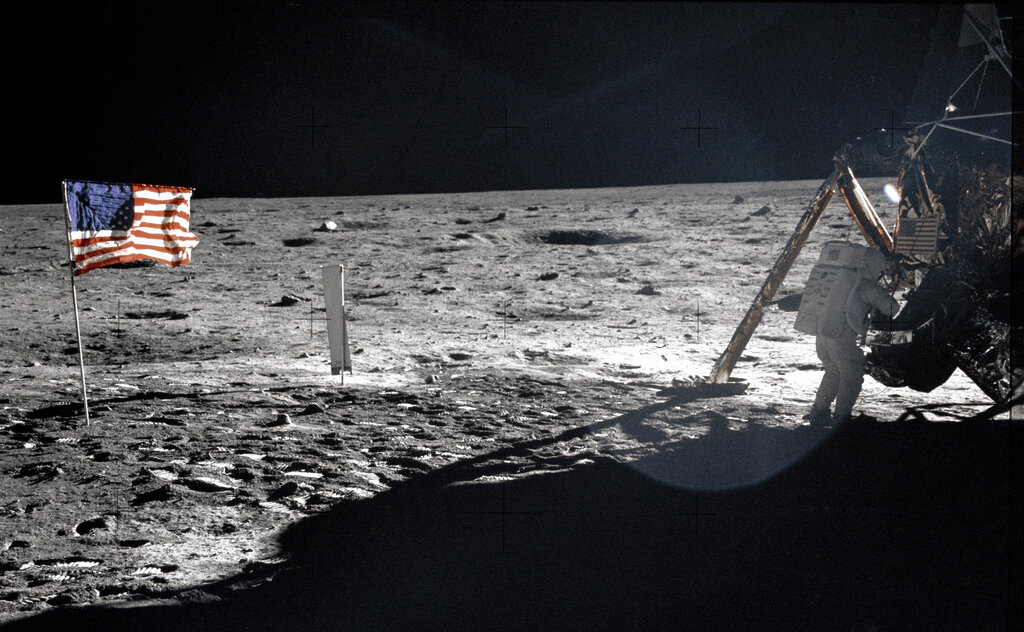
The United States' Apollo programme answered that challenge. On 20 July 1969, millions watched as Neil Armstrong and Buzz Aldrin of Apollo 11 became the first humans to walk on another celestial body. It was a monumental achievement that defined a generation and remains a high point of human exploration.
Why We Go
The motivations for exploring space are as vast as space itself. They extend far beyond political competition and national pride.
At its core, space exploration is driven by a quest for knowledge. We want to understand our place in the universe, search for life beyond Earth, and unravel the mysteries of cosmic origins. Each mission, whether it carries humans or robots, is a scientific expedition.
There's also the push for technological innovation. Solving the complex problems of space travel forces us to create new materials, more efficient energy sources, and advanced computing systems. These breakthroughs often have practical applications back on Earth.
Furthermore, space holds immense potential for economic activities, from satellite communications and navigation to the future prospect of mining resources on asteroids or the Moon. Finally, there is the simple, powerful human desire to explore, to push boundaries, and to see what lies over the next horizon.
| Motivation | Description |
|---|---|
| Scientific Discovery | Answering fundamental questions about the universe and searching for extraterrestrial life. |
| Technological Advancement | Developing new technologies to overcome the challenges of space travel, with benefits for Earth. |
| Economic Opportunity | Utilising space for communications, navigation, and potential future resource extraction. |
| Human Spirit | The innate drive to explore, discover new worlds, and expand the reach of humanity. |
The Perils of the Journey
Venturing into space is one of the most difficult and dangerous things humanity has ever attempted. The challenges are immense.
The environment itself is hostile. Outside the protective bubble of Earth's atmosphere, astronauts are exposed to a vacuum, extreme temperatures, and dangerous levels of radiation. Spacecraft must be meticulously designed to shield their occupants and sensitive equipment from these hazards.
The sheer scale of space presents another barrier. The distances are astronomical, meaning missions to even our closest planetary neighbours take months or years. This requires incredibly reliable life support systems and propulsion technology that can endure long journeys.
There's also a significant human cost. Astronauts face physical challenges like muscle atrophy and bone density loss in zero gravity, as well as the psychological strain of long-term isolation. The financial cost is also enormous, with missions often requiring billions of $ in funding.
Space is an unforgiving environment. A single faulty valve or a miscalculation in trajectory can have catastrophic consequences, a constant reminder of the high stakes involved in every launch.
Let's review some of the key concepts from this introduction to space exploration.
Ready to check your understanding? Take this short quiz.
Which event marked the beginning of the Space Race and the era of space exploration?
Who was the first human to travel into space and orbit the Earth?
From its competitive origins to its modern-day scientific and exploratory goals, the journey into space continues to push the boundaries of human capability and knowledge.