Louvre Infiltration Masterclass
Louvre Architectural Layout
The Three Wings
The Louvre Museum is not a single, monolithic building. It's a massive complex composed of three main wings arranged in a U-shape around a central courtyard. These wings are named Denon, Richelieu, and Sully, and each has its own distinct character and entry points from the central hub.
The Denon Wing runs along the Seine River and is arguably the most famous. It houses iconic works like the Mona Lisa and the Winged Victory of Samothrace. Its long galleries are almost always crowded, making it a high-traffic zone. Opposite the Denon is the Richelieu Wing, which stretches along the Rue de Rivoli. This wing contains European sculpture and decorative arts. The Sully Wing forms the base of the 'U', connecting the other two. It's the oldest part of the palace and contains antiquities.
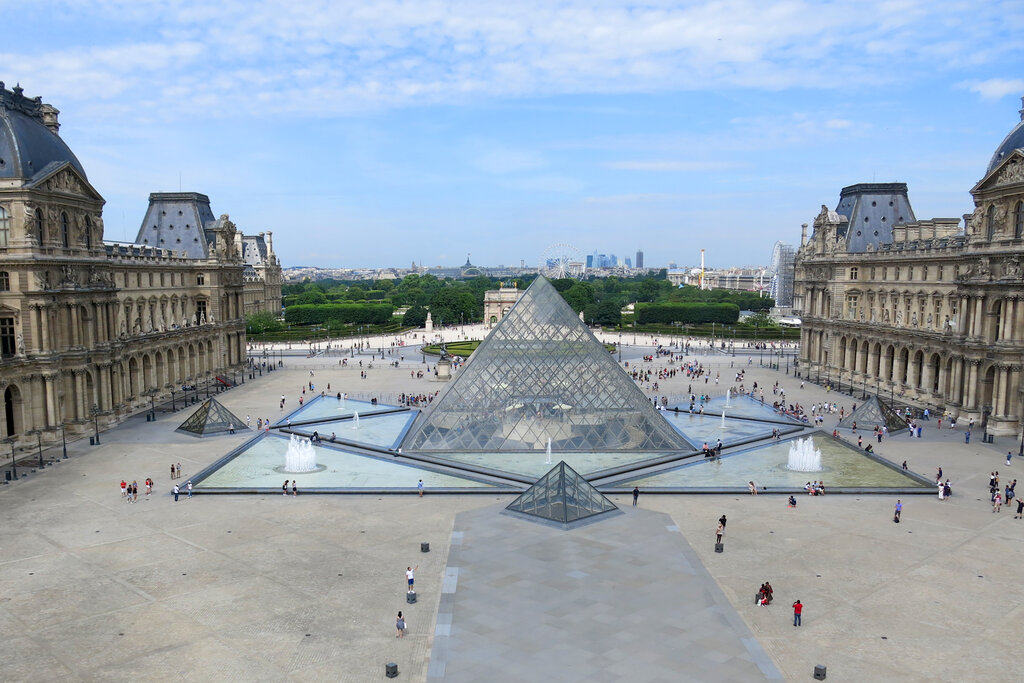
Understanding the layout of these three wings is the first step in navigating the museum's vast interior. Each wing connects to the others and to the central lobby beneath the main entrance, but they also have their own internal staircases and elevators, creating a complex web of pathways.
The Pyramid and the Courtyard
The main public entrance is located in the center of the Cour Napoléon, the grand courtyard created by the three wings. Here, a large glass-and-metal pyramid designed by architect I.M. Pei serves as the museum's modern front door. It funnels all visitors down into a sprawling underground lobby, which then provides access to the entrances of the Denon, Richelieu, and Sully wings.
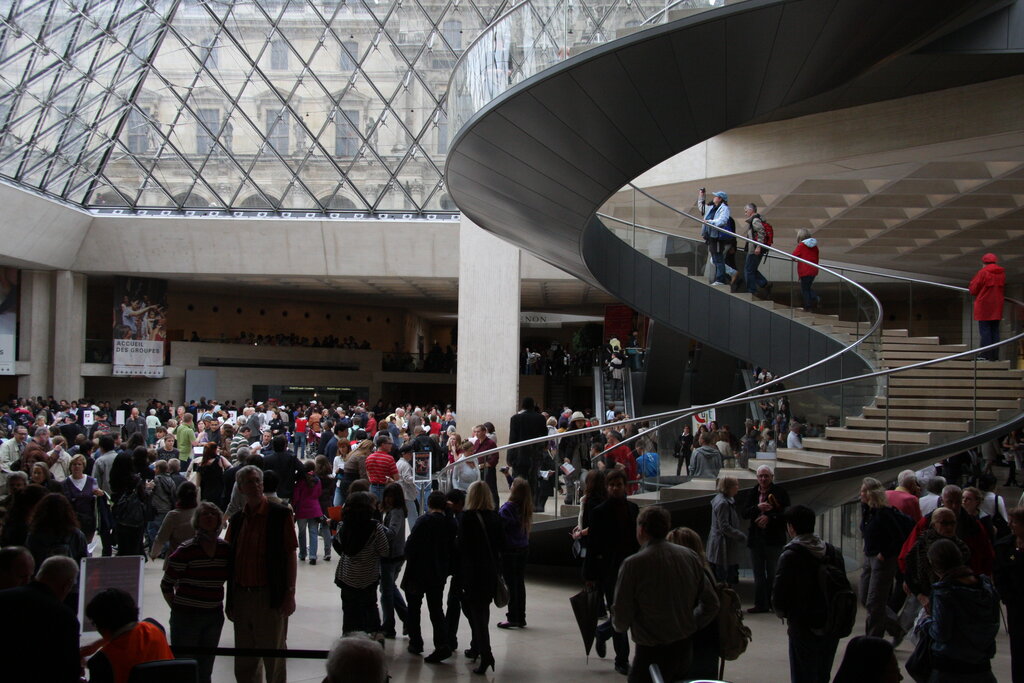
The pyramid structure itself, while iconic, is a significant bottleneck. All public traffic is channeled through this single point, creating predictable patterns of movement throughout the day. The open space of the Cour Napoléon offers a clear view of the surrounding palace facades, but the real entry and exit points are concentrated below ground.
Below Ground
Beneath the museum lies an extensive network of corridors, technical spaces, and public areas. The most significant of these is the Carrousel du Louvre, an underground shopping mall that connects directly to the museum's lobby. This mall has its own entrances from the street (99 Rue de Rivoli) and from the Palais Royal-Musée du Louvre Métro station. This creates several alternative access routes that bypass the main pyramid entrance entirely.
These secondary access points are often used by regular commuters and shoppers, blending museum traffic with the general public. This makes the underground complex a porous boundary, with multiple paths leading into the museum's core.
The underground Carrousel du Louvre provides direct, less-congested access to the museum lobby, completely avoiding the outdoor courtyard and pyramid.
Gaps in Coverage
The Louvre's immense size presents a significant surveillance challenge. Reports indicate that the museum's CCTV coverage is surprisingly incomplete. Only about 39% of the museum's rooms are monitored by cameras. This leaves vast sections of the collection and corridors without direct electronic observation.
Furthermore, the effectiveness of the existing cameras is questionable. Some have been found to be facing the wrong direction, creating blind spots even in theoretically monitored areas. These gaps are not random; they create predictable unobserved pathways through the museum. An individual with knowledge of the camera layout could potentially move through large sections of the building undetected.
The combination of multiple underground access points and inconsistent camera coverage creates significant vulnerabilities. The building's layout offers numerous routes for infiltration and exfiltration, many of which are not under constant surveillance.
Which wing of the Louvre houses the Mona Lisa and the Winged Victory of Samothrace?
What is the primary function of the large glass pyramid in the Louvre's central courtyard?