Logistics and Strategic Supply Chain Management
Strategy and Value Chain
From Distribution to Integration
In the past, companies viewed logistics through the narrow lens of Physical Distribution Management (PDM). The focus was purely tactical: moving finished goods from the factory to the customer. It was a siloed function concerned with warehousing, inventory management of final products, and transportation. Essentially, PDM was an outbound-focused cost center.
Supply Chain Management (SCM) represents a strategic shift. It expands the scope to include the entire flow of materials, information, and funds, from the initial raw material supplier all the way to the end consumer, and even back again through returns. SCM is not just about moving products; it’s about integrating and synchronizing activities across different companies to create a seamless, efficient, and responsive network. This shift turns logistics from a mere operational task into a strategic capability that can define a company's success.
The key difference is mindset. PDM seeks to optimize individual tasks, often at the expense of other functions. SCM aims to optimize the performance of the entire system, fostering collaboration and visibility from end to end.
Logistics in the Value Chain
To understand the strategic importance of logistics, we can use Michael Porter's Value Chain framework. This model views a firm as a series of activities that create value for customers. These are divided into primary activities (directly involved in creating and delivering a product) and support activities (which enable the primary ones). Logistics is not just a background cost; it's a core part of the primary activities.
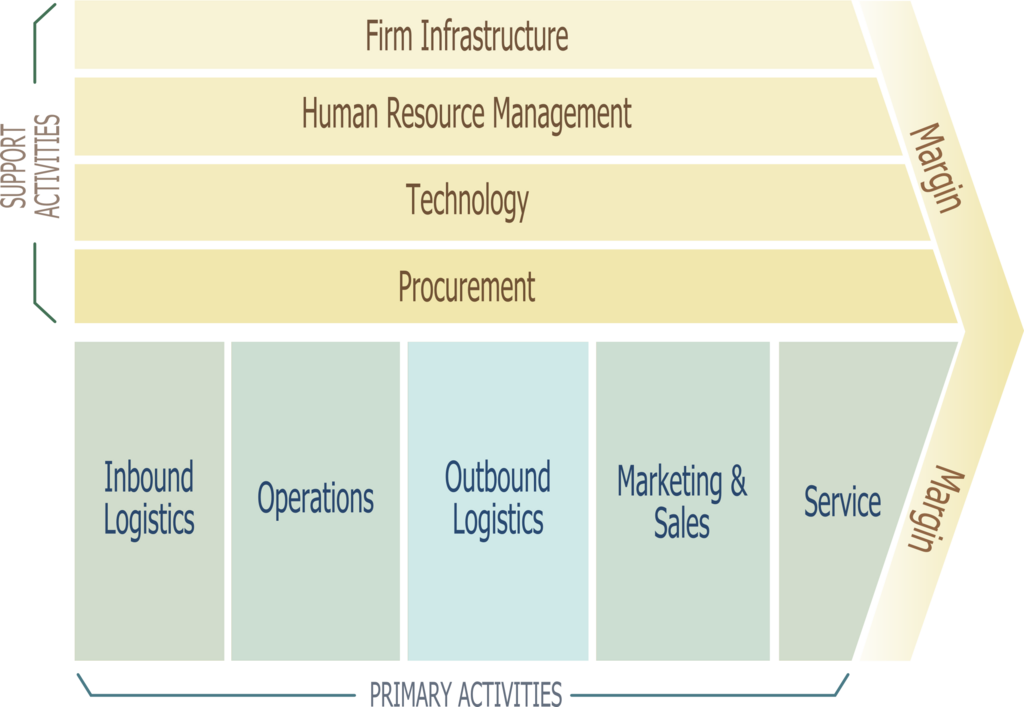
Logistics appears in several primary activities:
- Inbound Logistics: This involves managing the receipt, storage, and distribution of raw materials and parts from suppliers. Efficient inbound logistics minimizes stockouts, reduces material handling costs, and ensures production schedules are met.
- Outbound Logistics: These activities collect, store, and physically distribute the final product to buyers. This is a critical customer-facing function. Fast, reliable delivery can be a powerful competitive advantage.
- Service: This includes all activities required to keep the product working effectively after it's sold, such as installation, repair, and parts supply. Reverse logistics, the process of handling returns, is also part of this and significantly impacts customer loyalty.
By managing these activities effectively, a company can either lower its costs or differentiate itself by offering superior service, both of which build a competitive edge.
Well-executed logistics delivers the five "rights": the right product, in the right quantity and condition, at the right place, at the right time.
Aligning Cost and Service
A central challenge in logistics strategy is balancing service levels with costs. Offering next-day delivery (high service) is expensive. Using slower, cheaper transportation methods (low cost) might frustrate customers. This conflict requires a strategic approach, not a purely operational one.
The total cost approach is a framework for making these trade-offs. Instead of minimizing the cost of individual activities like transportation or warehousing in isolation, it focuses on minimizing the total cost of logistics. Sometimes, increasing the cost of one activity can lead to a greater reduction in the cost of another, lowering the overall total.
For example, spending more on faster, more reliable air freight (higher transport cost) might allow a company to close regional warehouses (lower inventory and facility costs), resulting in a net savings.
The optimal balance between cost and service depends on the company's overall strategy. A low-cost provider will prioritize efficiency and cost reduction, accepting a standard service level. A premium brand focused on customer experience will invest in superior logistics to deliver on its brand promise, even at a higher cost.
This alignment is known as strategic fit. Logistics decisions must support the company's value proposition. In a globalized economy, this becomes even more complex. A global supply chain must be designed to handle longer lead times, customs complexities, and diverse customer expectations while still aligning with the central corporate strategy.
Integrating Supply and Demand
The ultimate goal is to create a seamless link between the supply chain (what you can produce and deliver) and the demand chain (what customers want). This requires the tight integration of both material and information flows. When information from the point of sale is shared instantly with the factory and its suppliers, the entire chain can react in unison.
This integration helps solve a classic problem: the bullwhip effect. This is where small fluctuations in demand at the retail level become amplified as they move up the supply chain, leading to excess inventory or stockouts at the manufacturing and supplier levels.
By sharing data and collaborating, partners in the supply chain can smooth out these distortions. They can move from a "push" system, where products are made based on forecasts, to a "pull" system, where production is triggered by actual customer demand. This increases responsiveness, reduces waste, and ultimately enhances the perceived value of the product by ensuring it's available when and where the customer wants it.
What is the primary difference in mindset between Physical Distribution Management (PDM) and Supply Chain Management (SCM)?
According to Michael Porter's Value Chain framework, which of the following are all considered primary activities where logistics plays a key role?
Logistics has evolved from a simple operational function into a critical driver of strategy and value.