Logic of Parametric and Non Parametric Testing
Mathematical Assumptions
Why Assumptions Matter
Parametric tests like the t-test and ANOVA are the workhorses of psychological research. They're powerful tools for finding significant effects, but their power depends on the data playing by a specific set of rules. You already know that these tests require interval or ratio data, but that's just the first checkpoint.
Beyond the scale of measurement, there are four core mathematical assumptions that must be met for the results of these tests to be valid. When these assumptions are violated, our conclusions can be misleading, potentially leading us to claim an effect exists when it doesn't, or miss one that does. Think of them not as inconvenient hurdles, but as quality control checks that ensure our statistical inferences are sound.
The Bell Curve and Its Errors
The first assumption is normality. Many people mistakenly believe their raw data must form a perfect bell curve. The requirement is more nuanced: it's the sampling distribution of the mean that should be normal. For many tests, we check this by looking at the distribution of the residuals—the errors between the model's predictions and the actual data points.
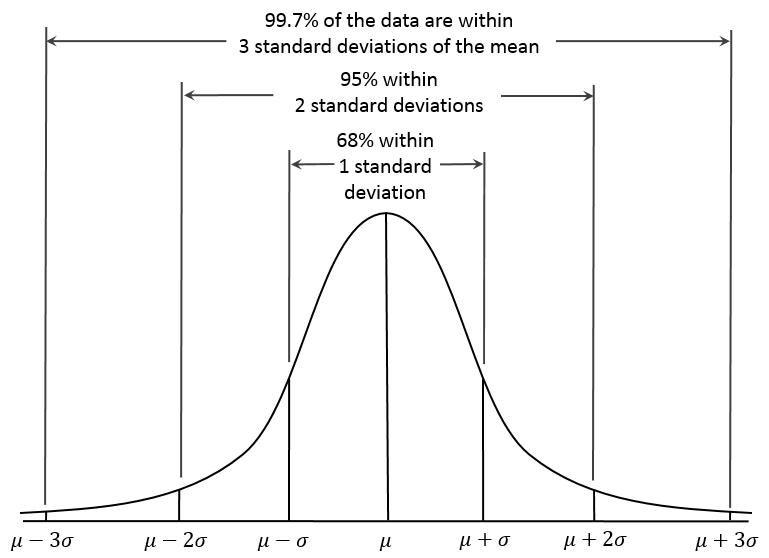
Why this shape? Because the math behind the p-value calculation in a t-test or ANOVA is based on the known probabilities of the normal curve.
Fortunately, the Central Limit Theorem often helps us out. This theorem states that if you have a sufficiently large sample size (typically n > 30), the sampling distribution of the mean will be approximately normal, regardless of the population's original distribution. This is a key reason why larger samples are so valuable in research; they make our tests more robust to violations of the normality assumption.
Equal Variance
The second assumption is homogeneity of variance, or homoscedasticity. This means that the variance of your outcome variable should be roughly equal across all levels of your independent variable. For example, if you're comparing the anxiety scores of a control group and a therapy group, the spread of scores within the control group should be similar to the spread of scores within the therapy group.
When this assumption is violated (a condition called heteroscedasticity), the group with the larger variance has a greater impact on the analysis. This can inflate the Type I error rate, meaning you might find a statistically significant result that isn't real.
Independent Lives
The third assumption is the independence of observations. This means that each data point in your sample should be unrelated to every other data point. The score from one participant should not influence the score of another. This is usually a matter of research design rather than something you test for statistically.
For example, if you're studying the effectiveness of a new teaching method on student test scores, you can't have students working together on the test. If they do, their scores are no longer independent, and the assumption is violated.
Violating this assumption is serious because it fundamentally alters the structure of the data. Most parametric tests assume a certain amount of random error, but when observations are dependent, that error is no longer random. This often leads to an underestimation of the true variance, making results seem more significant than they are.
Straight Lines and Simple Sums
Finally, for many parametric models like regression and ANOVA, we assume additivity and linearity. Linearity means the relationship between the predictor and outcome variables can be described by a straight line. Additivity means the combined effect of two or more predictor variables is simply the sum of their individual effects.
If the true relationship is curved (e.g., performance increases with anxiety up to a point, then decreases), a linear model will be a poor fit and won't capture the real nature of the relationship. This doesn't just reduce the power of your test; it gives you a fundamentally incorrect picture of the phenomenon you're studying.
When assumptions are violated, practitioners must either transform data to meet requirements, use alternative non-parametric methods, or acknowledge limitations that affect the validity of their conclusions.
Checking these assumptions isn't just a formality. It is a critical step in the research process that ensures the integrity and validity of your psychological findings. Now, let's test your understanding.
Which of the following statements most accurately describes the normality assumption for parametric tests like the t-test?
A researcher compares test anxiety scores between a group that received mindfulness training and a control group. They find that the scores in the training group are tightly clustered around the mean, while the scores in the control group are much more spread out. This scenario most directly suggests a violation of which assumption?