Logic Gates and Computer Architecture
Optimizing Combinational Logic
From Logic to Layout
You already know how basic logic gates like AND, OR, and NOT work. The next step is to translate a complex logical requirement into an efficient physical circuit. Just because an expression is logically correct doesn't mean it's the best way to build it in silicon. A clunky expression leads to a slow, power-hungry, and expensive chip.
Optimization is about simplification. We use the rules of Boolean algebra to reduce a complex logical expression into its simplest form. This directly translates to fewer gates, which means a shorter path for electrical signals. This reduction in path length, known as propagation delay, is critical for creating fast and efficient hardware. The goal is always to minimize complexity without changing the function.
Techniques like Karnaugh maps and Boolean laws reduce circuit complexity, saving cost and power.
Think of it like editing an essay. You can write a 500-word paragraph that gets the point across, or you can say the same thing in 100 words. The shorter version is easier to read and understand. In chip design, the simpler circuit is faster and consumes less energy.
The Rules of Reduction
Boolean algebra provides a formal set of rules for manipulating logical expressions. While there are many laws, a few are workhorses for simplification. The Distributive Law, for example, lets us expand or factor expressions, much like in regular algebra.
Then there's De Morgan’s Theorem, a powerful tool for dealing with inversions (NOT operations). It provides a way to convert expressions between AND and OR forms when they are under a negation bar.
Applying these rules lets you methodically chip away at an expression. For instance, if you have an output , you can use the distributive law to factor out A, giving you . Since or its inverse is always true (1), the expression simplifies to , which is just . We just eliminated two gates.
Standard Forms
Before we can reliably simplify expressions, we need to express them in a standard format. The two most common formats are Sum of Products (SOP) and Product of Sums (POS).
A expression is a set of AND terms (products) that are ORed together. Conversely, a Product of Sums expression is a set of OR terms (sums) that are ANDed together.
| Form | Structure | Example |
|---|---|---|
| Sum of Products (SOP) | Two AND gates feeding into one OR gate. | |
| Product of Sums (POS) | Two OR gates feeding into one AND gate. |
Any Boolean expression can be converted into either form. The choice often depends on which one results in a simpler final circuit.
Visual Simplification with K-Maps
Applying Boolean laws can be tedious and error-prone for expressions with many variables. A Karnaugh Map, or K-map, is a graphical method that makes simplification much more intuitive.
A K-map is a grid of cells where each cell represents a single row from a truth table. The key is how the rows and columns are labeled: they follow a Gray code sequence, where only one bit changes between adjacent cells. This adjacency is what allows us to spot opportunities for simplification.
To use a K-map:
- Create a grid with the correct number of cells for your variables ( cells for variables).
- Label the rows and columns using Gray code.
- Fill in a '1' for every combination of inputs that results in a 'true' output.
- Draw rectangles around groups of adjacent '1's. Groups must be powers of two (1, 2, 4, 8...). The larger the group, the simpler the resulting term.
- Write down the simplified Boolean term for each group. A variable is kept in the term only if it remains constant across all cells in the group.
- OR all the terms together to get the final, minimized expression.
This process visually transforms a complex truth table into a minimal SOP expression. For example, grouping four '1's in a 3-variable K-map eliminates two variables, leaving you with a single-variable term.
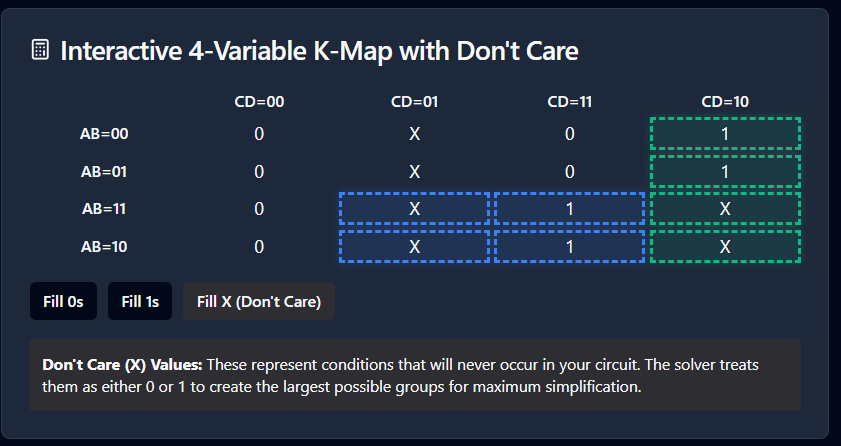
While powerful, K-maps become unwieldy for expressions with more than five or six variables. For those, engineers rely on computer algorithms like the to find the minimal form.
The trade-off is simple: a more complex design might be finished faster, but a simplified one performs better. In hardware, performance usually wins.
This process of minimization is a fundamental step in the journey from a logical concept to a physical chip. Every gate saved is a victory in power, speed, and cost.
Let's test your understanding of these optimization concepts.
What is the primary motivation for simplifying Boolean expressions in digital logic design?
Using Boolean algebra, what is the simplified form of the expression ?