Logic and Observation in Practice
Synthesis of Reason
The Engine of Science
Science doesn’t just pick a side between pure reason (rationalism) and raw observation (empiricism). Instead, it combines them into a powerful, self-correcting process. This synthesis is what allows us to build reliable knowledge about the world. It’s a dynamic dance between what we think might be true and what we can actually show to be true.
Purely deductive arguments are logically sound, but they don't teach us anything new about the physical world. Inductive arguments, based on observation, can be overturned by new evidence. The scientific method bridges this gap by using both.
From Hypothesis to Test
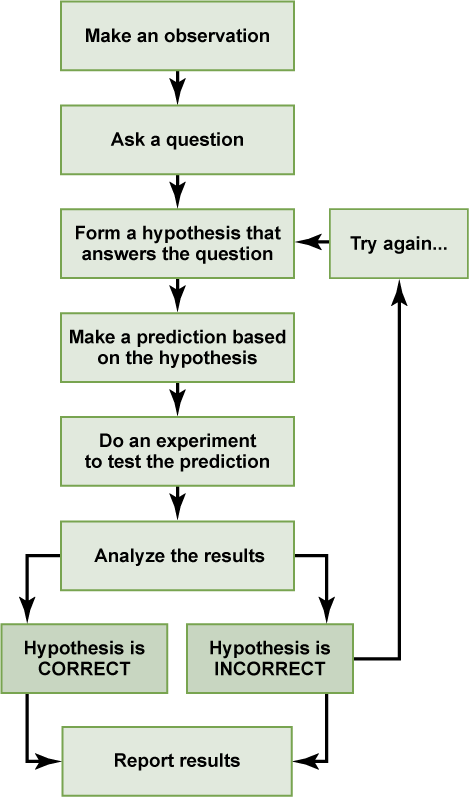
The hypothetico-deductive model is the core of modern science. It starts with a broad explanatory framework, or theory. From this theory, we use deduction—a 'top-down' process—to derive a specific, testable prediction called a hypothesis.
A hypothesis isn't a random guess. It’s a logical consequence of the theory. It takes the form: "If my theory is correct, then under these specific conditions, I should observe this specific outcome." This step is purely rationalistic; it’s about thinking through the logical implications of an idea.
Once we have a testable hypothesis, we switch to an empirical, 'bottom-up' approach. We design an experiment or make systematic observations to see if the predicted outcome occurs. This is where we collect data.
After analyzing the results, we use induction to generalize. If our observations match the hypothesis, the theory is strengthened. If they don't, the theory is weakened or shown to be incomplete. This might lead us to revise the theory or even discard it entirely.
A Feedback Loop, Not a Straight Line
This process isn't linear; it's a continuous feedback loop between theory and observation. Theories guide our observations by telling us what to look for and what questions to ask. Observations, in turn, discipline our theories by grounding them in reality.
Consider the transition from Aristotelian physics to Newtonian mechanics. For centuries, Aristotle’s theory that heavier objects fall faster than lighter ones was the accepted logical model. It was a 'top-down' idea derived from principles that seemed self-evident.
However, empirical observations—most famously attributed to Galileo—showed an anomaly. Objects of different weights fall at the same rate (ignoring air resistance). This 'bottom-up' data contradicted the existing theory. The logical model had to be restructured. Isaac Newton then developed a new theory, universal gravitation, which not only explained this observation but also made a host of new, testable predictions. This new theory provided a more robust framework, which was then subjected to its own cycle of deductive testing and inductive feedback.
Empirical anomalies force us to rethink our logical models. A single, repeatable observation can be enough to challenge a theory that has stood for centuries.
This loop is what makes science so successful. It has the rigor of deduction but remains open to correction from the real world through induction. It is a synthesis of reason and experience.
The scientific method is best described as a synthesis of which two philosophical approaches?
In the hypothetico-deductive model, the process of deriving a specific, testable hypothesis from a general theory is a 'top-down' process known as _______.
The constant interplay between our logical frameworks and empirical data is what drives scientific progress.