Logarithms for IIT JEE
Core Properties
Manipulating Logarithmic Expressions
In competitive exams like the IIT-JEE, you don't just solve for logarithms, you manipulate them. Mastering the core properties is about developing the intuition to see how a complex expression can be simplified. Let's start with the two most fundamental operations: multiplication and division.
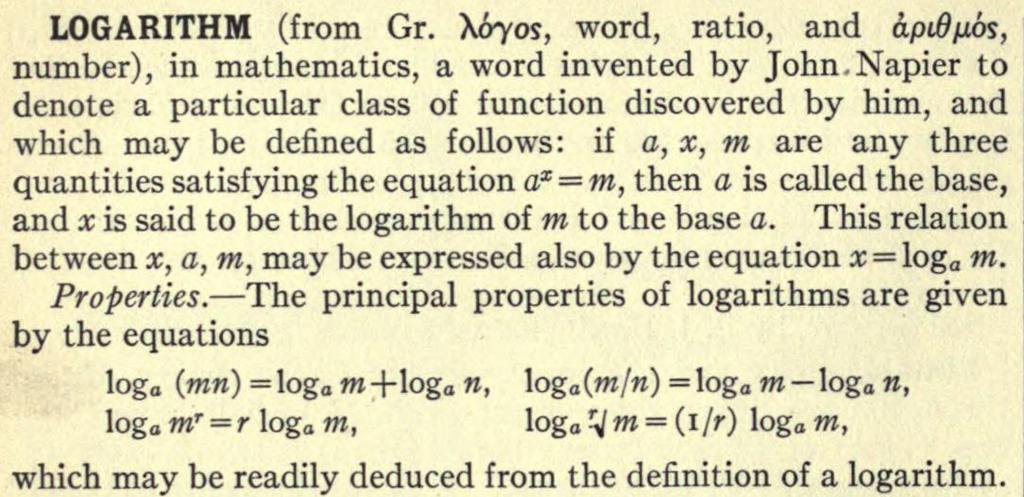
The product rule allows multiplication within logs to be expressed as the sum of separate logs, while the quotient rule transforms division into subtraction.
The Product Rule states that the logarithm of a product is the sum of the logarithms of its factors. The only condition is that they must share the same base.
Conversely, the Quotient Rule does the opposite for division, turning it into subtraction.
Example: Simplify . Using the product rule in reverse, this becomes . Since , the answer is 2.
Powers and Roots
The Power Rule is one of the most powerful tools for solving logarithmic equations. It allows you to move an exponent from inside a logarithm to the front as a coefficient. This is essential for isolating variables that are stuck in an exponent.
This rule extends naturally to roots, since a root is just a fractional exponent. For example, the square root of is .
Example: Evaluate . Using the power rule, we get . We know , so the expression simplifies to .
Changing the Game with Bases
What happens when you need to work with logarithms that have different bases? You can't directly combine and . This is where the Change of Base Theorem becomes indispensable. It allows you to rewrite any logarithm in terms of a new, common base. Often, this new base is 10 (common log) or e (the natural logarithm).
This theorem has some extremely useful corollaries. One is the base-switching property, which lets you swap the base and the argument of a logarithm.
Finally, we have the foundational identity that directly links exponents and logarithms. It states that raising a base to the power of a logarithm with the same base simply yields the argument of the logarithm.
Example: Simplify . Based on the identity, the base 5 and the logarithm base 5 cancel each other out, leaving the answer as 12.
Let's review these essential rules before testing your skills.
Now, let's see how well you can apply these properties.
Which of the following expressions is equivalent to ?
The statement is a valid logarithmic identity.
Consistent practice with these properties is key. In an exam, speed and accuracy come from recognizing patterns where these rules can be applied to break down a problem into a simpler form.