Logarithmic Expressions In Terms of Variables
Understanding Logarithms
The Question of Exponents
Exponents are straightforward. If you see $2^3$, you know it means to multiply 2 by itself 3 times to get 8. But what if you have the answer and need the exponent? For example, 2 to what power equals 8? The answer is 3.
A logarithm is simply a formal way of asking this question. It's the tool we use to find the missing exponent.
A logarithm asks: what exponent is needed to go from the base to the result?
The expression is read as "log base 2 of 8." It's asking, "What power do we need to raise 2 to, in order to get 8?" Since , we know that .
This gives us the general form of logarithmic notation. The exponential equation is equivalent to the logarithmic equation . In this form, is the base, and is the argument.
logarithm
noun
The exponent to which a base must be raised to produce a given number.
An Inverse Relationship
Logarithms and exponents are inverse operations. They undo each other, just like addition undoes subtraction, and multiplication undoes division.
If you take the logarithm of an exponential expression with the same base, you are left with just the exponent. For instance, simplifies to 2. The and the cancel each other out.
Conversely, if you raise a base to the power of a logarithm with that same base, you get the argument of the logarithm. For example, simplifies to 25. They are perfect opposites.
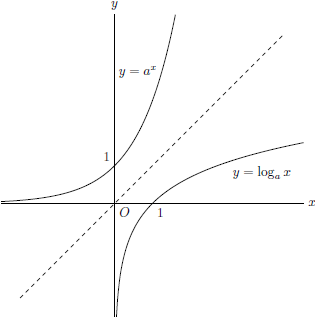
This inverse property is key. It allows us to solve for variables that are stuck in an exponent.
The Rules of Logarithms
Because logarithms are so closely related to exponents, they have a special set of rules that mirror the rules of exponents. These rules help us simplify complex logarithmic expressions.
To use these rules, the logarithms must have the same base.
First is the Product Rule. When we multiply two numbers with the same base, we add their exponents (). The product rule for logarithms works similarly. The logarithm of a product can be rewritten as the sum of two separate logarithms.
For example, we know . Let's check the rule with and .
. It works.
Next is the Quotient Rule. This rule mirrors exponent division, where we subtract exponents (). The logarithm of a quotient (a fraction) is the difference of the logarithms.
Let's test this with , which we know is 2. Let's use and .
. This rule also holds.
Finally, we have the Power Rule. This one is especially useful. It says that an exponent on the argument inside a logarithm can be moved out front as a coefficient.
Consider . This is , which equals 9. Using the power rule, we can simplify this differently:
. Both paths lead to the same answer.
These three rules are the foundation for working with logarithms.
What does a logarithm fundamentally help you find?
Which logarithmic equation is equivalent to the exponential equation ?
Mastering these properties is the first step toward using logarithms to solve more complex problems.