Logarithmic Equations Explained
Introduction to Logarithms
What is a Logarithm?
Exponential equations are all about growth. For instance, $2^3 = 8$. If you start with 2 and multiply it by itself 3 times, you get 8.
But what if you know the starting number and the final number, but not the exponent? What if you have the equation $2^x = 8$ and need to find $x$? You can probably figure out in your head that $x$ is 3. But what about $2^x = 10$? That's not as easy.
Logarithms are the tool we use to solve for that missing exponent. A logarithm answers the question: "What exponent do I need to raise a specific base to, in order to get a certain number?"
Simply put, a logarithm is an exponent.
Notation and Meaning
The way we write a logarithm looks like this: . Let's break down the parts.
| Part | Name | Question it Asks |
|---|---|---|
| Base | What number are we multiplying? | |
| Argument | What is the final number we want to get? | |
| The operation that finds the missing exponent. |
The entire expression, , equals the exponent we are looking for. So, the relationship between exponents and logarithms is a two-way street. They are two different ways of saying the exact same thing.
Let's see this with our first example. To solve $2^x = 8$, we would write it as a logarithm:
$\log_2(8) = x$
This asks, "What power do we need to raise 2 to, in order to get 8?" As we know, the answer is 3. So, $\log_2(8) = 3$.
Here are a few more quick examples:
- , because .
- , because .
- , because .
The Inverse Relationship
Logarithms and exponents are inverse operations. This means they undo each other, just like subtraction undoes addition, and division undoes multiplication.
If you take a number, apply an exponential function to it, and then apply a logarithmic function with the same base, you get back to your original number.
This inverse relationship is also visible in their graphs. The graph of a logarithmic function is a reflection of its corresponding exponential function across the line .
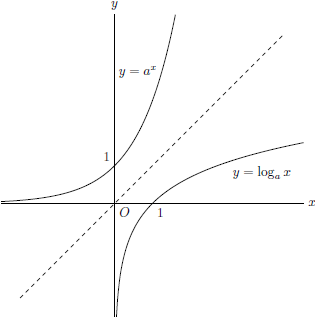
Understanding this core concept, that a logarithm is just a way to find a missing exponent, is the first step. It's a fundamental tool for solving problems that involve rapid growth or decay.