Local Debugging for Microservices
Introduction to Microservices
Breaking Down the Application
Imagine a huge, sprawling application that does everything. It handles user accounts, processes payments, manages inventory, and sends email notifications. In the software world, this all-in-one approach is called a monolithic architecture. For a long time, it was the standard way to build things. Everything is in one large codebase, deployed as a single unit.
But as applications grow, the monolith can become a problem. A small change in one part of the system requires testing and redeploying the entire thing. If one feature has a bug, it can crash the whole application. Scaling becomes an all-or-nothing game; if you need more power for payment processing, you have to scale up the entire application, even the parts that aren't busy.
This is where microservices come in. It’s an architectural style that structures an application as a collection of small, independent services.
Think of it like a restaurant kitchen. A monolithic kitchen might have one chef trying to do everything: chop vegetables, grill steaks, bake desserts, and wash dishes. It's chaotic and inefficient. A microservices kitchen, on the other hand, has specialized stations. One chef is on the grill, another is at the pastry station, and a third handles salads. Each station works independently, but they all communicate to create a complete meal. Each can be staffed up or down depending on how many steak or dessert orders are coming in.
Each microservice is built around a specific business capability. One service might handle user authentication, another might manage the product catalog, and a third would process payments. They are small, self-contained, and communicate with each other over well-defined APIs (Application Programming Interfaces).
Key Principles
Microservices aren't just about breaking an application into smaller pieces. They follow a few core principles that make the architecture work.
Single Responsibility: Each service does one thing and does it well. The user service only worries about users; it doesn't know or care how payments are processed.
Independence: Services are developed, deployed, and scaled independently. A team can update the payment service without touching the user service. If the product catalog gets a surge of traffic, you can scale just that service without affecting the others.
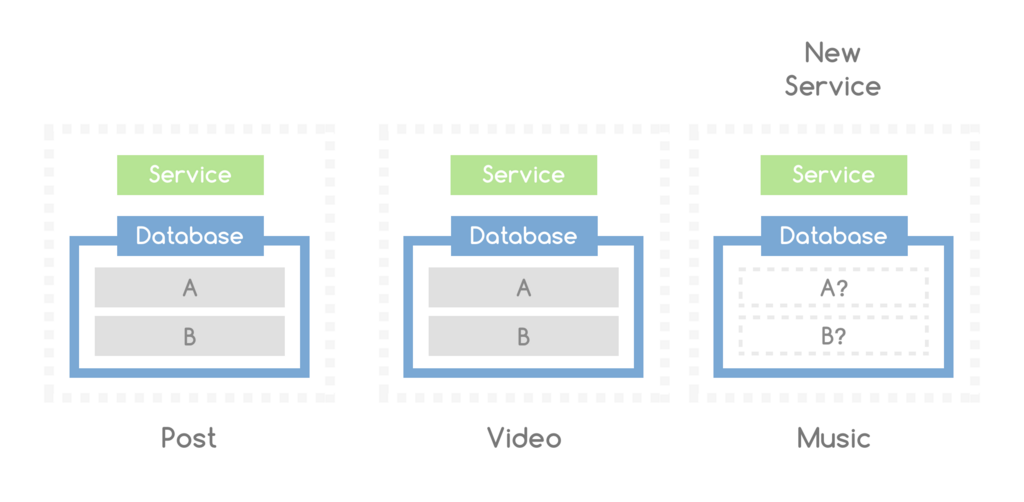
Decentralized Data: Each microservice typically owns and manages its own database. This prevents services from being tightly coupled at the data level. The order service has its order database, and the customer service has its customer database. They don't share.
Trade-Offs to Consider
This approach offers powerful benefits. Teams can innovate faster since they aren't stepping on each other's toes. You can choose the best technology for each service—maybe using Python for a machine learning service and Node.js for a real-time notification service. The application also becomes more resilient; the failure of one non-critical service doesn't have to bring everything crashing down.
However, microservices introduce their own challenges. What was once a simple function call inside a monolith is now a network call between two services, which can be slower and less reliable. Managing dozens or even hundreds of services is operationally complex. You need robust automation for deployment and monitoring.
One of the biggest hurdles is figuring out what went wrong when a single user request travels through multiple services. A bug could be in any one of them, or in the communication between them. This complexity is a key reason why understanding the architecture is the first step toward building an effective development and debugging setup.
What is the primary characteristic of a monolithic architecture?
Using the restaurant kitchen analogy, which element best represents a single microservice?