LLM Inference Explained
Introduction to LLM Inference
From Prompt to Text
When you type a question into a large language model (LLM) and get an answer, you're witnessing a process called inference. Inference is simply the term for using a trained model to make predictions on new data. The model isn't learning anymore; it's putting its knowledge to work.
Think of a chef who has spent years learning recipes and techniques. That's the training phase. When you hand them a basket of specific ingredients and ask for a dish, the process of them cooking that meal is inference. The LLM does something similar, but with words. This happens in three main steps: tokenization, execution, and generation.
Step 1 Tokenization
Computers don't understand words and sentences directly. They work with numbers. The first step in inference is to translate your text prompt into a format the model can use. This translation process is called tokenization.
Tokenization breaks the input text into smaller chunks called tokens. A token can be a whole word, a part of a word (like ing or est), or even a single punctuation mark. Each unique token in the model's vocabulary is mapped to a specific integer.
For example, the phrase "The quick brown fox" might be tokenized into
["The", "Ġquick", "Ġbrown", "Ġfox"]and then converted into a sequence of numbers like[464, 5323, 7586, 13359].
This method allows the model to handle a vast vocabulary efficiently. It can recognize parts of words, which helps it understand and generate new or rare words it hasn't seen before.
Step 2 Model Execution
Once the prompt is a sequence of numbers, it's fed into the LLM. The model itself is a massive neural network with a specific architecture, often called a Transformer. This network is made of many layers that process the input sequence.
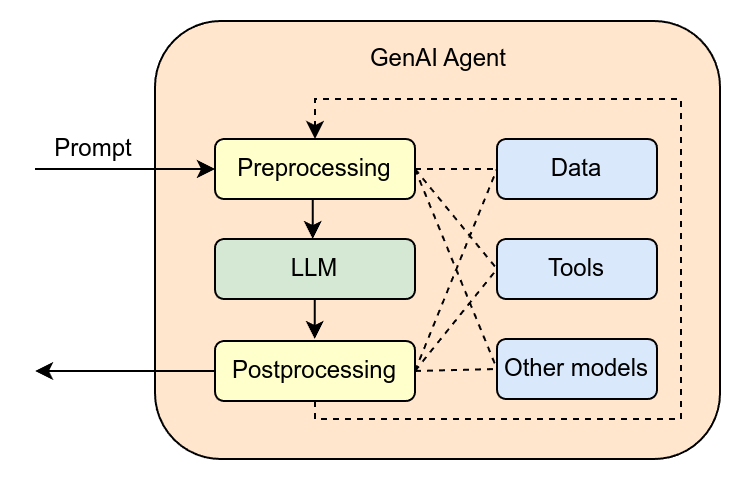
At its core, the model is a sophisticated prediction engine. For each token it receives, it performs a huge number of mathematical calculations to predict the most probable next token. It considers the context provided by all the previous tokens to make this prediction. This process flows through the network's layers, which are trained to weigh different parts of the input to understand grammar, facts, and context.
Step 3 Output Generation
The final step is to generate a response. LLMs do this one token at a time in a process called autoregressive generation. The model predicts the single most likely token to come next, adds it to the sequence, and then feeds the entire new sequence back into itself to predict the following token. This loop continues until the response is complete.
If the input is
"The capital of France is", the model might first predict"ĠParis". It then appends this to the input, creating"The capital of France is Paris", and uses that to predict the next token, which might be a period..
But how does the model choose the next token when there are many possibilities? Instead of always picking the single most probable token (a method called greedy search), models often use sampling strategies to produce more creative and natural-sounding text.
| Strategy | Description |
|---|---|
| Greedy Search | Always picks the token with the highest probability. Fast but can be repetitive. |
| Top-k Sampling | The model considers only the top k most likely tokens and chooses one randomly. |
| Temperature | A setting that adjusts the randomness of predictions. Higher temperatures increase creativity, while lower temperatures make the output more focused and predictable. |
The generation process stops when the model produces a special "end-of-sequence" token or reaches a predefined length limit. The resulting sequence of tokens is then converted back into human-readable text, and you see the final response.
Time to check your understanding of the core concepts of LLM inference.
What is "inference" in the context of a large language model?
What is the primary purpose of tokenization in the LLM inference process?
Together, these three steps—tokenization, execution, and generation—form the inference process that allows a large language model to turn a simple prompt into a coherent and useful answer.