LLM Evolution and Advanced Prompt Engineering
Attention Mechanisms
Breaking the Chain
Recurrent Neural Networks (RNNs) process information sequentially, like reading a sentence one word at a time. This works well for short sequences, but with longer texts, they struggle. The model has to compress the meaning of an entire paragraph into a single, fixed-length vector. Important details from the beginning can get lost by the time the model reaches the end, a problem known as the vanishing gradient problem when training.
Attention mechanisms solve this by allowing the model to look at the entire input sequence at once. Instead of relying on a compressed summary, the model can dynamically weigh the importance of every word in the input when processing any other word. It learns which parts of the input are most relevant to the current task, no matter how far apart they are.
This parallel processing approach is the core innovation of the Transformer architecture, making it far more efficient and powerful for handling long-range dependencies.
Queries, Keys, and Values
The fundamental building block of attention is called Scaled Dot-Product Attention. It works by calculating a set of attention scores using three matrices derived from the input embeddings: Query (Q), Key (K), and Value (V).
Think of it like searching a video database.
- Query: Your search term, like "cats jumping."
- Keys: The titles and tags associated with every video in the database.
- Values: The actual video files themselves.
The system calculates a similarity score between your query and each key. It then uses these scores to create a weighted sum of all the values. Videos with higher similarity scores (better matches) are weighted more heavily in the final output, giving you a playlist of relevant videos.
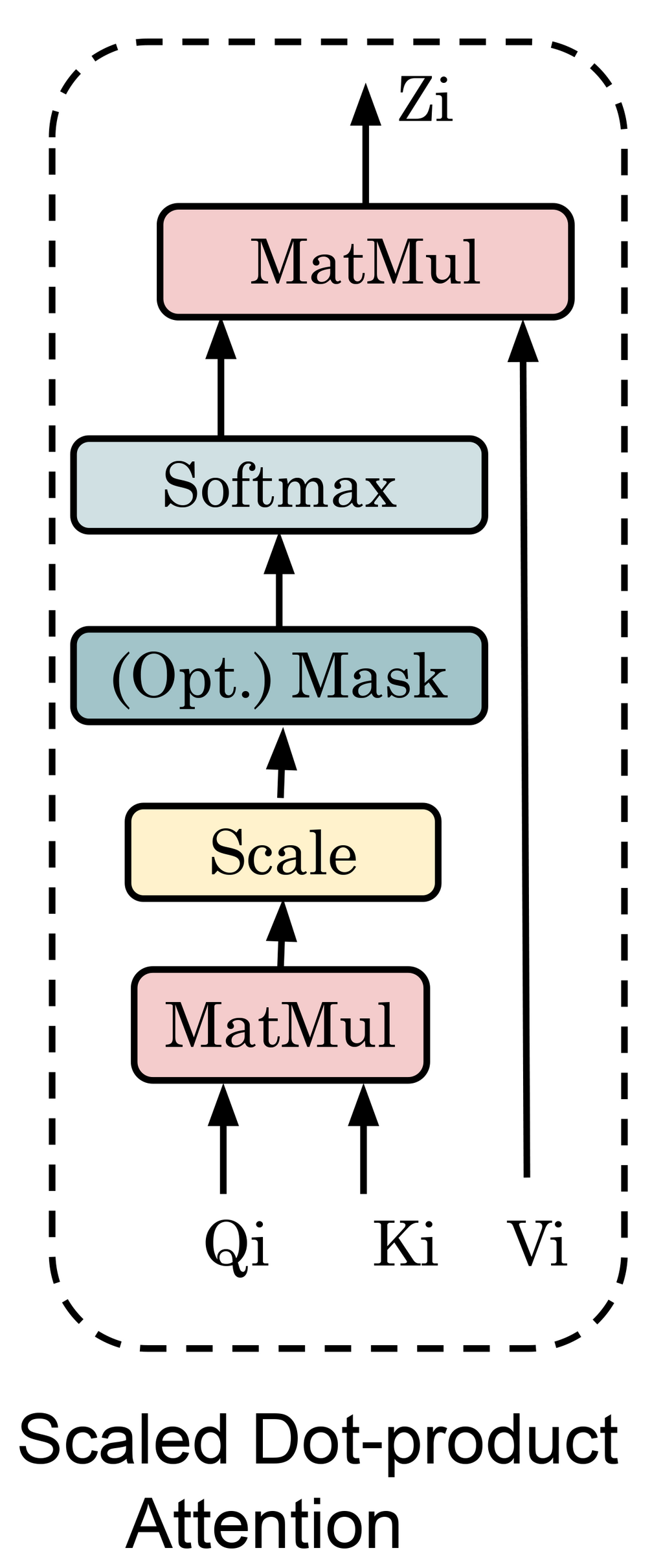
In a neural network, the model learns the optimal Q, K, and V matrices during training. The process is defined by this formula:
Multiple Perspectives
A single attention mechanism, or "head," is good at capturing one type of relationship. For example, it might learn to focus on subject-verb agreement. But language is complex, with many layers of syntactic and semantic relationships happening at once.
This is where Multi-Head Attention comes in. Instead of one set of Q, K, and V matrices, it creates multiple sets in parallel. Each "head" independently performs the scaled dot-product attention calculation, learning to focus on different types of relationships from different representational subspaces.
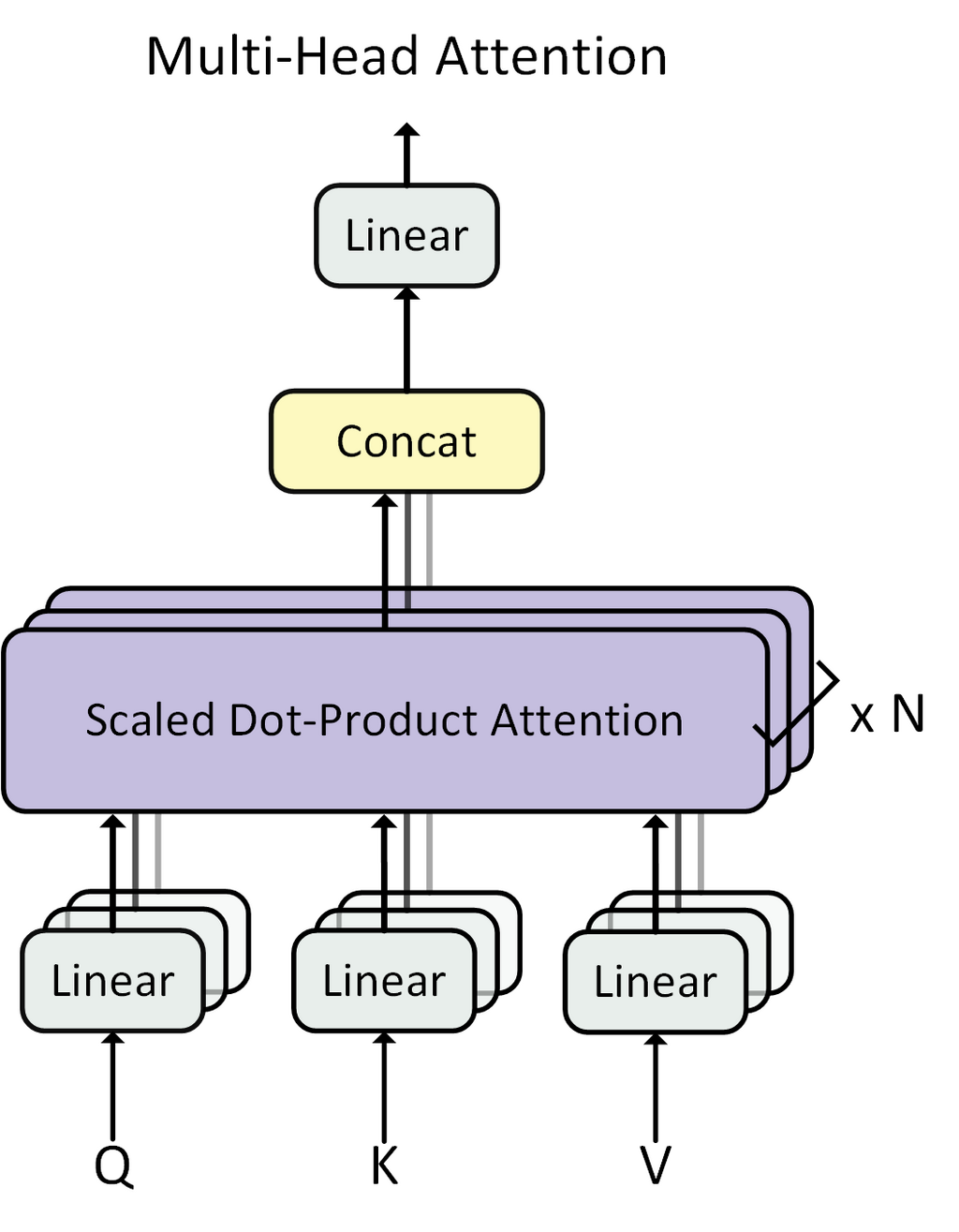
For instance, in the sentence "The dog, which was chasing a squirrel, barked loudly," one attention head might link "dog" to "barked" (subject-verb), while another links "dog" to "which" (relative clause). By running multiple heads in parallel, the model can capture a richer, more nuanced understanding of the text. The outputs from each head are then concatenated and passed through a final linear layer to produce the final output.
Multi-head attention significantly expands transformer capabilities by running multiple attention operations in parallel—each operating in different representation subspaces.
Keeping Things in Order
Because attention processes all words in a sequence simultaneously, it loses the original word order. "The cat chased the dog" and "The dog chased the cat" would look identical to the attention mechanism. To fix this, Transformers use Positional Encoding. These are vectors that provide information about the position of each word in the sequence.
These positional vectors are added to the input embeddings. This allows the model to learn the relative or absolute position of words, preserving the crucial sequential information of language.
Finally, to help train these very deep networks, Transformers employ two other key techniques you may know from computer vision models: and Residual Connections.
- Residual Connections: These are "skip connections" that add the input of a layer to its output. This allows gradients to flow more easily through the network, mitigating the vanishing gradient problem and enabling the training of much deeper models.
- Layer Normalization: This technique normalizes the inputs across the features for each training example. It helps stabilize the hidden state dynamics during training, making the model less sensitive to the initialization of parameters and speeding up convergence.
Together, these components—Multi-Head Attention, Positional Encoding, Layer Normalization, and Residual Connections—form the building blocks of the powerful Transformer architecture.
Time to test your knowledge on these core components.
What is the primary limitation of traditional Recurrent Neural Networks (RNNs) that the attention mechanism was designed to address?
In the Scaled Dot-Product Attention mechanism, what is the role of the 'Value' (V) matrix?
With these mechanisms, Transformers set a new standard for processing sequential data, paving the way for the large language models we use today.