Living and Expressing Yourself in Berlin
Bürgeramt and Administrative Basics
Your First Official Stop
Welcome to Berlin. Now for the paperwork. Your first and most important administrative task is the — registering your address. You'll do this at a local office called the Bürgeramt. Think of it as the city's main service center for residents. Getting this registration certificate, the Anmeldebestätigung, is the key that unlocks everything else: opening a bank account, getting a tax ID, and setting up internet service.
When you go to your appointment, you'll be in a formal environment. This is where the distinction between du (informal you) and Sie (formal you) becomes critical. Always, always use Sie with government officials. It signals respect and is the standard for any professional or official interaction.
Rule of thumb: If you don't know someone, and they aren't a child, use Sie.
To state your personal information, you'll rely heavily on two fundamental verbs: sein (to be) and haben (to have). Let's look at how they change when used with the formal Sie.
| Pronoun | Sein (to be) | Haben (to have) | Example (Formal) |
|---|---|---|---|
| ich (I) | bin | habe | Ich bin Programmierer. (I am a programmer.) |
| Sie (you, formal) | sind | haben | Sind Sie verheiratet? (Are you married?) |
| er/sie/es (he/she/it) | ist | hat | Er ist aus den USA. (He is from the USA.) |
Notice that for Sie, the verb forms are sind and haben. An official might ask you, "Was ist Ihr Beruf?" (What is your profession?). You would reply, "Ich bin..." followed by your job title. If they ask, "Haben Sie Kinder?" (Do you have children?), you'd answer, "Ja, ich habe..." or "Nein."
The Anmeldung Form
The registration form itself, the Anmeldeformular, can look intimidating. But it's just asking for basic personal data. Let's break down the most important vocabulary you'll encounter.
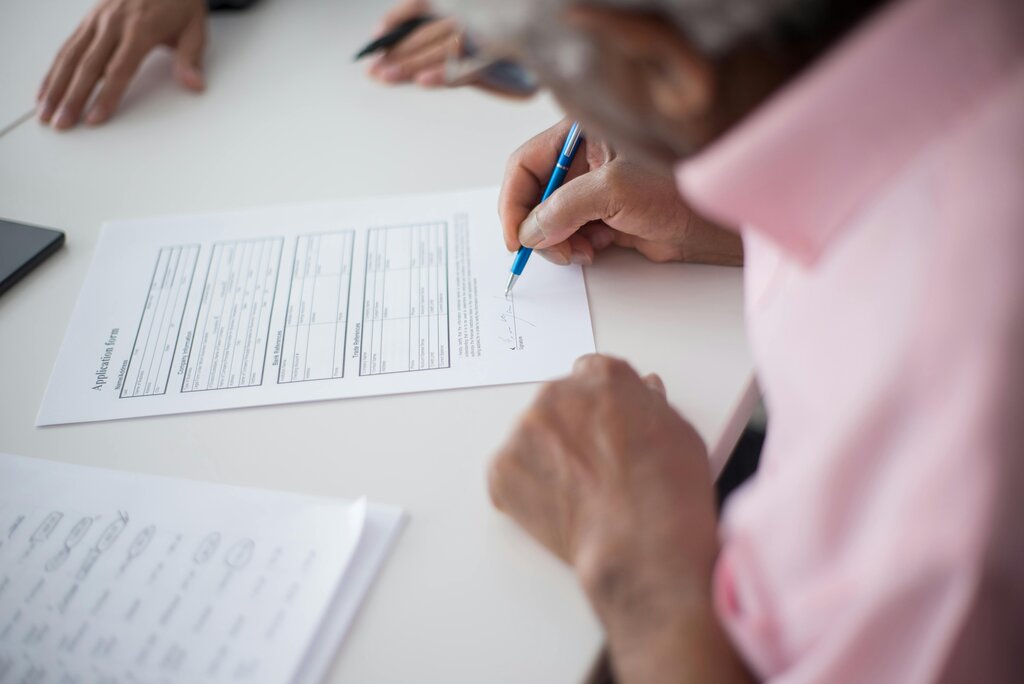
| German Term | English Meaning |
|---|---|
Anschrift | Address |
Straße und Hausnummer | Street and House Number |
Postleitzahl (PLZ) | Postal Code |
Wohnort | Place of Residence (e.g., Berlin) |
Familienname | Last Name |
Vornamen | First Name(s) |
Geburtsdatum | Date of Birth |
Familienstand | Marital Status |
ledig / verheiratet | single / married |
Beruf | Profession / Occupation |
Your address and birthdate require numbers. Cardinal numbers in German are straightforward. For your house number, you just say the digits. For example, Kurfürstendamm 19 is "Kurfürstendamm neunzehn." A postal code like 10115 is read out digit by digit: "eins, null, eins, eins, fünf."
Dates are given in Day.Month.Year format. For example, 24.08.1995 is "der vierundzwanzigste Achte neunzehnhundertfünfundneunzig."
At the Appointment
You've got your forms, you've practiced your vocabulary. Now you're at the and the official is speaking quickly. It happens. Don't panic. You have simple, polite phrases to control the pace of the conversation.
If you don't understand something, say: Wie bitte? (Pardon? / What was that?)
If you need them to slow down, say: Können Sie bitte langsamer sprechen? (Could you please speak slower?) Or more simply: Langsamer, bitte. (Slower, please.)
These phrases are perfectly polite and show that you're trying. Officials are usually accommodating when they see you making an effort. The goal isn't to be fluent; it's to complete the task successfully. Be prepared, be polite, and don't be afraid to ask for clarification.
Time to review what you've learned.
What is the primary purpose of the Anmeldung in Germany?
You are at the Bürgeramt. Which form of "you" is appropriate to use when addressing the official?