Lithuanian Language Basics
Lithuanian Alphabet
The Lithuanian Alphabet
Welcome to the Lithuanian alphabet! The good news is that it's based on the Latin script you already know. There are 32 letters in total. What makes Lithuanian special is how phonetic it is. Once you learn the sound for each letter, you can confidently pronounce almost any word you see. Unlike English, the letters rarely play tricks on you.
| Uppercase | Lowercase | Name | Approximate English Sound |
|---|---|---|---|
| A | a | a | 'a' as in father |
| Ą | ą | a nosinė | Long 'a' as in father |
| B | b | bė | 'b' as in bed |
| C | c | cė | 'ts' as in cats |
| Č | č | čė | 'ch' as in chat |
| D | d | dė | 'd' as in dog |
| E | e | e | 'e' as in ten |
| Ę | ę | e nosinė | Long 'a' as in cat (like an 'æ' sound) |
| Ė | ė | ė | 'ay' as in say |
| F | f | ef | 'f' as in fish |
| G | g | gė | 'g' as in go |
| H | h | ha | 'h' as in hat |
| I | i | i | 'i' as in bit |
| Į | į | i nosinė | Long 'ee' as in see |
| Y | y | i ilgoji | Long 'ee' as in see (same as Į) |
| J | j | jot | 'y' as in yes |
| K | k | ka | 'k' as in kite |
| L | l | el | 'l' as in leg |
| M | m | em | 'm' as in man |
| N | n | en | 'n' as in net |
| O | o | o | 'o' as in mop |
| P | p | pė | 'p' as in pen |
| R | r | er | Rolled 'r' like in Spanish |
| S | s | es | 's' as in sun |
| Š | š | eš | 'sh' as in shoe |
| T | t | tė | 't' as in top |
| U | u | u | 'oo' as in book |
| Ų | ų | u nosinė | Long 'oo' as in moon |
| Ū | ū | u ilgoji | Long 'oo' as in moon (same as Ų) |
| V | v | vė | 'v' as in vest |
| Z | z | zė | 'z' as in zoo |
| Ž | ž | žė | 's' in pleasure or 'zh' |
The Special Characters
You probably noticed a few letters with extra marks. These are called diacritics, and they're essential for correct pronunciation. Let's break them down.
Nosinė
noun
A hook-like mark (Ą, Ę, Į, Ų) that indicates a long vowel sound. Historically, it represented a nasal sound, but that has disappeared from the standard language.
The four vowels with a nosinė (a little tail) are Ą, Ę, Į, and Ų. While this mark used to mean the vowel was nasalized, today it simply means the vowel is long. Think of it as a signal to stretch the sound out a bit.
So, Į and Y make the exact same sound: a long "ee" like in see. The same is true for Ų and Ū—both sound like a long "oo" in moon.
Vowels with a nosinė (Ą, Ę, Į, Ų) are always long. They are never nasal.
Next are the letters with a paukščiukas (little bird) or varnelė (little check mark) on top: Č, Š, and Ž. This mark is called a caron. These letters create sounds that are common in English.
- Č is like "ch" in church.
- Š is like "sh" in ship.
- Ž is like the "s" in measure.
Finally, we have two unique vowels: Ė and Ū. The letter Ė (with a dot) has a sound like "ay" in hay. The letter Ū (with a line, or macron) is a long vowel, pronounced like "oo" in pool.
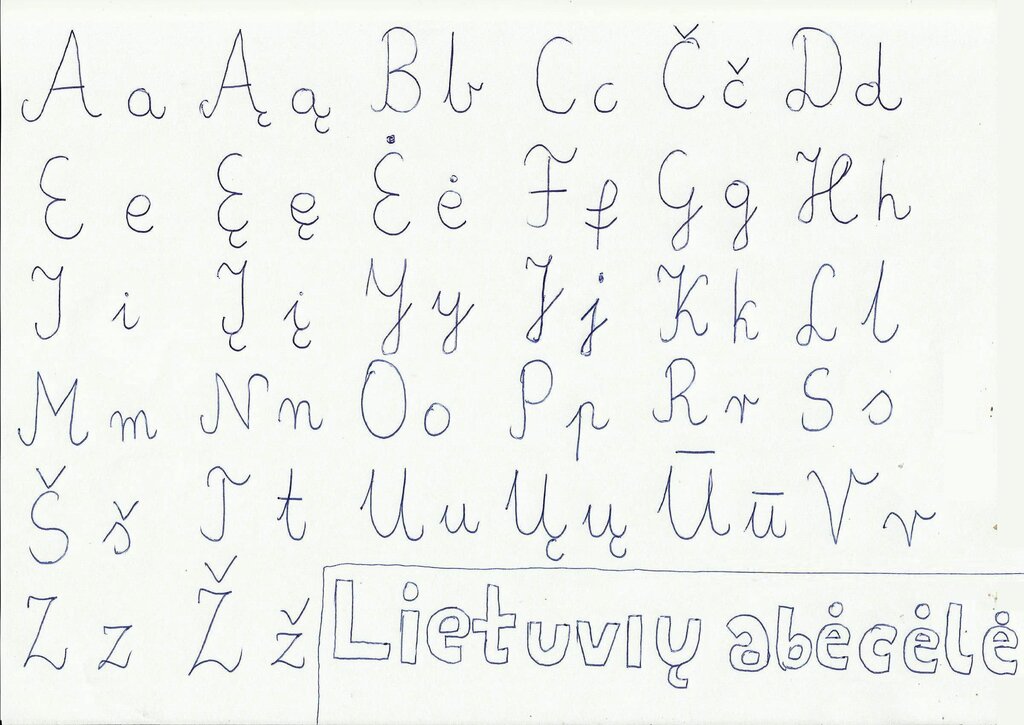
The best way to get comfortable is to practice. Try saying each letter from the chart out loud. Notice the subtle differences, like between a short a and a long ą, or a short u and a long ų. This foundation will make learning vocabulary much easier.
Ready to check your understanding? Let's see how well you know these new letters and sounds.
How many letters are in the modern Lithuanian alphabet?
What does the nosinė (the tail on letters like Ą, Ę, Į, and Ų) indicate in modern Lithuanian pronunciation?
Great work! Getting a handle on the alphabet is the single most important first step. Keep practicing the sounds, and you'll be reading Lithuanian words in no time.