Linked Lists Explained
List Fundamentals
The Building Blocks of a List
Arrays store data in one continuous block of memory. This is efficient for access but rigid for resizing. Linked lists offer a different approach. Instead of a single, monolithic block, they are built from individual pieces connected in a sequence.
The fundamental unit of a linked list is the node Each node is a small, self-contained package holding two key pieces of information: the actual data you want to store (like a number or a name) and a pointer that holds the memory address of the very next node in the chain.
The basic building block of a linked list is the node.
Think of it like a scavenger hunt. Each clue (a node) has a piece of information (data) and tells you where to find the next clue (the pointer). You can't just jump to the fifth clue; you have to follow the path from the first one.
Navigating the Chain
To navigate this chain, the program only needs to know the location of the very first node. This entry point is called the head node From the head, you can traverse the entire list by following the pointer from one node to the next.
But how do you know when you've reached the end? The last node in the list doesn't point to another node. Instead, its pointer is set to a special value called NULL, which is essentially a signpost that says "The list ends here." Losing the reference to the head node is like losing the starting point of the scavenger hunt; the rest of the list becomes inaccessible.
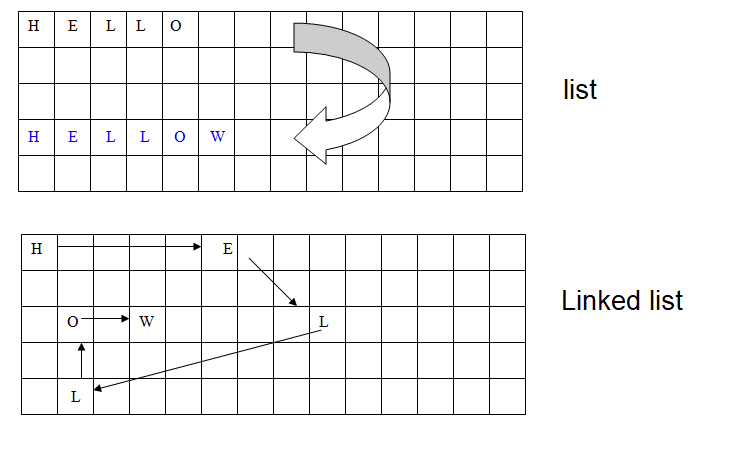
This structure is fundamentally different from arrays, which rely on An array is a single, unbroken block where elements are neighbors. A linked list is a distributed collection of nodes that can be located anywhere in memory, linked together logically by pointers. This flexibility is a key advantage of using linked lists.
Now that we understand the core components, let's review them before moving on.
Time to check your understanding of these concepts.
What are the two fundamental components of a node in a standard singly linked list?
What is the primary purpose of the 'head node' in a linked list?
Understanding the node, pointer, head, and null terminator is the foundation for working with any type of linked list.