Linked Lists Demystified
Introduction to Linked Lists
A Chain of Data
Think of a scavenger hunt. You start with one clue, which contains some information and tells you where to find the next clue. You follow this chain until you reach the end. A linked list works in a very similar way.
A linked list is a linear data structure where elements are not stored in a single block of memory. Instead, each element is a separate object that points to the next one in the sequence.
Each of these elements, or clues in our scavenger hunt, is called a node. A node has two parts:
| Part | Description |
|---|---|
| Data | The actual information you want to store, like a number, text, or any other type of data. |
| Pointer | An address that points to the next node in the chain. The last node points to null, signaling the end. |
This structure creates a chain of nodes. To find any element, you must start at the beginning, called the head, and follow the pointers from one node to the next.
Linked Lists vs. Arrays
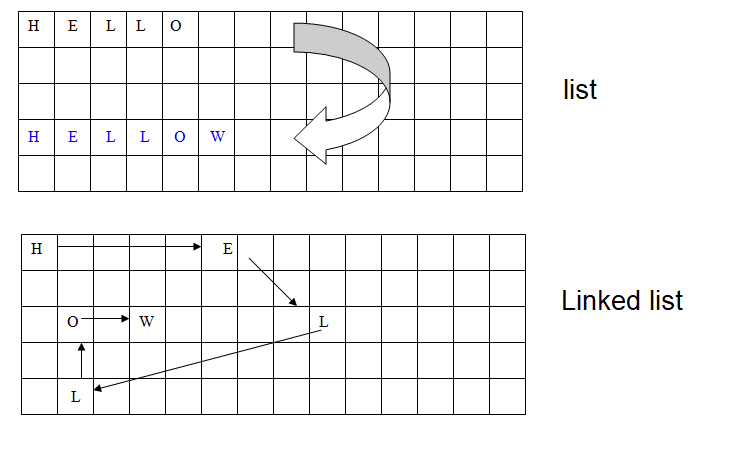
The most common way to store a list of items is in an array. The biggest difference between an array and a linked list is how they use computer memory.
An array is a single, continuous block of memory. Think of it like a row of connected townhouses. Each house has an address, and they are all right next to each other. This makes it very fast to jump to any house if you know its address (or index).
A linked list is different. Its nodes can be scattered all over memory. It's more like a chain of friends living in different parts of a city. The first friend knows where the second one lives, the second knows where the third lives, and so on. You can't just jump to the third friend's house; you have to ask the first two for directions.
When to Use Which
Because of their different structures, arrays and linked lists are good for different tasks. Neither is strictly better than the other; the right choice depends on what you need to do.
| Feature | Array | Linked List |
|---|---|---|
| Memory | Contiguous block. | Nodes stored anywhere. |
| Access | Fast random access. Jump to any element instantly using its index. | Slow sequential access. Must start from the head and follow pointers. |
| Size | Fixed size. Resizing is slow because you need to create a new, larger array and copy everything over. | Dynamic size. Can easily grow or shrink by adding or removing nodes. |
| Insertion/Deletion | Slow. Adding or removing an element in the middle requires shifting all subsequent elements. | Fast. Just change a few pointers to add or remove a node. |
In short, if you need to quickly access elements by their index and the size of your list doesn't change much, an array is a great choice. If you'll be adding or removing elements frequently, especially from the middle of the list, a linked list is often more efficient.
Now, let's review the key concepts we've covered.
Ready to test your knowledge?
What are the two essential components of a single node in a linked list?
In the scavenger hunt analogy, a linked list's head is equivalent to what?
Understanding the fundamental trade-offs between linked lists and arrays is a key step in learning how to write efficient code. In the next section, we'll look at how to perform common operations on linked lists.