Linear Proton Accelerators Explained
Introduction to Linear Proton Accelerators
Straight-Line Speed
Particle accelerators are machines designed to do one thing: make tiny particles, like protons, move incredibly fast. A linear accelerator, or “linac” for short, does this in a straight line. Think of it as a long, straight runway for subatomic particles.
Why the need for speed? When protons are accelerated to near the speed of light, they gain enormous amounts of energy. This energy is the key. High-energy protons can be smashed into other particles to reveal the fundamental building blocks of matter. This is the heart of particle physics research—understanding what our universe is made of by looking at its smallest pieces.
A linear accelerator uses powerful electric fields to push charged particles, like protons, to higher and higher speeds along a straight path.
A Race to Split the Atom
The story of the linear accelerator begins in the early 20th century. Scientists knew about the atomic nucleus but struggled to study it directly. They needed a way to probe it, which meant hitting it with something energetic enough to break it apart.
In 1928, a Norwegian physicist named Rolf Widerøe built the first device that successfully used this principle. His machine used oscillating electric fields to give particles a series of pushes, accelerating them more than a single, static field ever could. It was a groundbreaking idea.
A few years later, physicists Ernest Lawrence and David Sloan at the University of California, Berkeley, built on Widerøe's concept to create much larger and more powerful linacs. The real breakthrough, however, came after World War II. Technology developed for radar provided powerful new sources of high-frequency radio waves, which were perfect for pushing particles down the accelerator tube with incredible force.
Riding the Wave
So how do you give a proton a series of coordinated pushes? Imagine a surfer catching a wave. The surfer positions their board just right to be pushed forward by the wave's crest. A linac does something similar with electric fields.
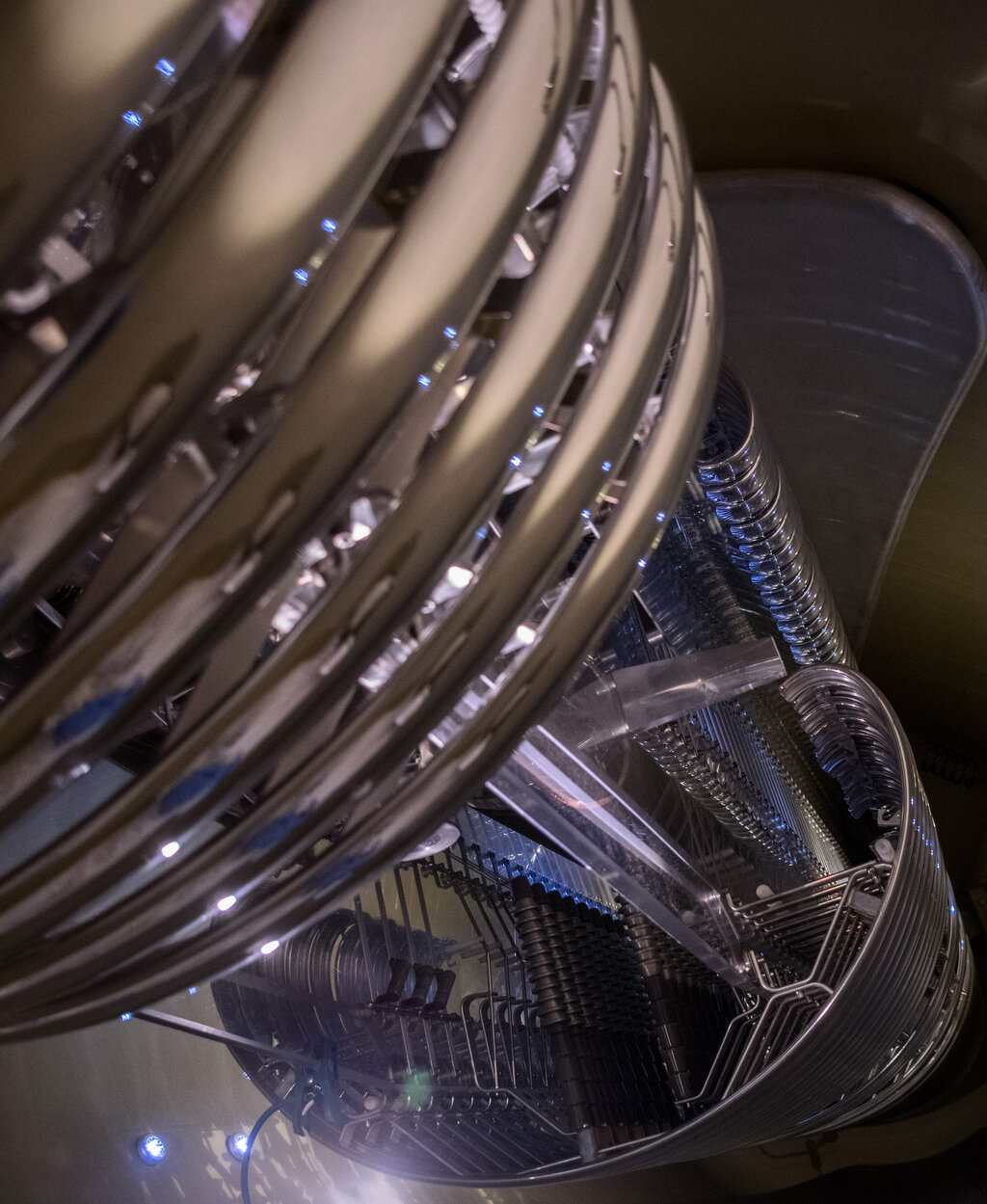
The accelerator is a long vacuum tube containing a series of smaller, hollow metal tubes called drift tubes. Protons are injected at one end and travel through these tubes. The key is that the electric charge of each drift tube alternates rapidly. A proton is pulled toward a tube that is negatively charged. As it passes through, the charge flips to positive, pushing the proton away and toward the next tube in line, which is now negative.
This push-pull sequence happens millions of times per second, with each push adding more energy and speed. It's like the surfer is catching an endless series of perfectly timed waves. To make this work, the drift tubes have to get longer and longer down the accelerator. Since the proton is moving faster and faster, it covers more ground in the same amount of time, so the tubes must be longer to keep the timing of the pushes just right.
This simple but powerful principle is the basis for some of the largest and most complex scientific instruments ever built.
What is the primary purpose of a linear particle accelerator (linac) in particle physics research?
In a linac, why must the drift tubes get progressively longer down the length of the accelerator?
These machines, born from a desire to understand the atom, have become essential tools in the quest to understand the fundamental laws of our universe.