Linear Algebra for the Analytical Mind
Vector Spaces
The Playground for Vectors
So far, we've treated vectors as individual arrows pointing in space. But vectors don't exist in a vacuum. They live and interact in a structured environment called a vector space.
Think of a vector space as a playground. The vectors are the kids playing on it, and there are specific rules they must follow. A vector space isn't just a random collection of vectors; it's a set that's self-contained and consistent. If you take any two vectors in the space and add them, the result is also in that space. If you scale a vector, making it longer or shorter, the new vector also belongs to the space.
A vector space is a collection of vectors where vector addition and scalar multiplication always produce a new vector that is also inside that collection.
This playground is defined by a set of ten rules, or axioms. These rules ensure that the 'game' of linear algebra is fair and predictable. We can split them into two main categories: rules for adding vectors together and rules for multiplying vectors by scalars.
The Rules of the Game
These axioms might seem abstract, but they are the bedrock that makes vector math work. They guarantee that our operations are consistent and logical.
Rules for Vector Addition
- Closure: If you add two vectors from a space, their sum is also in that space. (e.g., is in the space).
- Commutativity: The order of addition doesn't matter. .
- Associativity: When adding three or more vectors, the grouping doesn't matter. .
- Zero Vector: There is a special 'zero vector' () in the space, which acts like the number zero. Adding it to any vector leaves the vector unchanged: .
- Additive Inverse: Every vector has an opposite, , such that adding them together gives the zero vector: .
Rules for Scalar Multiplication Let and be scalars (regular numbers).
- Closure: Multiplying a vector by a scalar results in a vector that is also in the space.
- Distributivity (1): A scalar can be distributed over a sum of vectors. .
- Distributivity (2): A vector can be distributed over a sum of scalars. .
- Associativity: Grouping doesn't matter for scalar multiplication. .
- Identity: Multiplying any vector by the scalar 1 leaves it unchanged. .
Any set that satisfies all ten of these rules is a vector space. The familiar 2D plane () and 3D space () are perfect examples.
Spaces Within Spaces
Sometimes, a smaller vector space can exist inside a larger one. This is called a subspace. Think of a large park (the vector space). A perfectly flat soccer field inside that park can be a subspace. It's part of the park, but it's also a self-contained area where all the rules still apply.
For a set of vectors to be a subspace, it must satisfy three simple conditions:
- It must contain the zero vector.
- It must be closed under vector addition (if you add any two vectors from the subspace, the result is still in the subspace).
- It must be closed under scalar multiplication (if you scale any vector from the subspace, the result is still in the subspace).
In a 2D plane, any line that passes through the origin is a subspace. Why? It contains the origin (the zero vector), and if you add any two vectors on the line or scale any vector on the line, you'll always end up with another vector on that same line.
However, a line that doesn't pass through the origin is not a subspace. It fails the first and most basic test: it doesn't contain the zero vector.
Basis and Dimension
Every vector space can be described by a set of fundamental building blocks called a basis. A basis is a set of vectors that can be combined (using addition and scalar multiplication) to create any other vector in the entire space.
For a set of vectors to be a basis, they must satisfy two conditions:
- They must be linearly independent. This means no vector in the set can be created by combining the others. They are all truly unique directions.
- They must span the space. This means their combinations can reach every single point in the vector space.
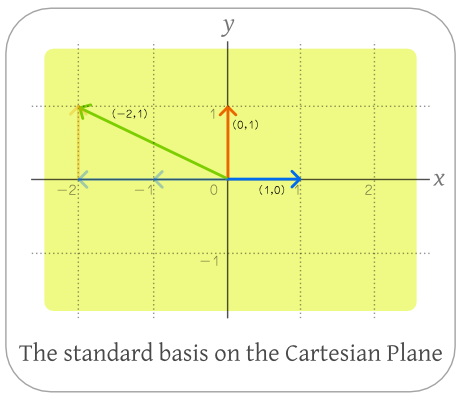
The number of vectors in a basis is called the dimension of the vector space. For the 2D plane, you need two basis vectors, so its dimension is 2. For 3D space, you need three, so its dimension is 3. Dimension tells us how many independent directions or pieces of information are needed to describe any point in the space.
A basis is the smallest possible set of vectors that can still span the entire space.
In economics, we often deal with more than three dimensions. Imagine a simple economic model tracking three variables: GDP, unemployment rate, and inflation rate. Any state of this economy can be represented by a vector with three components, like ($3 trillion, 4.5%, 2.1%). This vector lives in a 3-dimensional vector space, . If we add another variable, like consumer confidence, our vector space becomes 4-dimensional. The concept of a vector space allows us to apply the same geometric and algebraic rules no matter how many variables we're juggling.
Let's test your understanding of these foundational concepts.
What are the two fundamental closure properties that a set of vectors must satisfy to be considered a vector space?
The vector space axiom stating that for any scalar and vectors and is known as:
Vector spaces provide the stage on which linear algebra happens. By understanding their rules, we can analyze complex systems, from simple geometric shapes to multi-variable economic models.