Linear Algebra for Problem Solving
Vectors and Linear Combinations
Arrows in Space
Some quantities, like temperature or speed, can be described with a single number. These are called scalars. A vector is different. It's a mathematical object that has both a magnitude (or length) and a direction. Think of it as an arrow pointing in space.
Imagine telling someone how to get from their house to the library. You wouldn't just say "go 2 miles." You'd say "go 2 miles east." That instruction—"2 miles east"—is a vector. It has a magnitude (2 miles) and a direction (east). Velocity is another great example. A car's speed might be 60 miles per hour, but its velocity is 60 miles per hour north.
We often represent vectors using coordinates. In a 2D plane, a vector can be described by two numbers: how far it goes along the x-axis and how far it goes along the y-axis. For example, a vector represents an arrow that moves 3 units to the right and 1 unit up.
Vector Arithmetic
We can perform mathematical operations with vectors. The two most basic ones are addition and scalar multiplication.
To add two vectors, we place them tip-to-tail. The new vector, called the resultant, is an arrow drawn from the starting point of the first vector to the ending point of the second. If you walk 3 miles east and then 2 miles north, your final position is the sum of those two vector movements.
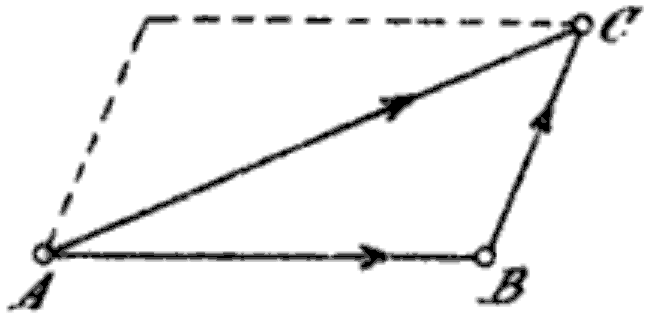
Numerically, vector addition is simple. You just add the corresponding components. If and , then their sum is:
Scalar multiplication involves changing a vector's length by multiplying it by a scalar (a regular number). Multiplying a vector by 2 doubles its length while keeping its direction. Multiplying by -1 reverses its direction but keeps its length.
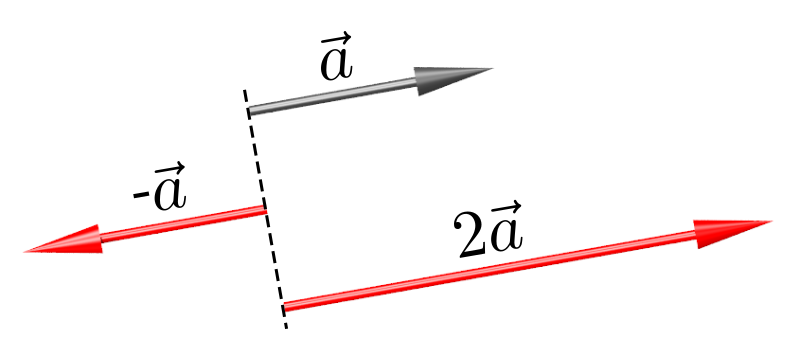
To perform scalar multiplication, you multiply each component of the vector by the scalar. If is a scalar and , then:
Linear Combinations
When we combine scalar multiplication and vector addition, we create what's called a linear combination. A linear combination of vectors is the sum of those vectors, each scaled by a constant.
For example, given two vectors and , a linear combination would look like this:
Here, and are scalars. By choosing different scalars, we can create any other vector in the same plane as and , as long as they aren't pointing in the same or opposite directions.
This idea is a cornerstone of linear algebra. It allows us to build complex vectors and spaces from a simple set of basic vectors.
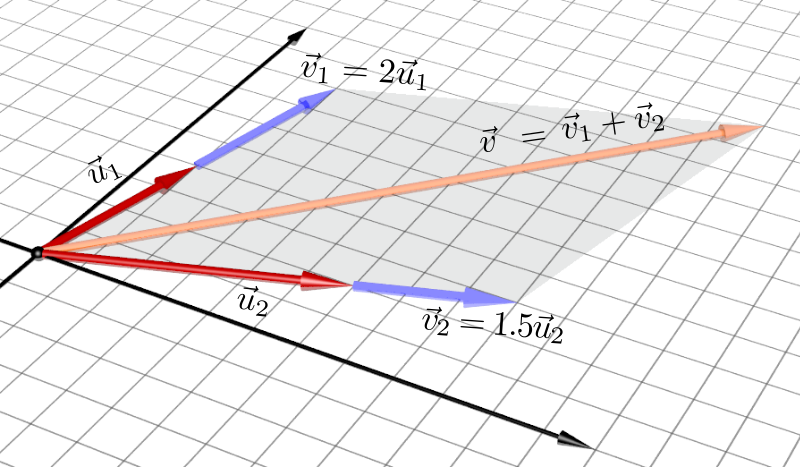
Let's say we have and . We can create a new vector by picking scalars, say and .
The set of all possible linear combinations of a group of vectors is called their span. If you have two non-parallel vectors in a 2D plane, their span is the entire plane. You can reach any point just by scaling and adding those two vectors.
Which of the following is the best definition of a vector?
Which of the following describes a scalar quantity?
Understanding how to scale and add vectors is fundamental. These simple operations allow us to navigate and describe complex, multi-dimensional spaces.