Linear Algebra Essentials
Vectors and Vector Operations
More Than Just a Number
Some quantities in the world can be described with a single number. Your height, the temperature outside, the price of a coffee. These are called scalars.
But what if you need to describe movement? If you say you walked 3 miles, that's a scalar. It only tells us distance. It doesn't tell us where you ended up. To do that, you need a direction. "I walked 3 miles northeast." That's a vector.
A vector is a mathematical object that has both magnitude (size or length) and direction. We usually draw them as arrows. The arrow's length represents the magnitude, and the way it points shows the direction.
In a 2D plane, we can describe a vector by its components along the x and y axes. The vector in the diagram moves 4 units to the right and 3 units up. We can write this vector as:
This notation is a clean way to bundle the magnitude and direction into a single package. Vectors aren't limited to two dimensions; they can exist in 3D space or even in much higher-dimensional spaces that are harder to visualize.
Combining Vectors
We can perform operations on vectors, just like with regular numbers. Let's start with addition. Imagine you walk 4 blocks east and then 3 blocks north. Your journey has two parts, each represented by a vector. The total change in your position, from your starting point to your final destination, is the sum of these two vectors.
Geometrically, we add vectors by placing them "tip-to-tail." The arrow representing the sum, called the resultant vector, is drawn from the tail of the first vector to the tip of the second.
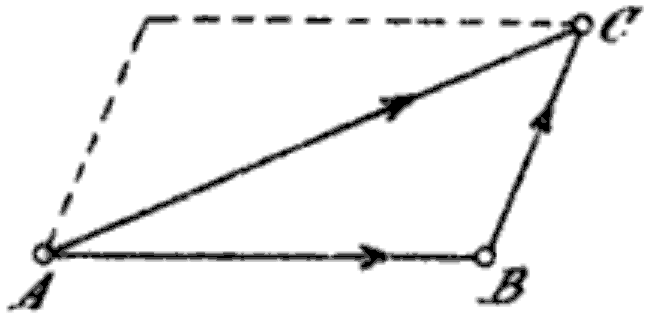
Another way to visualize this is the parallelogram rule. If you place the tails of the two vectors at the same starting point, they form the adjacent sides of a parallelogram. The resultant vector is the diagonal of that parallelogram that starts from the common tail.
Mathematically, adding vectors is simple. You just add their corresponding components.
Vector subtraction works similarly. Subtracting a vector is the same as adding its negative. A negative vector has the same magnitude but points in the exact opposite direction.
Scaling Vectors
What happens if you take a vector and multiply it by a plain number (a scalar)? This operation is called scalar multiplication. It scales the vector, changing its length.
Multiplying a vector by 2 doubles its length but keeps its direction the same. Multiplying it by 0.5 halves its length. Multiplying by a negative scalar, like -1, reverses its direction completely while keeping its magnitude.
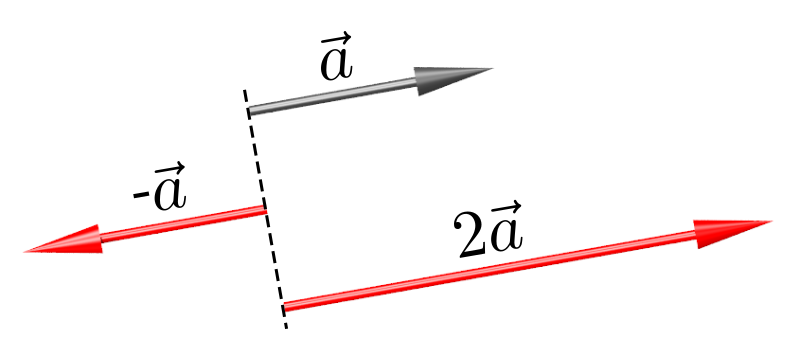
The calculation is straightforward: you multiply each component of the vector by the scalar.
For example, if , then . The new vector points in the same direction but is three times as long.
These basic operations—addition, subtraction, and scalar multiplication—are the building blocks for almost everything else in linear algebra. Understanding them visually and mathematically is the first key step.
Which of the following is a key difference between a scalar and a vector?
If you multiply a vector by a scalar of -2, what happens to the vector?