Light: Reflection and Refraction
Spherical Mirror Laws
The Rules of the Curve
When light waves meet a flat, reflective surface like a calm lake, they bounce off predictably. The angle at which they arrive equals the angle at which they leave. But what happens when the surface is curved? The fundamental law of reflection still holds, but the curvature changes the game entirely. Spherical mirrors, which are sections of a sphere, either bend light inwards to a point or scatter it outwards.
To make sense of this, physicists use a set of rules called the Cartesian sign convention. This system helps us track distances and orientations in a consistent way. It's like a map for light rays.
Imagine a number line laid across the mirror, with the mirror's centre (the pole) at zero. Light always travels from left to right. Any distance measured to the left of the pole is negative, and any distance to the right is positive. Heights above the central line (the principal axis) are positive; below, they're negative.
This convention prevents confusion when calculating where an image will form. For example, a real image, which can be projected onto a screen, will have a positive image distance. A virtual image, like the one you see 'inside' a flat mirror, will have a negative image distance.
Focus and Curvature
Every spherical mirror has a centre of curvature (C), which is the centre of the sphere from which the mirror was sliced. The distance from the mirror's surface to this point is the radius of curvature (R). When parallel rays of light hit a curved mirror, they are reflected to a specific point called the principal focus or focal point (F).
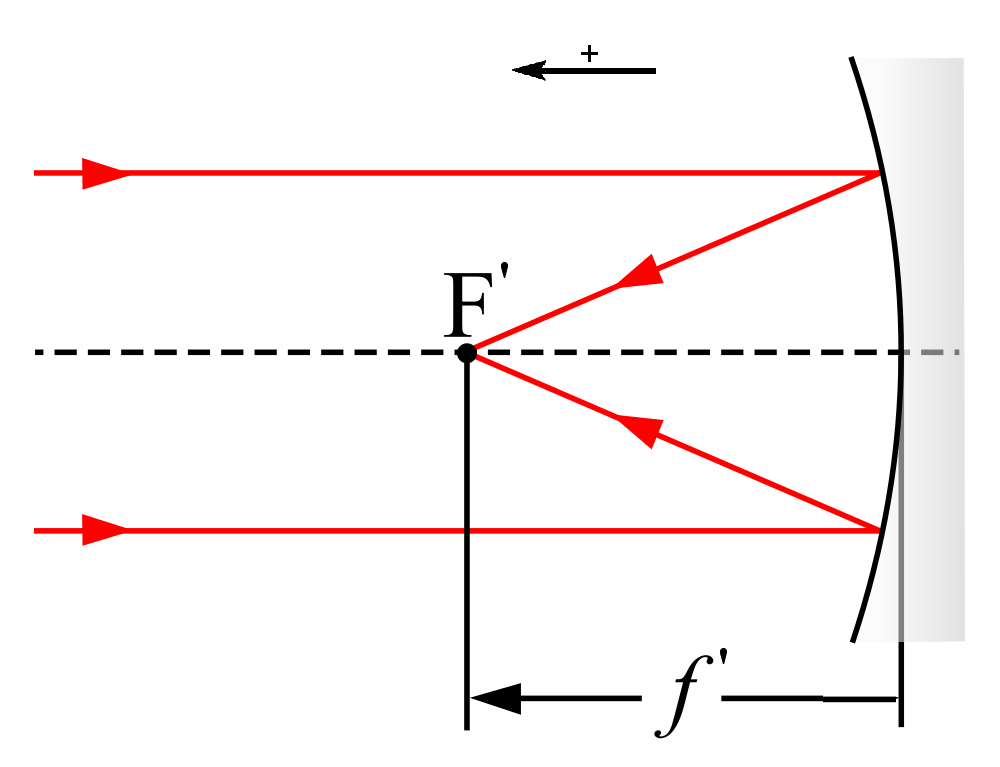
For spherical mirrors, there's a simple, elegant relationship between these two points. The focal point lies exactly halfway between the mirror and the centre of curvature.
This relationship is fundamental. For a concave mirror, which curves inward like a cave, the focal point is in front of the mirror, and both and are considered positive. For a convex mirror, which bulges outward, the focal point is behind the mirror. Since it's on the 'virtual' side, both its and are negative.
Drawing the Path of Light
We can predict exactly how a mirror will form an image by tracing the paths of a few key light rays. This technique is called ray tracing. For any point on an object, we only need to draw two of these special rays to find the corresponding point on the image.
For a Concave Mirror:
- A ray parallel to the principal axis reflects through the focal point F.
- A ray passing through the focal point F reflects parallel to the principal axis.
- A ray passing through the centre of curvature C reflects back on itself.
The point where these reflected rays cross is where the image forms. If they converge in front of the mirror, the image is real and inverted.
For a Convex Mirror:
- A ray parallel to the principal axis reflects as if it came from the focal point F (behind the mirror).
- A ray heading toward the focal point F reflects parallel to the principal axis.
- A ray heading toward the centre of curvature C reflects back on itself.
With a convex mirror, the reflected rays diverge. They never actually cross. However, our brain traces them back to a point behind the mirror where they appear to cross. This creates a virtual, upright, and smaller image.
These simple rules of ray tracing are powerful tools. They transform the complex behaviour of light waves at a curved boundary into predictable, geometric constructions. By mastering them, you can determine the location, size, and nature of an image formed by any spherical mirror.