Leonardo da Vinci
Verrocchio's Workshop Techniques
The Master's Workshop
In the 15th century, an artist's studio was more like a bustling factory than a solitary retreat. At the workshop of Andrea del Verrocchio, one of Florence's most successful artists, apprentices learned by doing. They ground pigments, prepared wooden panels, and eventually, contributed to the master's commissioned works. This was the environment where a young Leonardo da Vinci began his training. The standard medium at the time was egg tempera, a paint made by mixing pigment with egg yolk. Tempera dried quickly and produced a flat, matte finish. It encouraged a linear, precise style, as blending colors on the surface was nearly impossible. Artists built up color with small, careful strokes, almost like drawing with a paintbrush.
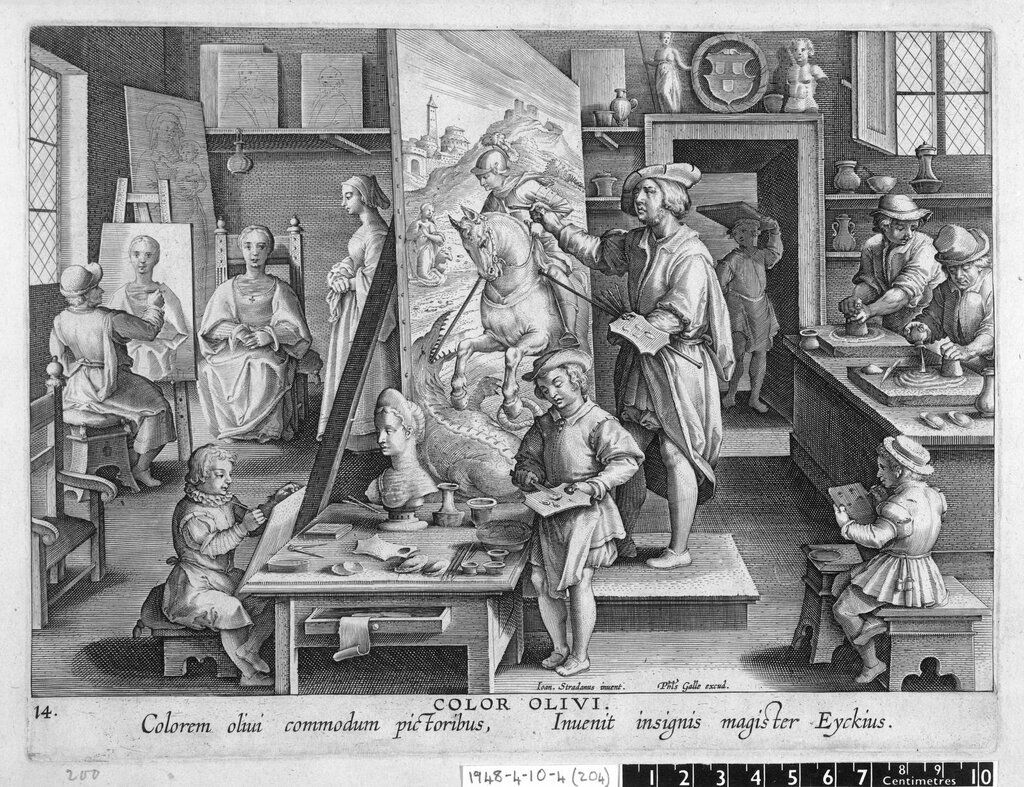
However, a new technology was making its way down to Italy from Northern Europe: oil paint. Unlike tempera, oil paint dried slowly, giving artists weeks to work with it. This allowed for smooth blending of colors directly on the canvas, creating soft transitions and a greater sense of realism. More importantly, oil paint could be applied in thin, translucent layers. This technique, known as glazing, was a game-changer. By building up dozens of these see-through layers, an artist could achieve an unparalleled luminosity and depth. Light could seemingly penetrate the surface of the painting and reflect back out, creating a glow that tempera could never match. Leonardo was fascinated by this new medium and its potential to capture the subtleties of light and form in the natural world.
A Revolutionary Contribution
The transition from apprentice to master was often gradual, marked by trusted assistants being assigned more significant portions of a painting. A key example of this is Verrocchio's "The Baptism of Christ." Verrocchio, a master of structural anatomy, painted the central figures of Christ and John the Baptist with his typical sharp, sculptural precision in tempera. He tasked Leonardo, still his student, with painting one of the angels on the left and parts of the background landscape. It was here that Leonardo put his revolutionary oil techniques into practice.
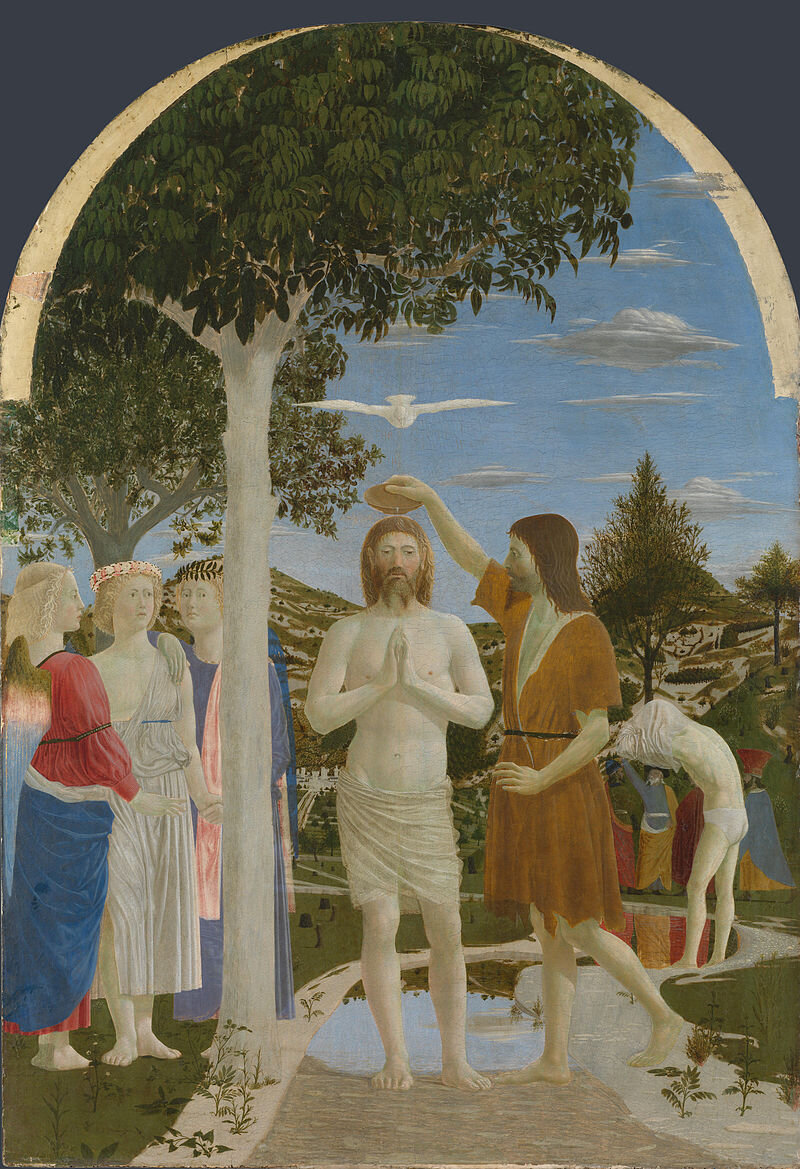
Leonardo's angel is a departure from the style of the rest of the painting. Its face is softer, the curls of its hair catch the light with a naturalistic frizz, and the drapery has a supple, flowing quality. This was achieved through the painstaking application of oil glazes. Instead of the hard lines of tempera, Leonardo used his mastery of the new medium to create soft, smoky transitions from light to shadow, an early example of what would become his signature sfumato technique. The landscape behind him, with its misty atmosphere and realistic depiction of water, also bears his touch. It was a demonstration of a new way of seeing, one that was less concerned with linear definition and more with the optical effects of light and atmosphere.
The difference was not just a matter of preference; it represented a fundamental shift in artistic goals. Verrocchio's work excelled at defining form and structure, a legacy of the Quattrocento focus on anatomical accuracy. Leonardo, while also a master anatomist, was more interested in capturing the living, breathing quality of a subject. His use of oil paint was not just a technical choice but the essential tool for his scientific obsession with optics and how light interacts with surfaces. This early work in Verrocchio's studio set the stage for his entire career, from the ethereal landscapes of the "Mona Lisa" to the dramatic lighting of "The Last Supper."
This early experience combining art with the scientific study of materials and light established a pattern Leonardo would follow for the rest of his life. He was not just a painter, but a systemic thinker who saw art and science as inseparable pursuits. His innovations in Verrocchio's workshop were the first major steps in a lifelong quest to render the world not just as it was structured, but as it was seen.