Lense-Thirring Precession Explained
Introduction to General Relativity
A New Idea of Gravity
For centuries, Isaac Newton's law of universal gravitation was the final word on gravity. It described gravity as a force, an invisible rope pulling objects toward each other. This worked beautifully for predicting the orbits of planets and the fall of an apple. But Albert Einstein had a different idea.
Einstein's insight began with a thought experiment. Imagine you are in a windowless room, like an elevator. If you feel your feet pressed to the floor, how can you tell if the room is sitting on Earth or accelerating through space at ? Einstein realized you can't. There is no experiment you could perform inside the room to distinguish between the effects of gravity and the effects of uniform acceleration.
This idea is called the equivalence principle: the effects of gravity are locally indistinguishable from the effects of acceleration.
This simple but profound concept was a cornerstone of his new theory. If gravity and acceleration are two sides of the same coin, then maybe gravity isn't a force at all. Maybe it's something more fundamental about the structure of the universe itself.
Bending Spacetime
Einstein proposed that space and time are not separate, static concepts. Instead, they are woven together into a single, four-dimensional fabric called spacetime. This fabric is not just a passive background; it can be bent, stretched, and warped by the presence of mass and energy.
Think of spacetime as a stretched-out rubber sheet. If you place a heavy bowling ball in the center, the sheet will sag and curve. Now, if you roll a small marble nearby, it won't travel in a straight line. It will follow the curve created by the bowling ball, spiraling inward as if pulled by a force. But there is no force. The marble is simply following the straightest possible path through the curved fabric.
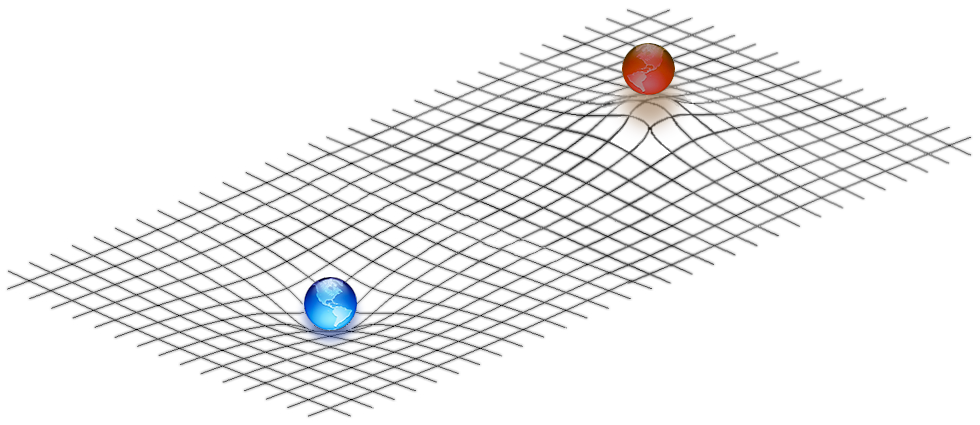
This is Einstein's vision of gravity. The Sun doesn't pull the Earth with an invisible rope. Instead, the Sun's immense mass creates a deep curve in spacetime, and the Earth follows this curve in its orbit. What we perceive as the force of gravity is just motion through this warped geometry.
The Rules of Curvature
To describe this relationship mathematically, Einstein developed a set of equations known as the Einstein Field Equations. In essence, these equations are the rules that govern how spacetime behaves. They connect the geometry of spacetime to the distribution of matter and energy within it.
On one side of the equations, you have the curvature of spacetime. On the other, you have the mass, energy, and momentum of everything in that region of spacetime. The equations say these two things are equal.
The core of the theory can be summarized in a single, compact equation:
Here, is the Einstein tensor, which describes the curvature of spacetime. is the stress-energy tensor, which represents the density and flow of energy and matter. The terms in the middle, including Newton's gravitational constant and the speed of light , are constants that ensure the two sides match up. This elegant formula dictates how matter and energy shape the cosmos.
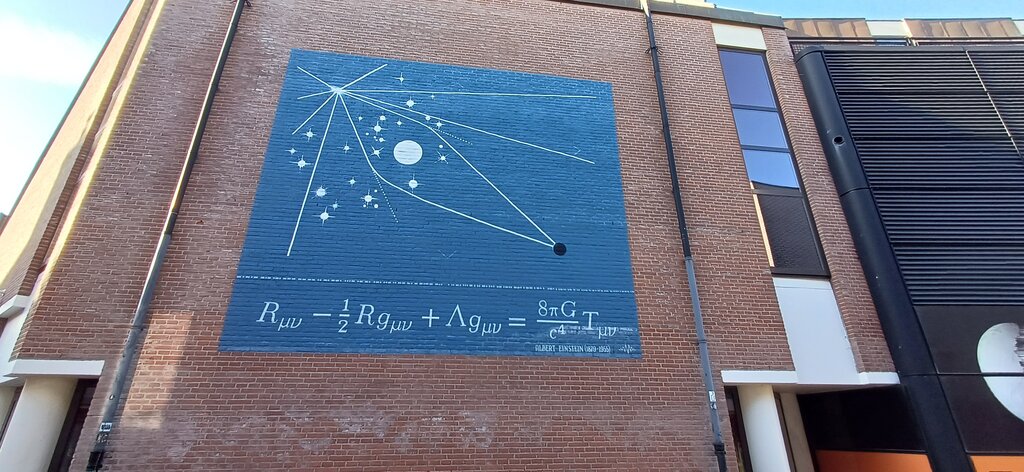
The equivalence principle gives us the conceptual leap to connect gravity with acceleration. Spacetime curvature provides the new picture of how gravity works. And the field equations give us the precise mathematical tools to calculate it. Together, they form the foundation of general relativity.
According to Albert Einstein's theory of general relativity, what is gravity?
The "Equivalence Principle" was a cornerstone of Einstein's thought process. What does it state?