Legacy of the Modern Father
Pedagogical Mentorship Frameworks
From Instructor to Coach
Your background in biology and history gives you a rich source of facts and stories. The goal isn't to simply transfer that information. It's to use those subjects as a lens to teach your son how to think, analyze, and form his own worldview. This is the shift from being an instructor, who provides answers, to a coach, who builds the skills to find them.
Instead of explaining DNA, you'll use it to discuss evidence and inference. Instead of listing dates of a war, you'll use it to explore cause and effect. Every walk in the park or conversation about the news becomes a potential 'teachable moment'—not for lecturing, but for collaborative inquiry.
The Art of the Question
The most powerful tool in your new role is the question. The Socratic Method isn't about trapping someone in a logical corner; it's about guiding their own discovery. When your son asks why a leaf is green, resist the urge to jump straight to chlorophyll. Instead, start a dialogue.
"That's a great question. What do you think the green color does for the leaf?" "Have you noticed other things in nature that are green? What do they have in common?" "What might happen if the leaf was a different color, like red or purple?"
This approach encourages curiosity and teaches him to form hypotheses from observation. He learns that his own thoughts are the starting point for understanding. You can apply the same technique using historical analogy. If he's having a conflict with a friend, you might ask questions that help him see parallels to a historical negotiation or rivalry, turning a simple disagreement into a lesson on strategy and perspective.
Building Independence
When teaching a new skill, we can't just throw someone in the deep end. We provide support and then gradually remove it as they become more competent. This concept is called scaffolding in education. It's the process of providing temporary support to a learner who is navigating a new task.
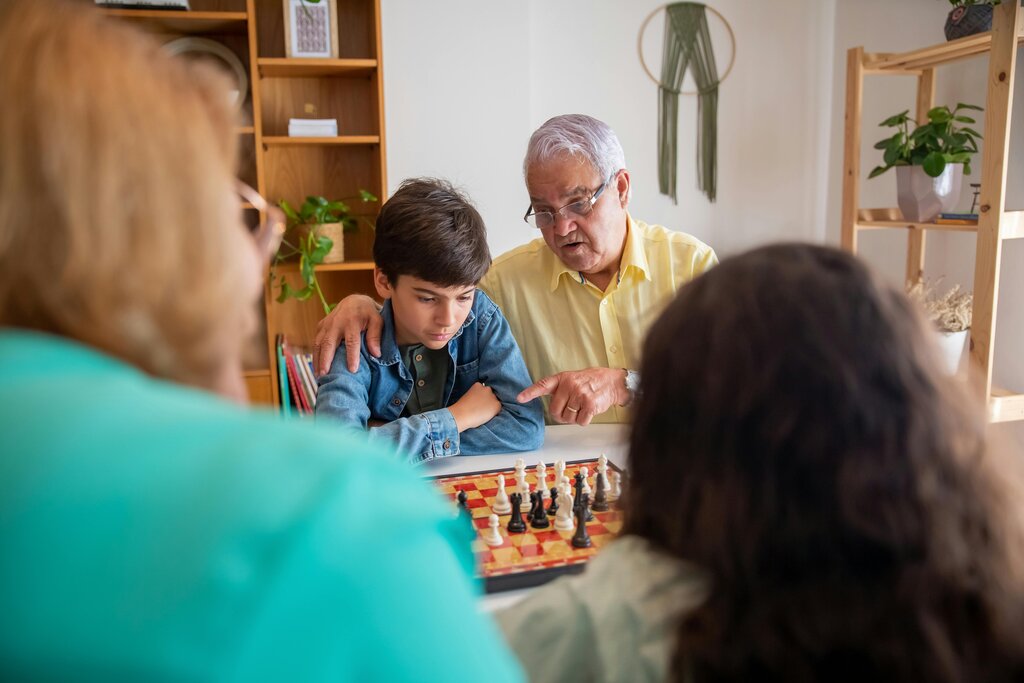
Imagine teaching your son to identify different types of trees. At first, you point out the oak and the maple, explaining the key features of the leaves and bark. Next, on a walk, you might ask, "Based on what we know about leaf shapes, what kind of tree do you think this is?" You're still there to guide, but he's doing more of the cognitive work. Eventually, he'll be identifying them on his own and explaining his reasoning to you. This is scaffolding in action.
This method works best when the task is within the child's (ZPD). This is the sweet spot between what he can already do independently and what is completely beyond his reach. The ZPD is the area where he can succeed with your guidance. A task that is too easy results in boredom; one that is too hard leads to frustration. Your role as a mentor is to identify and operate within this zone, constantly adjusting the challenge as his skills develop.
Let's review the core ideas with a few questions.
What is the primary difference between acting as an 'instructor' and a 'coach' according to the text?
Which of the following scenarios is the best example of 'scaffolding'?
By combining questioning, scaffolding, and an awareness of your son's developmental zone, you can use your knowledge not just to teach him facts, but to build his capacity for independent, critical thought.