Legacy of Iapetus and the Fates of His Sons
The Iapetid Revolt
The Piercer and His Progeny
In the cosmic hierarchy of Greek mythology, some figures are defined less by their own actions and more by their children's. Such is the case with , the Titan whose name means “The Piercer.” While his direct role in the great war between the Titans and Olympians is not heavily detailed, his symbolic function and the legacy of his sons are central to understanding the mortal condition.
Ancient sources, like Hesiod’s Theogony, position Iapetus as one of the four corner pillars holding the heavens apart from the earth. Specifically, he was the pillar of the West, a role his son Atlas would later inherit in a much more punishing form. This association with a cosmic boundary hints at Iapetus’s deeper domain: the finite lifespan of mortals. He wasn't just a piercer with a spear; he pierced life, assigning it a beginning and an end.
The sons of Iapetos were also described as possessing some of the worst of human traits : on an intellectual level, Prometheus is overly sly and crafty, Epimetheus a guileless fool, Atlas overly daring, and arrogant Menoitios (Menoetius) prone to rash and violent actions.
A Special Punishment
When the ended, the defeated Titans were, for the most part, rounded up and cast into the abyss of Tartarus. It was a group punishment for a collective rebellion. But the sons of Iapetus, the Iapetids, were singled out. Their fate wasn't merely imprisonment; it was a series of bespoke, eternal torments designed to fit their specific crimes against the new Olympian order.
This distinction is critical. While other Titan lineages were simply locked away, Zeus made a public and permanent example of the Iapetids. Their punishments weren't just about retribution for fighting in a war; they were about crushing an ongoing ideological rebellion that challenged the very structure of Zeus’s cosmos.
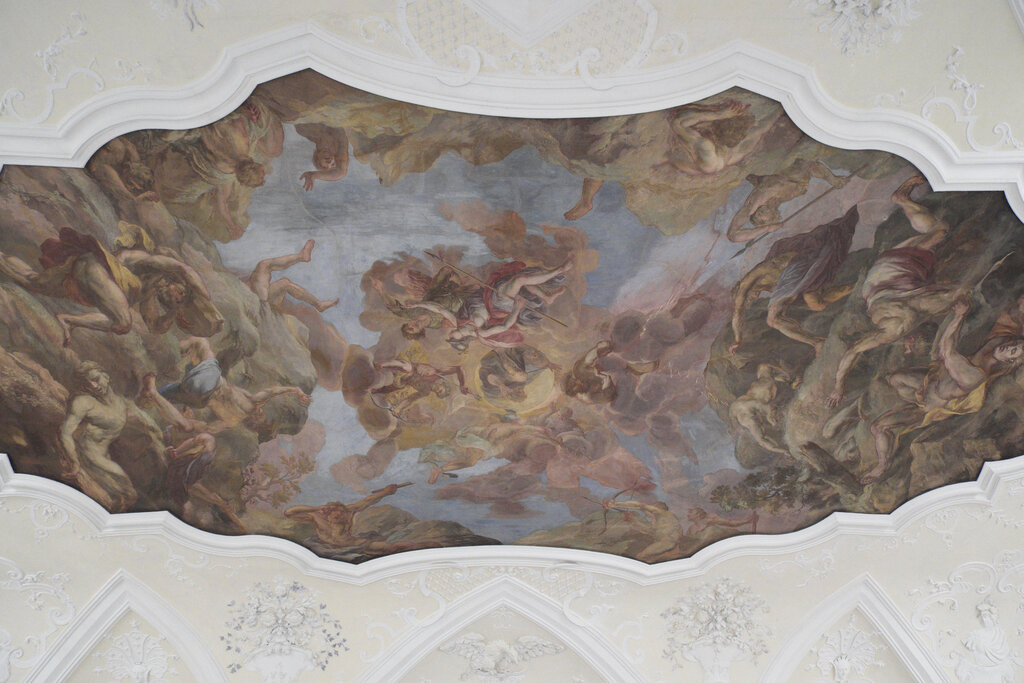
Each punishment was a direct reflection of the son's specific transgression.
| Iapetid | Transgression | Punishment |
|---|---|---|
| Atlas | Overly daring leadership in the war | Forced to hold up the heavens for eternity |
| Menoetius | Arrogance and violent rage | Struck down by Zeus's lightning and banished to Erebus |
| Prometheus | Deceit and stealing fire for humanity | Chained to a rock, his liver eaten daily by an eagle |
| Epimetheus | Foolishness and accepting Pandora | His creation, humanity, is afflicted with all evils from Pandora's jar |
An Ideological Rebellion
Why the special treatment? Because the Iapetids represented a threat that went beyond mere physical force. Their actions were an intellectual and moral challenge to Zeus's authority. Prometheus, the “Forethinker,” was cunning and defied divine command by empowering humanity. Epimetheus, the “Afterthinker,” was a fool whose choices had disastrous consequences for mortals.
Atlas's crime was daring to lead the charge against the Olympians, an act of supreme defiance. Menoetius embodied the kind of violent insolence that Zeus could not tolerate in his new, ordered world. Together, they represented the source of human flaws and suffering: craftiness, foolishness, excessive ambition, and rash violence.
By punishing them so severely and so personally, Zeus wasn't just winning a war. He was making a statement about the new rules of the cosmos. He established a clear boundary between the divine and the mortal, and the tormented bodies of the Iapetids served as a permanent, gruesome warning to any who might dare to cross it.
What symbolic role did Iapetus originally hold in the cosmic order, which his son Atlas later inherited in a more punitive form?
According to the text, why did Zeus single out the sons of Iapetus for unique and severe punishments compared to the other defeated Titans?