Lecture Content Mastery and Analysis
Tax Dynamics
The Tax Wedge
Governments often tax specific goods, like gasoline or cigarettes. A common method is the per-unit tax, a fixed fee charged for every unit sold. This isn't a percentage, but a set amount, like $0.50 per gallon of gas. While it might seem simple, this tax drives a wedge between the price a buyer pays and the price a seller receives.
Imagine the market for a cup of coffee is in equilibrium at $3.00. At this price, the quantity supplied equals the quantity demanded. Now, the government imposes a $1.00 per-unit tax on coffee. The question is, who pays it? Does the price simply jump to $4.00? Or does the coffee shop owner eat the cost, still selling at $3.00 but only keeping $2.00? The answer is usually somewhere in the middle.
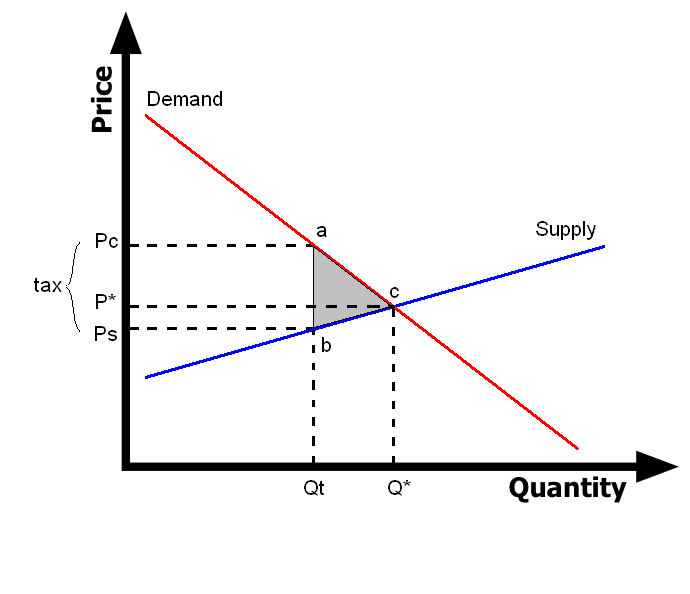
This gap between the buyer's price and the seller's net revenue is called the a crucial concept for understanding how taxes affect a market. It doesn't matter who is legally required to send the tax money to the government, the consumer or the producer. The final economic outcome, the new prices and quantity, will be the same. This is the difference between statutory and economic incidence.
Statutory vs. Economic Burden
The statutory burden of a tax falls on the party legally responsible for paying it. If the law says producers must remit the coffee tax, they bear the statutory burden. If the law says consumers must, they do. But the economic incidence, or the actual financial burden, is determined not by laws but by the market itself.
Economic incidence depends on the relative price elasticity of supply and demand. The group that is less responsive to price changes will bear a larger portion of the tax burden.
Let's analyze this by looking at shifts in the supply and demand curves. First, consider a tax levied on producers. From their perspective, a $1.00 tax on every cup of coffee is an additional cost of production. To be willing to supply the same quantity as before, they now need to receive a price that is $1.00 higher. This shifts the entire supply curve vertically upwards by the amount of the tax.
The new equilibrium occurs where the new supply curve () intersects the original demand curve. At this point, the quantity sold () is lower than the original quantity (). The price consumers pay () is higher than the original price, but not by the full $1.00. The price producers receive () is what consumers pay minus the tax. So, .
Now, what if the tax is levied on consumers instead? Legally, every time they buy a coffee, they owe the government $1.00. This reduces their willingness to pay for any given quantity by exactly $1.00. The result is a downward vertical shift of the demand curve by the amount of the tax. The new equilibrium quantity is the same reduced quantity (), and the wedge between the buyer's and seller's price is still exactly $1.00. The is identical, regardless of who writes the check to the government.
Regardless of whether the legal responsibility to pay the tax falls on producers or consumers, economic theory suggests that the burden of taxes falls on the market participant whose behavior is less responsive to price.
Elasticity and Who Really Pays
The less elastic side of the market bears more of the tax burden. Elasticity measures how much quantity demanded or supplied responds to a change in price. If demand is inelastic, consumers are not very sensitive to price changes. For goods like medicine or gasoline, people will continue to buy similar quantities even if prices rise. In this case, producers can pass most of the tax on to consumers in the form of higher prices.
Conversely, if demand is very elastic, consumers are highly sensitive to price. Think of a specific brand of soda with many substitutes. If a tax raises its price, consumers will easily switch to another brand. Here, producers cannot raise the price much without losing all their customers. They must absorb most of the tax themselves, leading to lower net revenue.
The same logic applies to the supply side. If supply is inelastic (e.g., beachfront property, which is fixed in quantity), producers will bear most of the tax burden because they can't easily reduce their production. If supply is elastic (e.g., t-shirts, which can be made quickly and cheaply), producers can more easily scale back production, forcing consumers to bear more of the tax.
By inserting a wedge between what buyers pay and sellers receive, a per-unit tax reduces the quantity of the good bought and sold. This distortion moves the market away from the efficient equilibrium quantity, creating a loss of economic welfare for both sides.
Ready to test your understanding?
What does the 'tax wedge' created by a per-unit tax represent?
If the government imposes a per-unit tax on producers, the supply curve shifts vertically upward by the exact amount of the tax.
Understanding the tax wedge and incidence is key to analyzing the true impact of government policies on market behavior and outcomes.