Learn Greek with Russian
Greek Alphabet
Meet the Greek Alphabet
Before you can read, write, or speak any Greek, you need to know its alphabet. The good news is that it's largely phonetic, meaning words are pronounced just as they are written. Once you learn the 24 letters, you’ll be able to sound out almost any Greek word you see.
Learning the Greek alphabet is the first step in mastering the language.
Many of these letters will look familiar, as they are the ancestors of letters in the Latin alphabet used for English. Let's go through each one, looking at its uppercase and lowercase forms, its name, and the sound it makes.
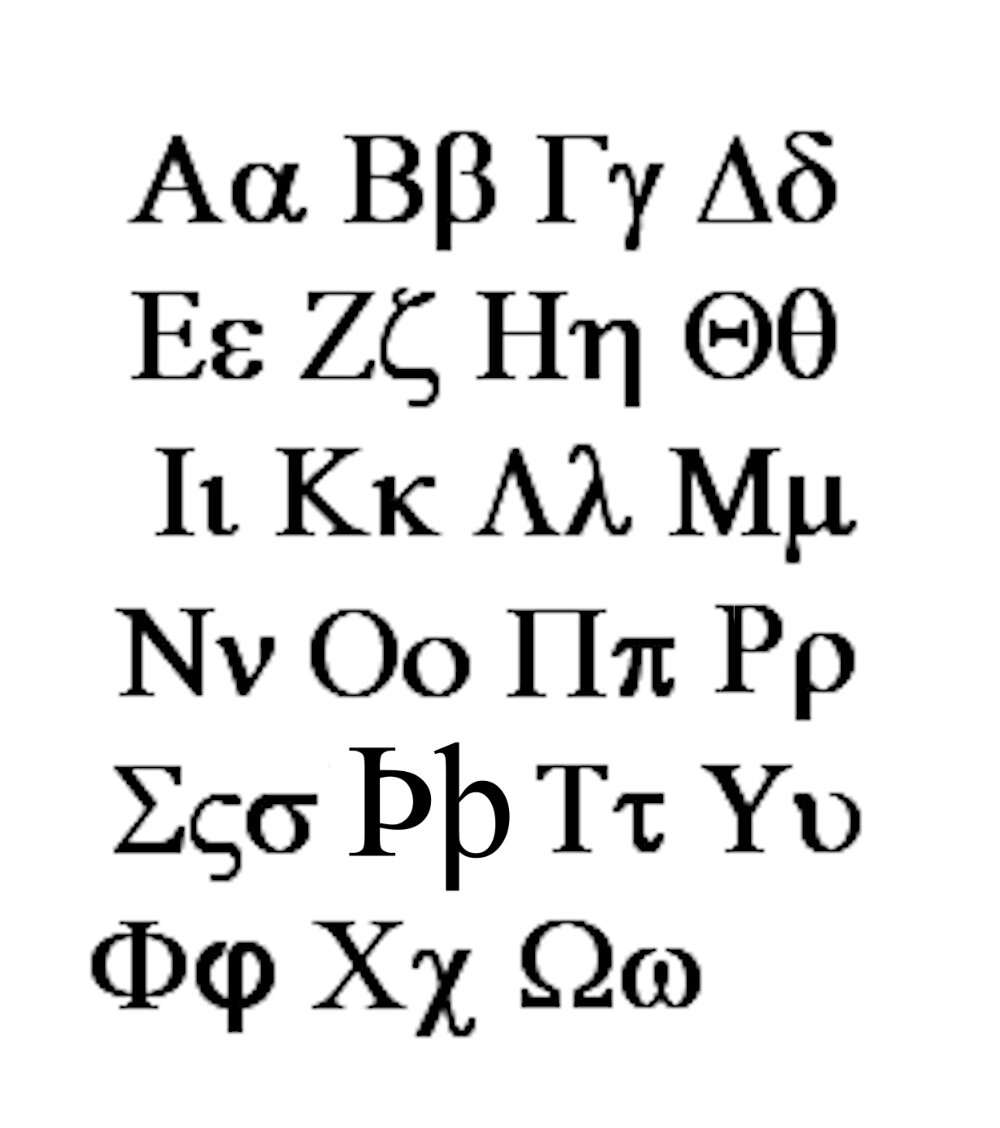
| Uppercase | Lowercase | Name | Sound |
|---|---|---|---|
| Α | α | Alpha | 'a' as in father |
| Β | β | Beta | 'v' as in __v__ase |
| Γ | γ | Gamma | 'y' as in __y__es, or a throaty 'g' |
| Δ | δ | Delta | 'th' as in __th__en |
| Ε | ε | Epsilon | 'e' as in pet |
| Ζ | ζ | Zeta | 'z' as in __z__oo |
| Η | η | Eta | 'ee' as in meet |
| Θ | θ | Theta | 'th' as in __th__in |
| Ι | ι | Iota | 'ee' as in meet |
| Κ | κ | Kappa | 'k' as in __k__ite |
| Λ | λ | Lambda | 'l' as in __l__amp |
| Μ | μ | Mu | 'm' as in __m__an |
| Ν | ν | Nu | 'n' as in __n__et |
| Ξ | ξ | Xi | 'x' as in axe |
| Ο | ο | Omicron | 'o' as in hot |
| Π | π | Pi | 'p' as in __p__en |
| Ρ | ρ | Rho | 'r' as in __r__ose (often rolled) |
| Σ | σ / ς | Sigma | 's' as in __s__un ('ς' is only used at the end of a word) |
| Τ | τ | Tau | 't' as in __t__op |
| Υ | υ | Upsilon | 'ee' as in meet |
| Φ | φ | Phi | 'f' as in __f__un |
| Χ | χ | Chi | 'h' as in __h__e (like clearing your throat) |
| Ψ | ψ | Psi | 'ps' as in tips |
| Ω | ω | Omega | 'o' as in go |
Pronunciation Pointers
While many letters have straightforward English equivalents, a few have unique sounds that require a little practice.
First, notice that there are three different letters that make the 'ee' sound: Eta (η), Iota (ι), and Upsilon (υ). For now, just remember they all sound like the 'ee' in 'meet.'
Similarly, Omicron (ο) and Omega (ω) both make an 'o' sound. The difference is subtle; think of Omicron as a short 'o' and Omega as a longer 'o'.
The letter Delta (δ) is a soft 'th' sound, like in the word 'then', not the hard 'th' in 'thin'. That sound belongs to Theta (θ).
A key difference: The Greek letter Beta (β) is pronounced like a 'v', not a 'b'. This is a common point of confusion for beginners.
The letter Gamma (γ) also has a special sound. Before 'a', 'o', or 'u', it has a deep, throaty 'g' sound. But before 'e' or 'i' sounds, it's pronounced like a 'y' in 'yes'.
Finally, there’s Chi (χ). This isn't the 'ch' from 'church'. It's a breathy sound made in the back of your throat, similar to the 'h' in 'huge' or the 'ch' in the Scottish word 'loch'.
Tricky Look-Alikes
Some Greek letters look just like English letters but have completely different sounds. This can trip you up when you're starting out. Your brain will want to read them the English way, so it's important to train yourself to see them differently.
The most common mix-ups are:
- Rho (Ρ, ρ) looks like an English P, but it makes an 'r' sound.
- Nu (Ν, ν) can be mistaken for an English V, but it makes an 'n' sound.
- Chi (Χ, χ) looks like an English X, but it makes that breathy 'h' sound we discussed earlier.
Getting these right from the start will make reading much easier down the line. It just takes a little focus and repetition.
Ready to review? Use these flashcards to test your memory of the uppercase and lowercase letters and their names.
Now, let's see how well you can connect the letters to their sounds.
Which Greek letter looks like the English letter 'P' but makes an 'r' sound?
The Greek letter Gamma (γ) is pronounced like a 'y' (as in 'yes') when it comes before which types of sounds?
Mastering the alphabet is the biggest first step. Once the letters and their sounds become second nature, you'll be ready to start reading and writing words.