Leap 71 Rocket Engine Technology
Introduction to Rocket Propulsion
Action and Reaction
A rocket sitting on the launchpad isn't going anywhere. To get it moving, it needs a push. But in the vacuum of space, there's nothing to push against. So, how does it work?
The secret is Newton's Third Law of Motion: for every action, there is an equal and opposite reaction. A rocket works by throwing mass out of its back end at very high speed. This mass, the hot exhaust gas, is the "action." The rocket moving forward is the "reaction."
Imagine standing on a skateboard and throwing a heavy bowling ball forward. The act of throwing the ball pushes you and the skateboard backward. A rocket does the same thing, but it throws a continuous stream of hot gas instead of a bowling ball.
This forward push is called thrust. The amount of thrust depends on two things: how much mass you're throwing out (mass flow rate) and how fast you're throwing it (exhaust velocity). To get more thrust, a rocket engine needs to either expel more propellant per second or expel it at a higher speed. This fundamental relationship is at the heart of all rocket propulsion.
Rocket propulsion harnesses Newton's Third Law, expelling mass to generate thrust.
The ultimate velocity a rocket can reach is described by the Tsiolkovsky rocket equation. We won't dive into the math, but the core idea is simple. A rocket's final speed is determined by its engine's efficiency (exhaust velocity) and how much of its total initial mass is propellant. This is why rockets are mostly giant fuel tanks with a tiny payload on top.
Types of Engines
While the principle is the same, rocket engines come in several different flavors. The most common are chemical rockets, which get their energy from chemical reactions.
A key thing to remember is that fire needs oxygen. In space, there's no air, so rockets must carry their own oxygen supply, called an oxidizer, along with their fuel. Together, these are called propellants.
Solid Rocket Engines
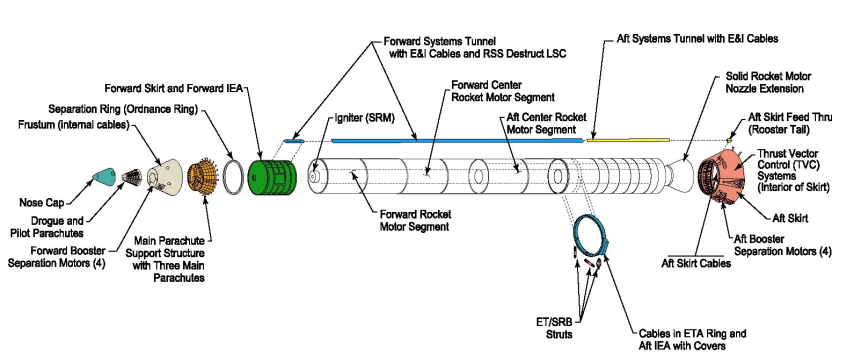
These are the simplest type. The fuel and oxidizer are mixed together and cast into a solid block, called a grain. Think of it like a giant, very powerful firework. Once you light it, it burns until all the propellant is gone.
They provide enormous thrust and are relatively simple and reliable. However, they can't be throttled up or down, shut off, or restarted. The Space Shuttle's large white side boosters were solid rocket motors.
Liquid Rocket Engines
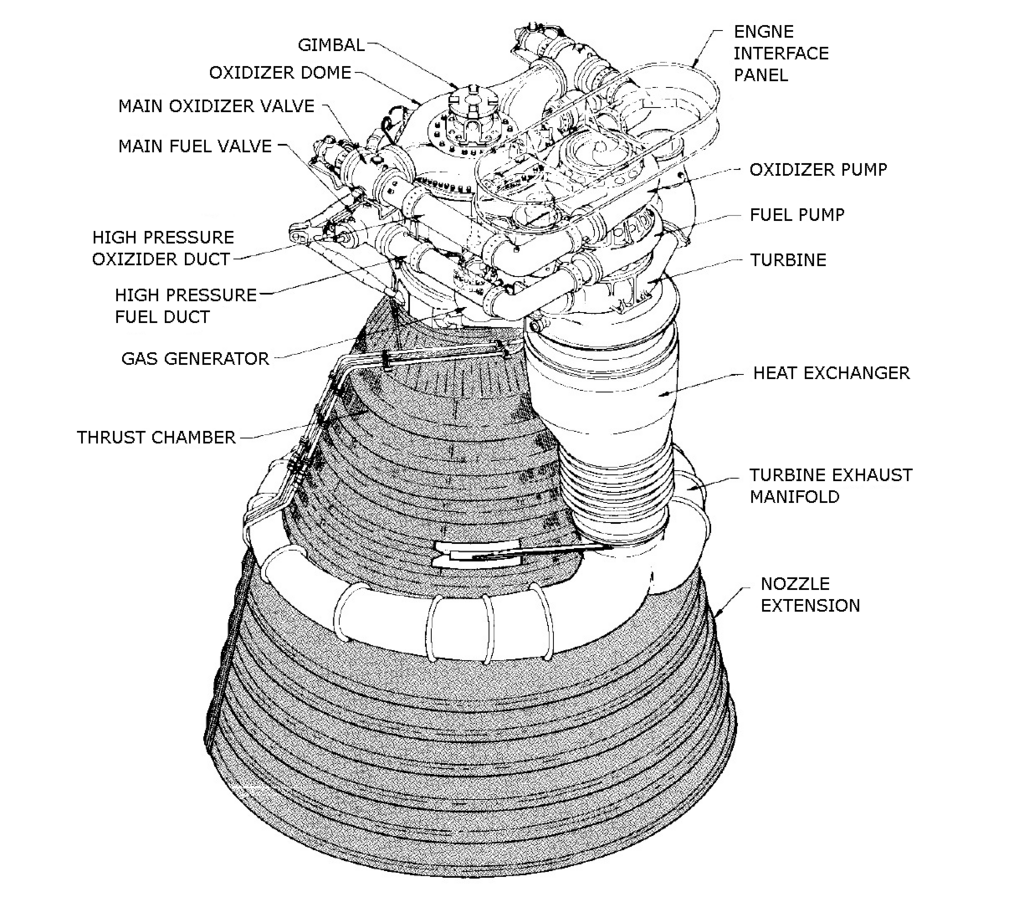
In these engines, the fuel and oxidizer are stored as separate liquids in tanks. They are then pumped into a combustion chamber where they mix and ignite.
Liquid engines are much more complex than solid ones, with intricate networks of pumps, turbines, and valves. But this complexity comes with a huge advantage: control. They can be throttled, shut down, and even restarted in space. The main engines of the Saturn V moon rocket were liquid-fueled.
Electric Propulsion
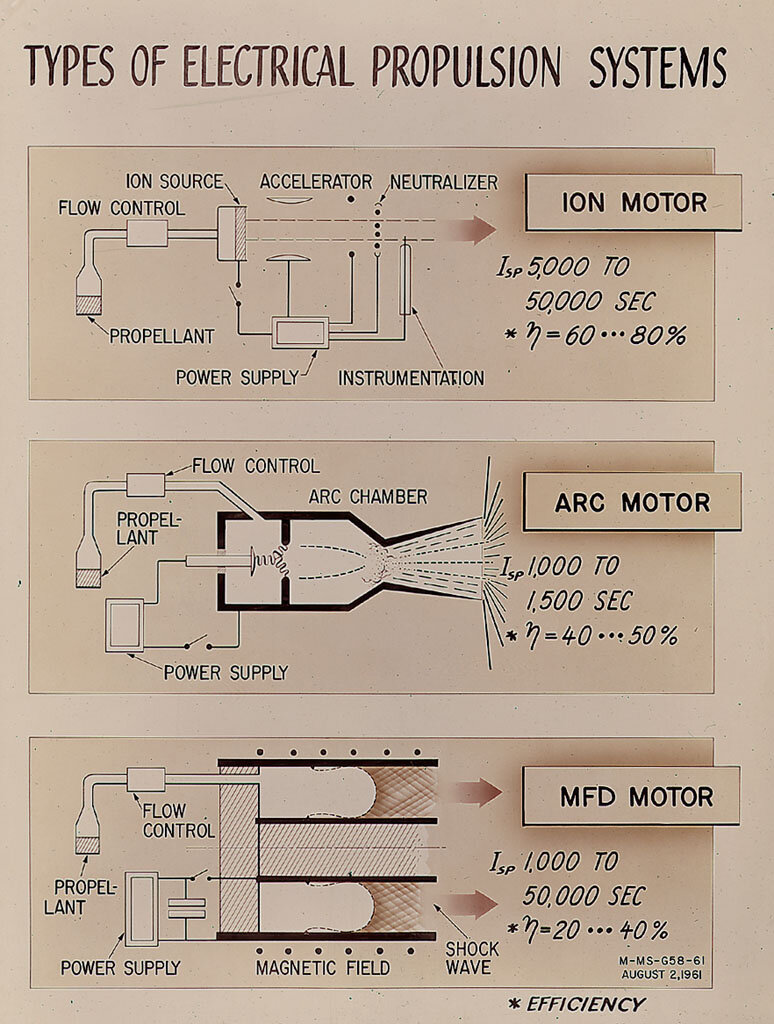
Not all rockets use chemical reactions. Electric propulsion systems, like ion thrusters, use electrical energy to accelerate a propellant (often an inert gas like xenon). They eject ions at extremely high speeds, making them incredibly fuel-efficient.
The trade-off is that they produce very low thrust, like the force of a piece of paper resting on your hand. They can't lift a rocket off the ground, but in the frictionless environment of space, this gentle, constant push can build up to enormous speeds over months or years. They are ideal for deep-space probes and satellite station-keeping.
Fuel for the Fire
The choice of propellant is critical to a rocket's performance. Propellants are chosen for their energy content, density, and ease of handling.
Liquid Propellants
Common liquid fuels include Rocket Propellant-1 (RP-1), a highly refined form of kerosene, and liquid hydrogen (LH2). The most common oxidizer is liquid oxygen (LOX). The combination of LH2 and LOX is one of the most efficient chemical propellants, but hydrogen is difficult to store because it must be kept incredibly cold and has a very low density.
Some propellants are hypergolic, meaning they ignite spontaneously on contact, removing the need for an ignition system. This makes them highly reliable, which is why they are often used in spacecraft maneuvering thrusters where quick, dependable engine starts are essential.
| Propellant Type | Common Fuel | Common Oxidizer | Key Feature |
|---|---|---|---|
| Cryogenic | Liquid Hydrogen (LH2) | Liquid Oxygen (LOX) | High efficiency, but requires extremely low storage temperatures. |
| Petroleum-based | RP-1 (Kerosene) | Liquid Oxygen (LOX) | Denser than LH2 and easier to handle, but less efficient. |
| Hypergolic | Monomethylhydrazine (MMH) | Dinitrogen Tetroxide (NTO) | Ignites on contact, highly reliable but also highly toxic. |
Solid Propellants
Solid propellants are a mixture that includes both fuel, typically a metal powder like aluminum, and an oxidizer, like ammonium perchlorate. A binder, which is a type of rubbery plastic, holds everything together and also serves as additional fuel. The exact composition is carefully tuned to control the burn rate and performance of the motor.
Ready to test your knowledge? Let's see what you've learned about the fundamentals of getting to space.
According to Newton's Third Law, how does a rocket propel itself forward in the vacuum of space?
What is a major advantage of a liquid rocket engine compared to a solid rocket motor?
Understanding these basic principles—thrust, engine types, and propellants—provides the foundation for everything that follows in rocket science and engineering.