Lean Six Sigma for Process Improvement
Introduction to Lean Six Sigma
Combining Speed and Quality
Imagine a world-class pit crew at a car race. Their goal is to get the car back on the track as fast as possible, with zero mistakes. Every movement is precise, every tool is in its place, and no action is wasted. Now, imagine an expert archer who hits the bullseye with nearly every shot, time and time again. Their process is so consistent and refined that errors are almost nonexistent.
Lean Six Sigma is a business methodology that brings these two ideas together. It combines two powerful approaches: Lean and Six Sigma. Think of it as a one-two punch for process improvement.
Lean focuses on speed by eliminating waste. Six Sigma focuses on quality by eliminating defects.
Let's break them down. Lean originated with Toyota's manufacturing system. Its main goal is to remove any step in a process that doesn't add value for the customer. This 'waste' can be anything from unnecessary transportation of goods to waiting for the next step in a process. The idea is to make workflows smooth, efficient, and fast.
Six Sigma, on the other hand, was developed at Motorola in the 1980s. It's a data-driven approach aimed at reducing variation and eliminating defects. The name 'Six Sigma' refers to a statistical level of quality so high that it allows for only 3.4 defects per million opportunities. It’s all about making processes predictable and reliable, like our archer hitting the bullseye consistently.
Better Together
So why combine them? Lean and Six Sigma are powerful on their own, but they solve different problems. Lean makes a process faster, but it doesn't guarantee it's a good process. Six Sigma makes a process high-quality and consistent, but it doesn't necessarily make it fast.
By integrating them, you get the best of both worlds. You can design a process that is not only fast and efficient but also produces high-quality, reliable results. You streamline the process by removing waste, and then you perfect the remaining steps to ensure consistency. This synergy allows organizations to improve dramatically.
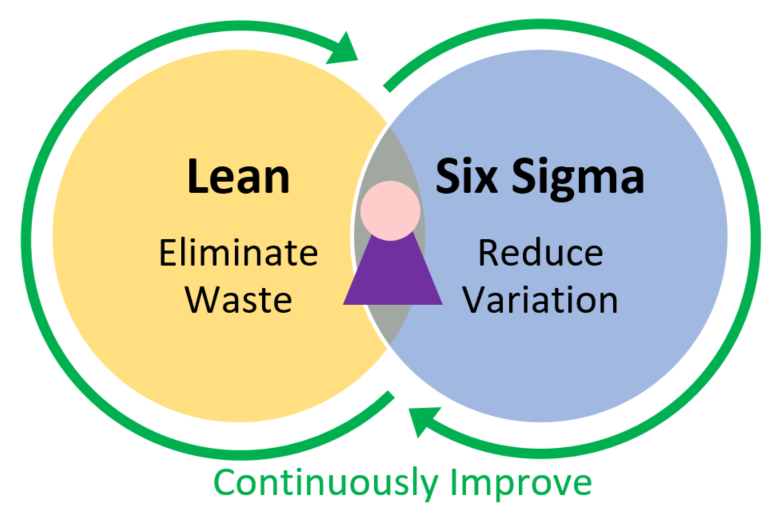
The integration of these two methods began in the early 2000s. Companies realized that using just one approach often left gaps. A fast process with high defects isn't useful, and a perfect but slow process can't keep up with demand. Lean Six Sigma provides a comprehensive toolkit to tackle both issues at once.
Not Just for Factories
While Lean Six Sigma has its roots in manufacturing, its principles are universal and have been adapted for virtually every industry. The core idea is simple: any process can be improved.
In healthcare, it's used to reduce patient wait times and prevent medical errors. In finance, it helps streamline loan application processes and reduce errors in financial reporting. IT departments use it to speed up software development and resolve support tickets more efficiently.
The benefits are clear. Businesses see lower costs because they're not wasting resources or redoing work. Customer satisfaction improves because products and services are delivered faster and more reliably. Employees are often more engaged because their work processes are less frustrating and more efficient.
Let's check your understanding of these core concepts.
What is the primary focus of the 'Lean' methodology?
The 'Six Sigma' methodology aims for a quality level of near perfection. What does this translate to statistically?
By focusing on both speed and quality, Lean Six Sigma offers a powerful framework for continuous improvement in any field.