Lean Six Sigma for Financial Services
Introduction to Lean and Six Sigma
Two Paths to Improvement
In the world of process improvement, two names stand out: Lean and Six Sigma. Though they started in different places, they both aim for the same goal: making processes better, faster, and more reliable. They just tackle the problem from slightly different angles.
Lean thinking originated with Toyota's manufacturing system after World War II. Its core idea is simple: eliminate waste. In this context, "waste" is anything that doesn't add value for the end customer. This could be wasted time waiting for a part, wasted motion moving items unnecessarily, or wasted effort producing something with defects. The goal of Lean is to create a smooth, efficient flow from the start of a process to the end, delivering exactly what the customer wants with as little friction as possible.
Lean is focused on speed and efficiency. It asks, "How can we deliver value to the customer with the least amount of wasted effort?"
Six Sigma, on the other hand, was developed at Motorola in the 1980s. Its main enemy is variation. Imagine a baker who wants every loaf of bread to weigh exactly 500 grams. If some loaves come out at 490g and others at 510g, there's variation in the process. This inconsistency can lead to unpredictable results and unhappy customers.
Six Sigma uses statistical analysis to pinpoint the causes of this variation and systematically reduce it. The goal is to make processes so consistent and predictable that defects become incredibly rare.
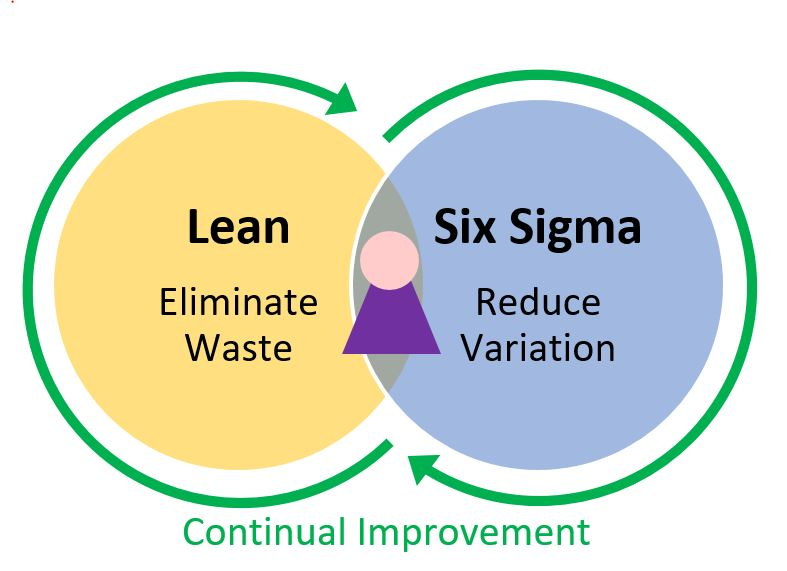
By combining Lean’s focus on waste elimination and Six Sigma’s emphasis on defect reduction, businesses can streamline operations, reduce costs, and significantly enhance customer satisfaction.
Frameworks for Action
Both methodologies provide structured frameworks to guide improvement projects. The two most common are DMAIC and DMADV. While their names are similar, they serve different purposes.
DMAIC is used to improve an existing process that is falling short of expectations. It's a five-step method for finding the root cause of a problem and fixing it.
DMADV is used to design a new process or product, or to redesign a broken process from scratch. It aims to build a high-quality process from the ground up, ensuring it meets customer needs from day one.
| Step | DMAIC (Improve Existing Process) | DMADV (Design New Process) |
|---|---|---|
| D | Define the problem and project goals. | Define the project goals based on customer needs. |
| M | Measure the current process performance. | Measure customer needs and specifications. |
| A | Analyze the data to find root causes of defects. | Analyze options to meet customer needs. |
| I / D | Improve the process by eliminating root causes. | Design the new process in detail. |
| C / V | Control the future state to prevent backsliding. | Verify the design through testing and implementation. |
Understanding these core philosophies and frameworks is the first step. Lean helps you see and eliminate waste, while Six Sigma gives you the tools to tackle variation and defects. Together, they create a powerful system for continuous improvement.
What is the primary goal of the Lean methodology?
Six Sigma was developed to primarily combat which of the following issues in a process?