Lead Product Designer Mastery AI and Data
AI Foundations
What Is AI, Really?
Artificial Intelligence, or AI, is about making machines smart. The goal is to create systems that can perform tasks that typically require human intelligence, like learning, reasoning, problem-solving, and understanding language. It's not a single technology but a broad field of computer science.
Think of AI as a way to teach a computer how to think, or at least how to imitate thinking, to solve problems on its own.
A Quick Trip Through Time
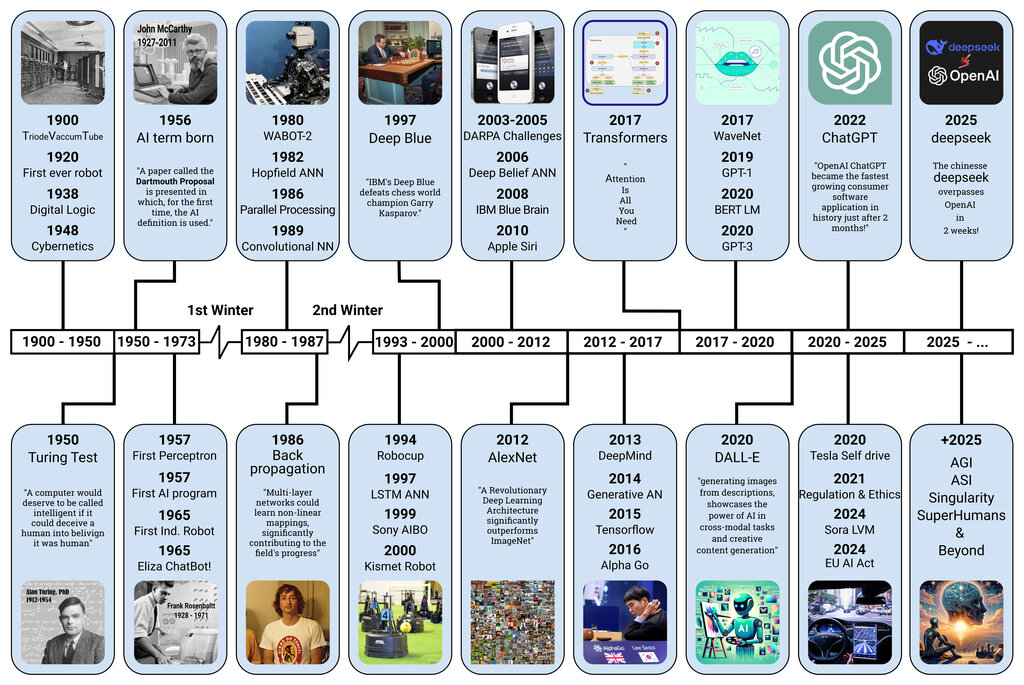
The dream of intelligent machines isn't new. It has roots in ancient myths. But the actual science of AI began in the mid-20th century. The field was officially born at a conference in 1956, where the term "Artificial Intelligence" was coined. Early research was full of optimism, with pioneers predicting machines would be as smart as humans in just a few decades.
Progress came in waves. There were periods of excitement and funding, known as "AI summers," followed by periods of disillusionment and budget cuts, called "AI winters." Breakthroughs in computing power and the availability of massive amounts of data in the 21st century have fueled the AI boom we see today.
The Language of AI
To understand AI, you need to know a few key terms. These concepts are often used interchangeably, but they have distinct meanings. They build on each other, with each one being a subset of the one before it.
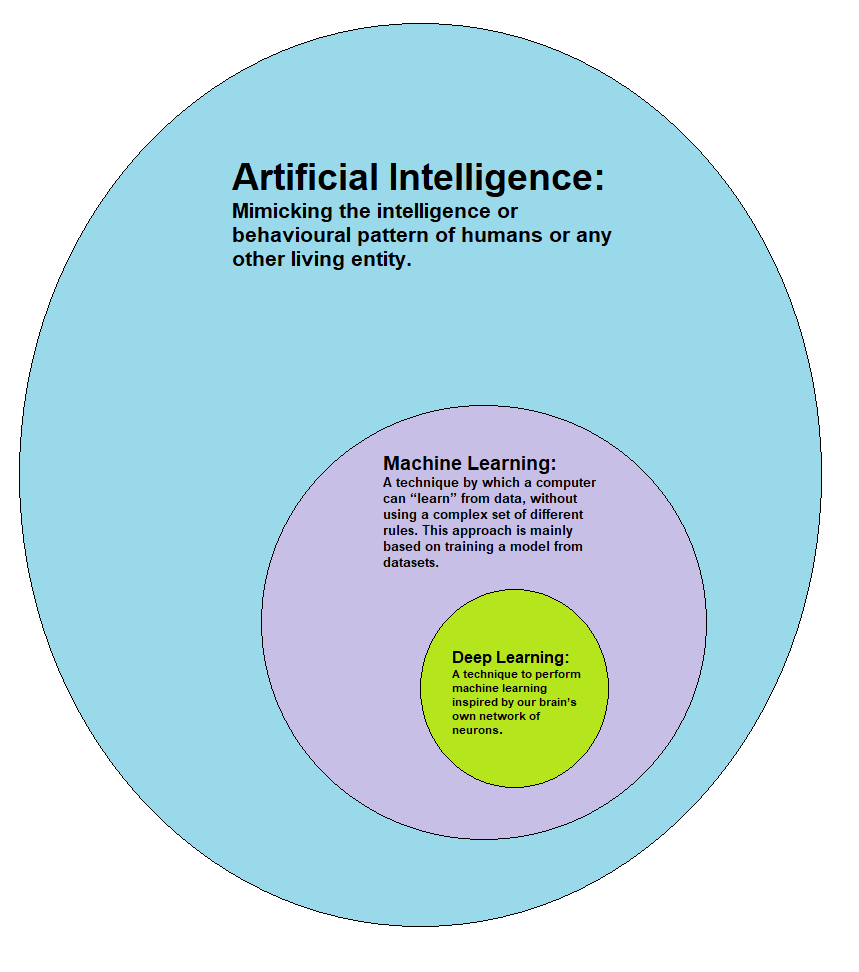
The broadest category is Artificial Intelligence itself. It's the overall field of making machines intelligent. Within AI, there's a specific approach that has become dominant.
Machine Learning
noun
A subset of AI where systems learn directly from data, identify patterns, and make decisions with minimal human intervention. Instead of being explicitly programmed for a task, they are trained on large datasets.
And within Machine Learning, there's an even more specialized technique that powers many of today's most advanced AI systems.
Deep Learning
noun
A subfield of machine learning based on artificial neural networks with many layers (hence "deep"). These networks are inspired by the structure and function of the human brain, allowing them to learn from vast amounts of unstructured data like text and images.
Different Kinds of AI
Not all AI is created equal. We can categorize AI based on its capabilities. Right now, all the AI we interact with falls into one specific category.
| Type | Description | Example |
|---|---|---|
| Artificial Narrow Intelligence (ANI) | Specializes in one specific task. | A chess-playing computer, a spam filter, or a voice assistant. |
| Artificial General Intelligence (AGI) | Has human-like intelligence; can understand, learn, and apply knowledge across a wide range of tasks. | This is still theoretical and does not yet exist. Think of the android Data from Star Trek. |
| Artificial Superintelligence (ASI) | An intellect that is much smarter than the best human brains in virtually every field. | This is also theoretical and a topic of both excitement and concern for the future. |
For product designers, understanding the distinction is key. You'll be working with Narrow AI to solve specific user problems. AGI and ASI remain in the realm of science fiction for now, but they shape the long-term vision and ethical conversations around AI.
AI in Product Design
AI isn't just a futuristic concept; it's already integrated into many products we use every day. As a product designer, your job is to figure out how to use AI to make products more useful, personal, and intuitive.
Think about a music streaming service. AI powers the recommendation engine that suggests new songs you might like based on your listening history. It's what makes the experience feel personalized. A navigation app uses AI to analyze traffic data in real time to find the fastest route. E-commerce sites use AI to show you products you're more likely to buy.
The goal is to use AI to enhance the user experience. It could be by automating a tedious task, providing personalized content, or offering smarter search results. The key is to start with a real user problem and ask, "Could AI help solve this in a better way?"
Good AI integration is invisible. It feels less like a feature and more like the product just gets you.
The Responsibility of Creation
With great power comes great responsibility. AI systems learn from data, and if that data reflects existing human biases, the AI will learn and even amplify those biases. For example, if a hiring tool is trained on historical data where men were hired more often for technical roles, it might learn to unfairly favor male candidates.
This is called AI bias. It can lead to products that are unfair, discriminatory, and untrustworthy. As a designer, you have a crucial role in mitigating this. It starts with asking tough questions about the data being used to train the AI. Who is represented in the data? Who is left out?
Ethical AI design also means being transparent with users about how AI is being used and giving them control over their data and experiences. The goal is to build AI that is not only smart but also fair, accountable, and transparent.
Integrating ethical practices into the AI development process for artificial intelligence (AI) is essential to ensure safe, fair, and responsible operation.
Ready to check your understanding of these foundational concepts?
What is the primary goal of Artificial Intelligence?
The term "Artificial Intelligence" was officially coined during a conference in which decade?
Understanding these fundamentals is the first step. It gives you the language and context to think critically about how to build better, smarter, and more responsible products with AI.