Lasers in Space Communication and Power
Introduction to Laser Communication
Sending Data on a Beam of Light
At its core, communication is about sending information from one place to another. For over a century, we've mostly done this with radio waves. But there's another way: using light itself. Think of sending Morse code with a flashlight. You turn the light on and off in a specific pattern to spell out a message. Laser communication works on the same principle, but it's far more advanced. Instead of a simple flashlight, it uses a highly focused beam of light called a laser.
A laser creates a tight, powerful beam of a single color, or wavelength, of light. This focus is what makes it perfect for long-distance communication.
By rapidly changing properties of the laser beam—like its brightness or phase—we can encode vast amounts of digital data. A satellite in orbit can aim this beam at a receiver on Earth, transmitting data as a stream of light pulses. The receiver then decodes these pulses back into the original information, whether it's a high-definition video, a scientific measurement, or a simple message.
Why Lasers Beat Radio Waves
Radio frequency (RF) communication is reliable, but it has limitations. Imagine radio waves as a floodlight, spreading out over a wide area. A laser is, well, a laser beam—a concentrated pinpoint of energy. This key difference gives lasers several major advantages, especially for space communications.
| Feature | Radio Frequency (RF) | Laser (Optical) |
|---|---|---|
| Data Rate | Lower (like a country road) | 10-100x Higher (like a superhighway) |
| Beam Spread | Wide | Very Narrow |
| Power Needs | High | Low |
| Equipment Size | Large & Heavy | Small & Light |
| Security | Easier to intercept | Harder to intercept |
The most significant advantage is bandwidth. Light waves have a much higher frequency than radio waves, which means they can carry far more information. This is why laser links can transmit data 10 to 100 times faster than the best radio systems.
Because the laser beam is so narrow, the transmitter doesn't need as much power to send a clear signal over vast distances. This also means the equipment can be much smaller and lighter—a huge plus when every kilogram launched into space is incredibly expensive. Finally, that narrow beam is much harder for anyone to eavesdrop on, making the communication link more secure.
The Nuts and Bolts
A laser communication system has three essential parts that work together to move data across space.
Transmitter
noun
The device that generates the laser beam and encodes data onto it by modulating the light.
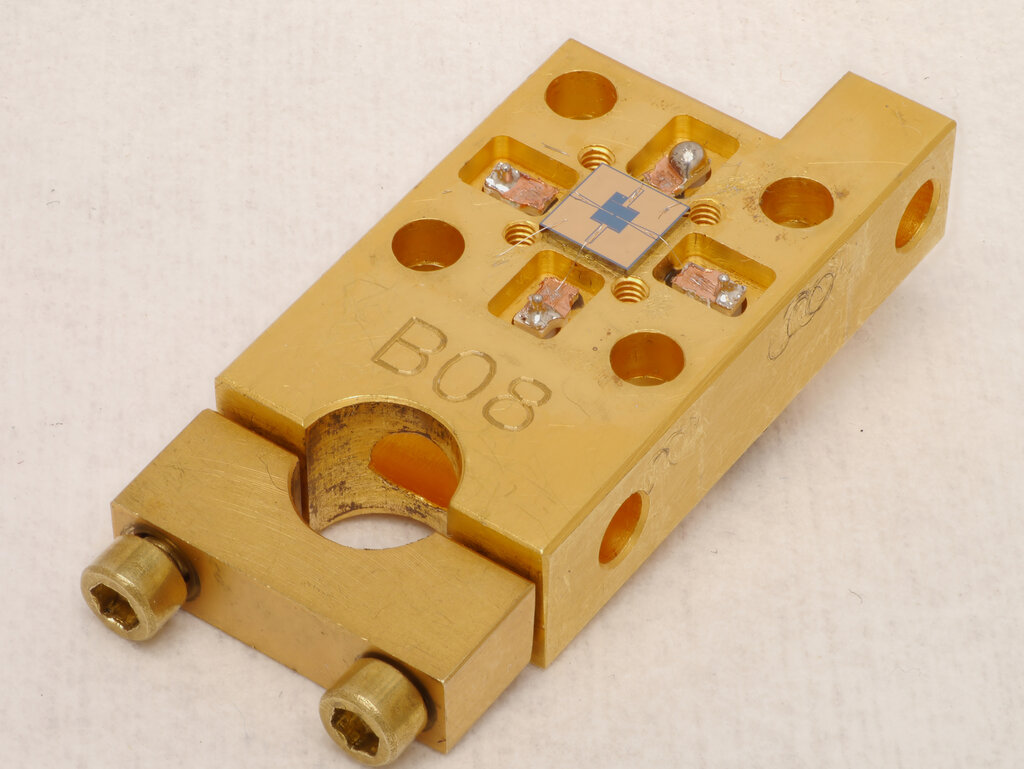
The transmitter is the starting point. It takes digital data (ones and zeros) and translates it into a pattern of light pulses. It's essentially a very sophisticated, high-speed light switch.
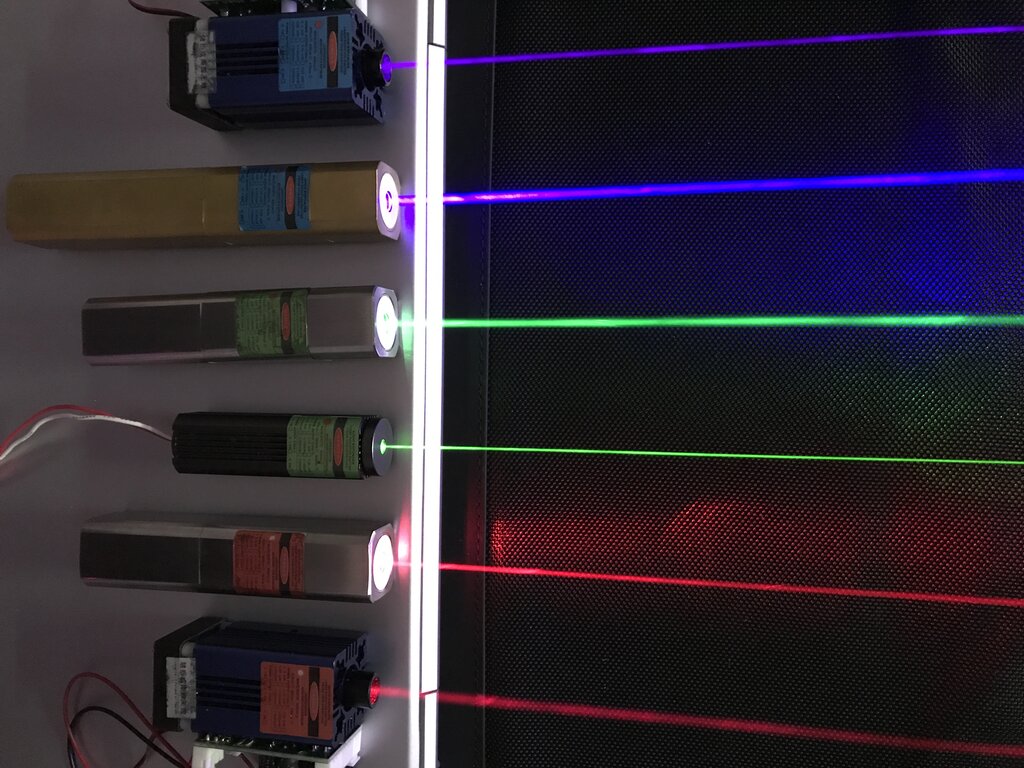
Next is the receiver. Its job is to catch the faint light from the transmitter. A receiver is basically a telescope paired with a highly sensitive detector. The telescope collects as many photons—particles of light—as possible, and the detector converts them back into electrical signals, recreating the original digital data.
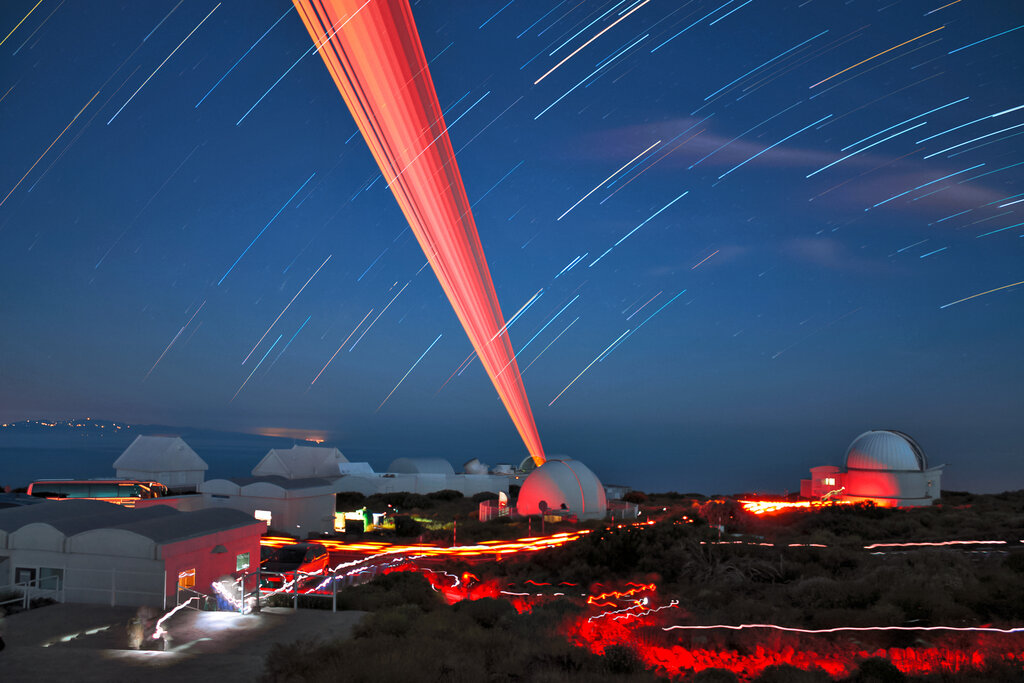
Finally, we have optical ground stations. These are the facilities on Earth that house the receiver telescopes. They are our planet's connection point to the space-based laser network, sending commands up and receiving data down.
Aiming for a Moving Target
Laser communication isn't without its challenges. The two biggest hurdles are pointing accuracy and Earth's atmosphere.
Because the laser beam is so narrow, the transmitter must point with incredible precision. Imagine trying to hit a dime from a mile away with a laser pointer while both you and the dime are moving. That's the scale of the problem.
Satellites and ground stations are constantly moving relative to each other at thousands of miles per hour. The system must calculate exactly where the receiver will be when the light arrives and aim the beam there. This requires sophisticated tracking systems that can correct the beam's direction in real time.
The other major challenge is our own atmosphere. Clouds can block the laser beam entirely. Even on a clear day, pockets of air at different temperatures create turbulence that can bend and scatter the light, disrupting the signal. Engineers overcome this by building ground stations in dry, high-altitude locations and using adaptive optics—special mirrors that change shape hundreds of times per second to cancel out atmospheric distortion.
What is the primary reason laser communication can transmit data much faster than traditional radio frequency (RF) systems?
Which component of a laser communication system is responsible for converting incoming light particles back into digital data?
Despite these challenges, laser communication is rapidly becoming a key technology for our future in space, promising to connect us with satellites and astronauts faster than ever before.