Laser Cutting Fundamentals and Applications
Introduction to Laser Cutting
How Laser Cutting Works
At its core, laser cutting is a process that uses a powerful, focused beam of light to cut through materials. Think of using a magnifying glass to focus sunlight onto a leaf. The concentrated sunlight becomes so hot it can burn a hole. A laser cutter does something similar, but on a much more powerful and precise scale.
The machine generates an intense beam of light. This beam is directed through a series of mirrors and then focused by a lens into a tiny, powerful point. When this focused beam hits a material, its energy is converted into heat. This intense heat melts, burns, or vaporizes the material in a very small area, creating a cut.
The result is an incredibly precise and clean cut. Because the beam is so small, intricate shapes can be created with high accuracy. The process is also non-contact, meaning only the light beam touches the material. This minimizes warping and contamination.
Inside a Laser Cutter
While laser cutters come in many sizes, they all share three fundamental components that work together to turn a digital file into a physical object.
- Laser Source: This is the heart of the machine. It's a device that generates the high-intensity beam of light. Think of it as the engine that provides all the power for cutting.
- Optics: The beam created by the source isn't immediately useful. It needs to be guided and focused. A system of mirrors directs the beam from the source to the cutting head, and a special lens inside the head concentrates all that light into one tiny, powerful spot.
- Motion Control System: This is the machinery that moves the cutting head over the material. It's often a gantry system, similar to what you might see on a 3D printer or CNC machine. It moves with extreme precision along X and Y axes, following the path laid out in the digital design file.
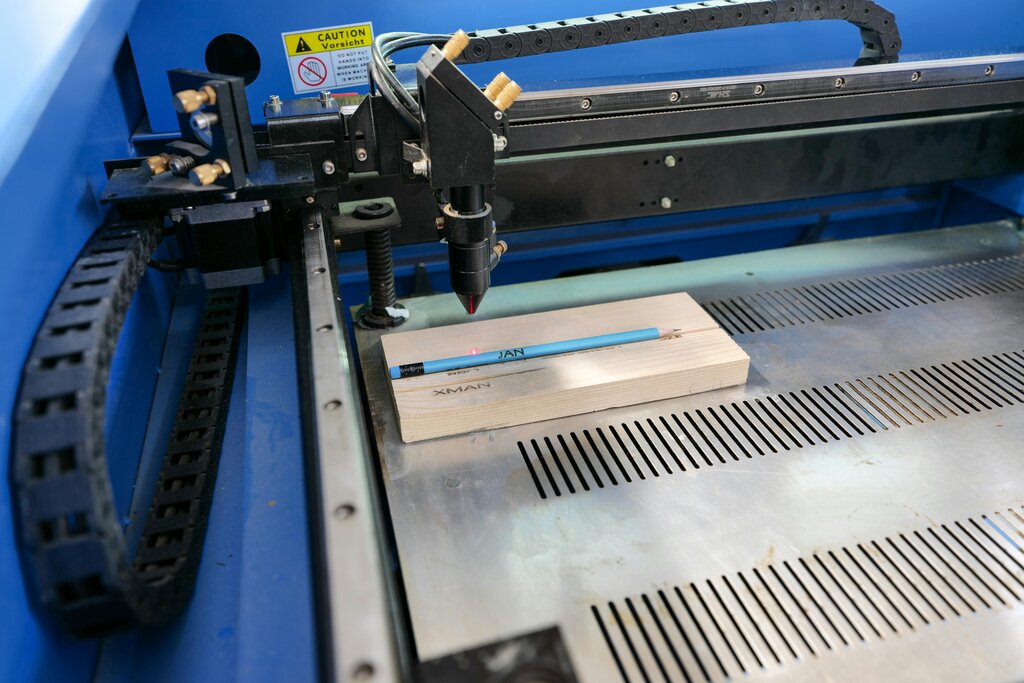
These three systems work in perfect harmony. The motion control system moves the cutting head, while the optics ensure the laser is perfectly focused on the material, allowing the laser source's power to do its work.
From Design to Reality
The journey from an idea to a finished part is a straightforward digital process.
| Step | Action | Description |
|---|---|---|
| 1 | Digital Design | The process starts with a 2D vector file created in design software. This file contains the lines and shapes that the laser will cut. |
| 2 | Machine Setup | The operator places the material on the machine's workbed and ensures the laser is properly focused for the material's thickness. |
| 3 | Sending the Job | The design file is sent to the laser cutter's software. Here, settings like power and speed are configured based on the material being cut. |
| 4 | Cutting | The machine takes over. The motion control system moves the cutting head to follow the paths from the digital file, and the laser fires to make the cuts. |
| 5 | Final Product | Once the machine is finished, the cut parts can be removed from the remaining material. The result is a physical object that precisely matches the original digital design. |
This seamless workflow from digital to physical makes laser cutting a powerful tool for rapid prototyping and custom manufacturing.
Now that you understand the basic principles, let's test your knowledge.
What is the fundamental principle behind how a laser cutter cuts material?
The journey from a digital design to a finished part is a seamless workflow in laser cutting.
By combining light, optics, and motion, laser cutters offer a versatile way to create detailed and precise parts.