Langchain Fundamentals
Introduction to LangChain
Connecting Language Models to the World
Large language models (LLMs) are powerful. They can write essays, generate code, and answer complex questions. But by themselves, they have a major limitation: they're isolated. An LLM's knowledge is frozen at the time it was trained, and it can't access your private data or interact with other applications.
This is where LangChain comes in. It's a framework that acts as a bridge, connecting LLMs to live data, services, and other tools. Think of it as a toolkit for building apps that are powered by LLMs, rather than just being simple interfaces to them.
LangChain is a framework that makes it easier to build applications using large language models (LLMs) by connecting them with data, tools and APIs.
Instead of just having a conversation with a model, you can build applications that use the model's reasoning abilities to perform tasks. For example, you could create a customer service bot that can look up a user's order history from a database and then compose a helpful email. LangChain provides the plumbing to make these connections happen.
Key Features
LangChain's main purpose is to make developing LLM-powered applications easier and more modular. It achieves this through a few key benefits.
First, it allows applications to be data-aware. It gives an LLM the ability to connect to external data sources, like a PDF file, a company's internal wiki, or a database. This lets the model answer questions about information it wasn't originally trained on.
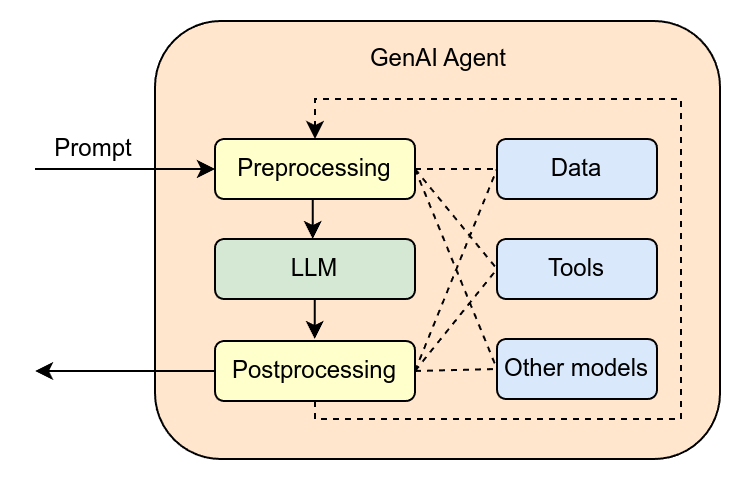
Second, it enables applications to be agentic. This means the LLM can interact with its environment. LangChain provides tools that allow the model to perform actions, like searching the web, running code, or calling an API. The LLM can decide which tool to use and in what order to accomplish a goal.
Finally, LangChain offers a standard, modular architecture. It provides a set of building blocks that you can piece together to create complex applications. This saves you from writing repetitive code and makes your projects easier to manage.
The Core Components
LangChain is built around a few core components that work together. Understanding these at a high level is the key to understanding how the framework operates.
Here’s a quick rundown of the main pieces:
-
Models: This is the language model itself, like GPT-4 or an open-source alternative. LangChain provides a standard interface to communicate with many different models.
-
Prompts: These are templates that structure the input sent to the model. They can include instructions, examples, and placeholders for user input, guiding the LLM to produce a better response.
-
Indexes: Indexes are used to structure external documents so that LLMs can work with them efficiently. This is the key to making your application data-aware, allowing it to retrieve relevant information from your data sources.
-
Chains: Chains are the fundamental building block. They allow you to combine multiple components together to execute a sequence of operations. A simple chain might take user input, format it with a prompt, and then send it to an LLM.
The most basic chain is LLMChain, which takes a prompt template, formats it with user input, and returns the LLM's response.
-
Memory: By default, LLMs are stateless, meaning they don't remember past interactions. The memory component allows a chain or agent to remember previous conversations, creating a more coherent user experience.
-
Agents: Agents use an LLM to decide what actions to take and in what order. An agent can be given access to a set of tools (like a web search or a calculator) and will use the LLM's reasoning to figure out how to best use those tools to answer a user's request.
These components are the foundation for building sophisticated applications with LangChain. They are designed to be modular, so you can mix and match them to create exactly what you need.