LangChain and LangGraph for LLM Applications
Introduction to LangChain
What is LangChain?
Large Language Models (LLMs) are powerful, but on their own, they're like a brain in a jar. They can think, but they can't interact with the world or remember past conversations. LangChain is a framework that connects these models to other resources, allowing developers to build sophisticated applications.
LangChain is a framework that makes it easier to build applications using large language models (LLMs) by connecting them with data, tools and APIs.
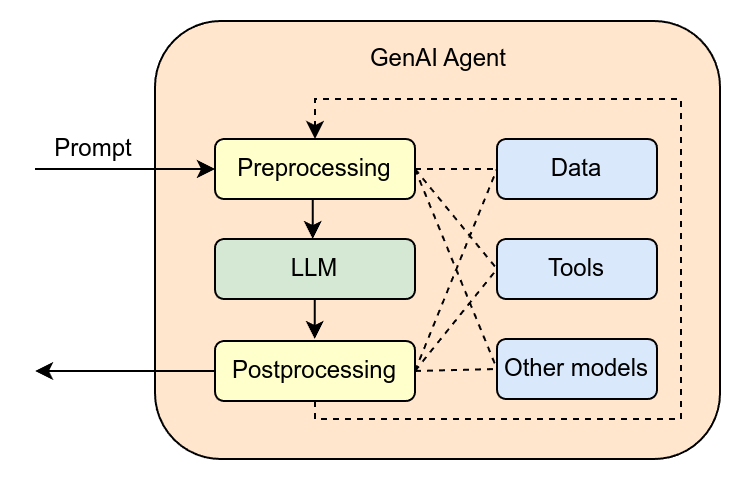
Think of it as an orchestrator for your AI application. It provides the building blocks to combine an LLM with your own data, give it access to tools like search engines, and grant it memory. This lets you move beyond simple prompts and create complex workflows, like a customer service bot that can look up order information or a research assistant that can browse the web.
The Core Components
LangChain is built around a few key concepts that work together. Understanding these components is the first step to building anything with the framework.
The main building blocks are:
- Models
- Prompts
- Chains
- Agents
- Memory
Models are the LLMs themselves. LangChain provides a standard interface to communicate with dozens of different models, whether they're from providers like OpenAI, Google, or open-source alternatives from Hugging Face. This makes it easy to swap out the underlying model without rewriting your entire application.
Prompts are the instructions you send to the model. LangChain helps you build dynamic prompts using templates. A prompt template might have variables you can fill in based on user input, which is much more flexible than hardcoding a static prompt.
from langchain.prompts import PromptTemplate

prompt_template = PromptTemplate.from_template(
    "Tell me a short joke about {subject}."
)
prompt_template.format(subject="cats")
# -> "Tell me a short joke about cats."
Chains are the heart of LangChain. As the name suggests, they chain together components. The simplest chain, an LLMChain, links a prompt template with a model. You provide input variables, LangChain formats the prompt, sends it to the model, and returns the output. More complex chains can link multiple chains together or combine an LLM with other tools.
Agents are a step beyond chains. An agent uses an LLM not just to generate text, but to decide what actions to take. You can give an agent a set of tools, like a calculator or a web search API. The agent's LLM then acts as a reasoning engine, figuring out which tool to use, in what order, to accomplish a goal. This is how you build applications that can interact with their environment and solve multi-step problems.
Memory solves a key limitation of LLMs: they are stateless. By default, a model doesn't remember any previous interactions. Memory components give your chains and agents the ability to recall past conversations. This is essential for building coherent chatbots that can follow a conversation's context.
Getting Started
To start building with LangChain, you'll need Python and its package manager, pip, installed on your system. The first step is to install the core LangChain library.
# Installs the core LangChain library
pip install langchain
You will also need to install the library for the specific LLM you want to use. Since many examples use OpenAI's models, it's common to install their Python package as well.
# Installs the OpenAI Python library to interact with their models
pip install langchain-openai
Finally, to use a service like OpenAI, you'll need an API key. This is a secret key that authenticates your requests. You'll need to sign up on the provider's website to get one. It's best practice to store this key as an environment variable rather than writing it directly in your code.
# Set this in your terminal or a .env file
export OPENAI_API_KEY="your-api-key-goes-here"
With these dependencies installed and your environment configured, you have the foundation needed to start creating applications with LangChain.
What is the primary role of the LangChain framework?
Which LangChain component acts as a reasoning engine, allowing an LLM to choose which tool to use (like a calculator or web search) to accomplish a goal?
These are the fundamental pieces of the LangChain ecosystem. By combining them, you can build powerful and intelligent applications that go far beyond simple text generation.