Landmark Physics Experiments
Introduction to Classical Mechanics
The Rules of Motion
Classical mechanics is the physics of our everyday world. It describes how a baseball flies through the air, how planets orbit the sun, and why you feel a push back in your seat when a car speeds up. These are the rules that govern objects we can see and touch, all laid out with stunning clarity by Isaac Newton centuries ago.
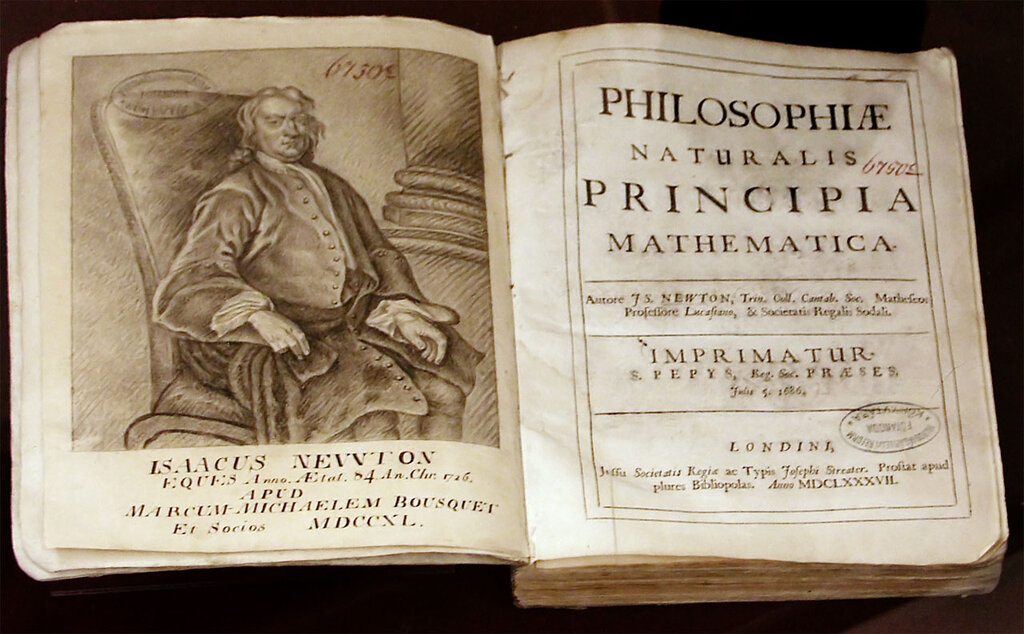
Newton's First Law of Motion is about inertia. It states that an object will stay at rest or continue moving in a straight line at a constant speed unless an outside force acts on it. A soccer ball won't move until you kick it. Once it's rolling, it will keep rolling until friction from the grass and air resistance (outside forces) slow it down and stop it.
Inertia
noun
The property of an object to resist changes in its state of motion.
Force, Mass, and Acceleration
So what happens when a force does act on an object? Newton's Second Law gives us the answer. It connects three key ideas: force, mass, and acceleration. A force is a push or a pull. Mass is a measure of how much "stuff" is in an object. Acceleration is any change in an object's velocity, which means speeding up, slowing down, or changing direction.
The second law says that the acceleration of an object is directly proportional to the net force applied to it and inversely proportional to its mass. In simpler terms, the more force you apply, the more the object accelerates. But the heavier the object (the more mass it has), the harder it is to get it to accelerate. This relationship is captured in one of physics' most famous equations:
Think about pushing a shopping cart. Pushing an empty cart (low mass) is easy, and you can make it accelerate quickly. Pushing a full cart (high mass) requires much more force to get it moving at the same rate.
Finally, Newton's Third Law states that for every action, there is an equal and opposite reaction. When you push on a wall, the wall pushes back on you with the same amount of force. This is how rockets work. They push hot gas out the back (the action), and the gas pushes the rocket forward (the reaction).
The Universe's Currencies
Beyond forces, classical mechanics is built on two powerful principles: the conservation of energy and the conservation of momentum. Think of energy and momentum as the currencies of the physical world. They can be transferred from one object to another or change form, but the total amount in a closed system never changes.
Energy conservation means energy can't be created or destroyed, only converted from one form to another.
A roller coaster at the top of a hill has a lot of potential energy (stored energy due to its height). As it races down, that potential energy converts into kinetic energy (the energy of motion). The total energy stays the same, just switching between forms.
Momentum is a measure of an object's motion, combining its mass and velocity (). Like energy, the total momentum in a system before a collision is equal to the total momentum after. A classic Newton's cradle toy shows both principles beautifully.
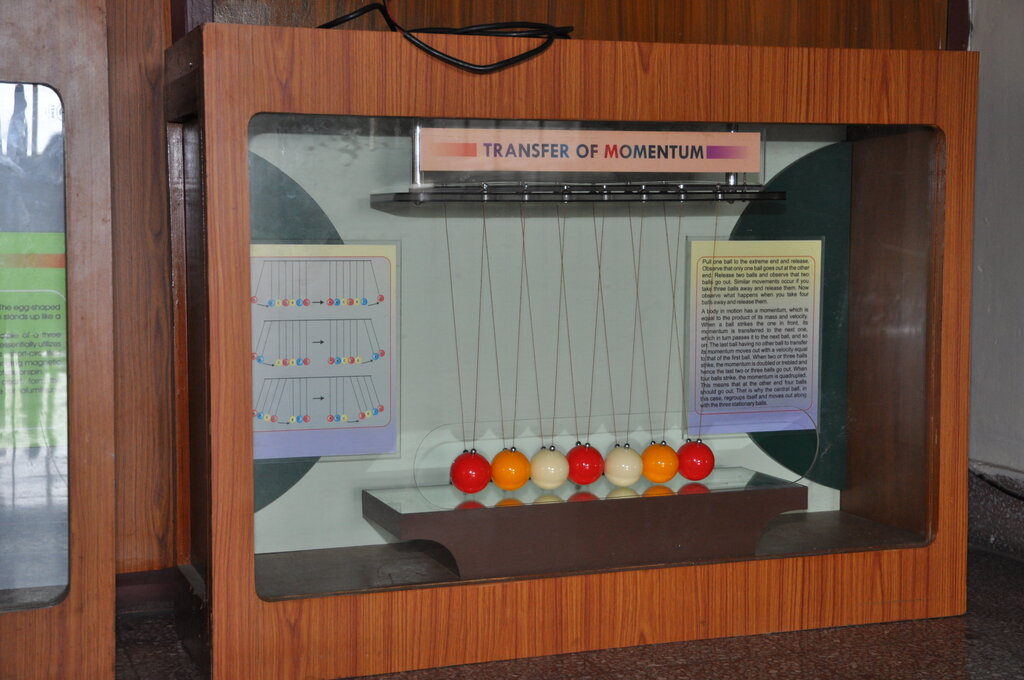
When you lift and release one ball, it strikes the stationary ones. You see the ball on the opposite end fly out with the same speed, while the ones in the middle barely move. The momentum and energy are transferred almost perfectly through the line of balls from the first to the last. This elegant exchange is governed by the same fundamental rules that steer planets in their orbits.
These core ideas—Newton's laws and the principles of conservation—form the bedrock of classical mechanics. They provide a powerful toolkit for understanding and predicting the motion of the world around us. Now, let's test your understanding.
A hockey puck is sliding across a perfectly frictionless ice rink at a constant velocity. If no other forces act on it, what will happen to the puck?
According to Newton's Second Law, if you apply the same net force to two objects, one with a small mass and one with a large mass, which statement is true?