Laminar Flow Dynamics
Fluid Properties
What Makes a Fluid?
Solids and fluids respond to forces in fundamentally different ways. If you push on a solid object, it deforms a certain amount and then stops. A fluid, on the other hand, will continuously deform as long as a force is applied. Think about stirring a cup of coffee. The coffee keeps moving as long as you stir. This is because fluids can't resist shearing forces, which are forces that act parallel to a surface.
Even though fluids are made of discrete molecules buzzing around, we can usually treat them as a continuous substance, or a continuum. This is called the continuum hypothesis. It's a simplification that allows us to define properties like density and pressure at any point within the fluid, which makes analyzing their motion much easier. This assumption holds true as long as we're looking at scales much larger than the distance between individual molecules.
Core Fluid Properties
Three key properties dictate how a fluid behaves: density, viscosity, and surface tension.
Density () is the mass of a fluid packed into a certain volume. It’s calculated as mass divided by volume () and is typically measured in kilograms per cubic meter (kg/m³).
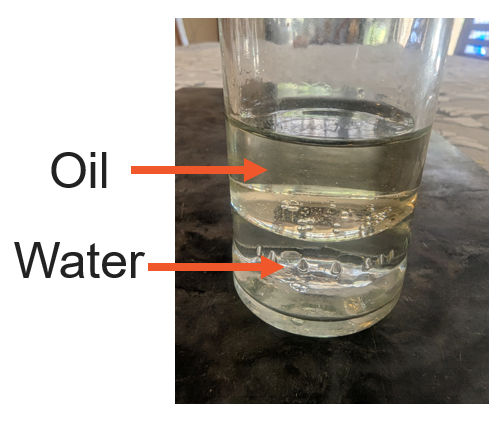
A related concept is specific gravity (SG), which compares a fluid's density to the density of a reference substance, usually water. Since it's a ratio, specific gravity has no units. For example, oil has a specific gravity less than 1, which is why it floats on water.
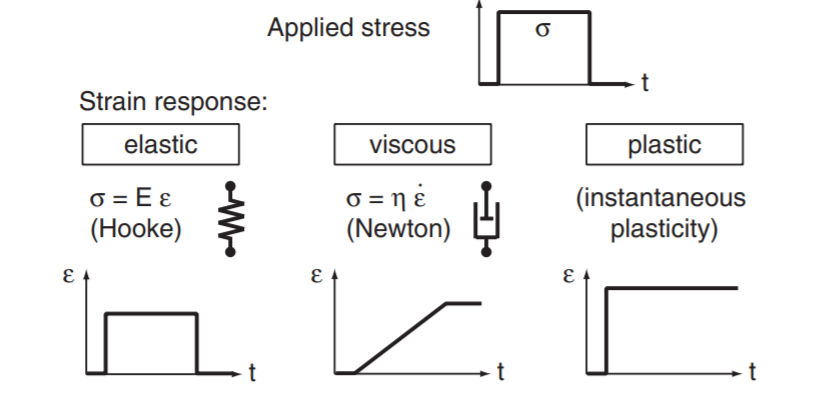
Viscosity () is a measure of a fluid's resistance to flow. You can think of it as the fluid's internal friction. Honey is highly viscous, while water has a low viscosity. This resistance arises from the cohesive forces between molecules in a liquid or from molecular collisions in a gas.
When a fluid flows over a surface, the layer of fluid touching the surface sticks to it, a condition called the 'no-slip' condition. The layer above it moves a bit faster, and so on, creating a velocity gradient. The force required to cause this motion is called shear stress (), and Newton's law of viscosity relates it to the velocity gradient:
Here, is the dynamic viscosity. We also often use kinematic viscosity (), which is just the dynamic viscosity divided by the fluid's density (). Kinematic viscosity describes how quickly momentum spreads through a fluid.
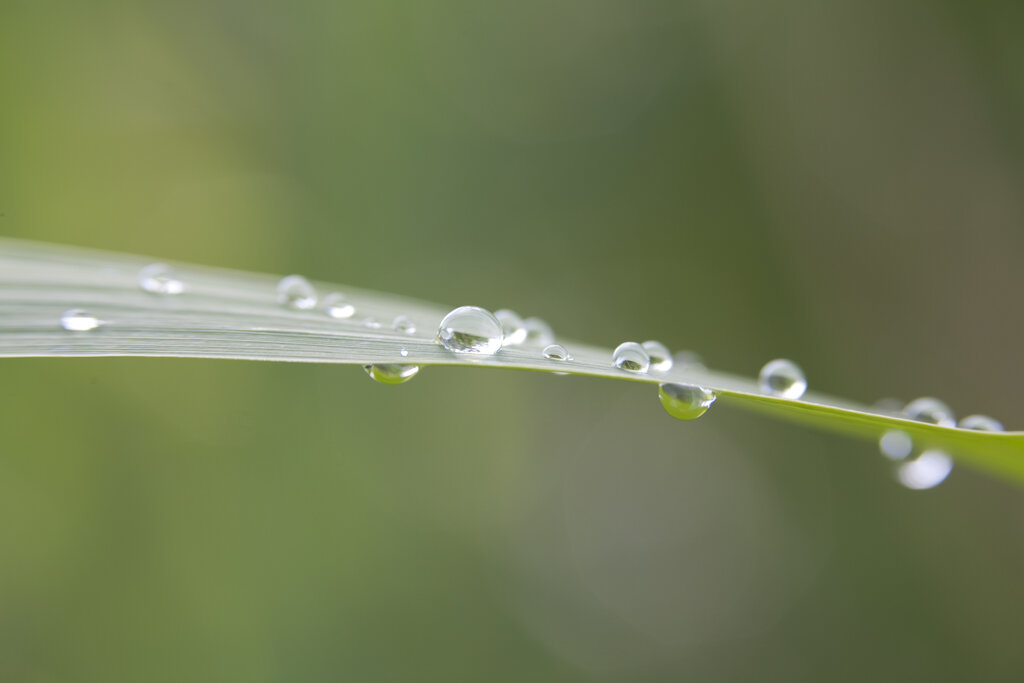
Surface tension is the tendency of liquid surfaces to shrink into the minimum surface area possible. It’s what allows insects like water striders to walk on water and what causes water to bead up on a waxy surface. This effect is caused by the cohesive forces between liquid molecules. Molecules inside the liquid are pulled equally in all directions, but those at the surface are pulled inward, creating a sort of thin, elastic film.
A direct result of surface tension is capillarity, or capillary action. This is the ability of a liquid to flow in narrow spaces without the assistance of, or even in opposition to, external forces like gravity. It happens because of the interplay between the liquid's surface tension (cohesion) and its attraction to the surface of the tube (adhesion). This is how plants draw water up from their roots.
Measuring Pressure
Pressure is defined as force applied perpendicular to a surface, divided by the area over which the force is distributed. In a static fluid, pressure increases with depth and is exerted equally in all directions.
One of the simplest and most common ways to measure pressure differences is with a manometer. A manometer is typically a U-shaped tube containing a liquid of known density, often mercury or water. When both ends of the tube are open to the atmosphere, the liquid levels are equal. But when one end is connected to a container with a different pressure, the liquid level shifts.
By measuring the height difference () between the two columns of liquid, we can calculate the pressure difference. The pressure of the gas is equal to the atmospheric pressure plus the pressure exerted by the column of liquid of height . This is known as the gauge pressure.
Time to check your understanding of these core concepts.
What is the primary characteristic that distinguishes a fluid from a solid?
Which physical phenomenon is the direct result of a liquid's surface tension and its adhesive forces with a solid surface?
With these fundamental properties in mind, we can begin to explore how fluids move and interact with their surroundings.