Lagrange Multipliers for Optimization
Introduction to Optimization
What is Optimization?
At its core, optimization is about making the best possible choice. Think about planning a road trip. You want to find the fastest route, which means minimizing your travel time. Or imagine you're on a budget at the grocery store. You want to buy the most food you can, maximizing the items in your cart while staying under your spending limit.
In both cases, you're trying to achieve the best outcome based on certain factors. In mathematics and data science, we formalize this process. An optimization problem has two main parts:
- Objective Function: This is the thing you want to maximize or minimize. It could be profit, speed, efficiency, or fuel consumption. It's the goal you're aiming for.
- Decision Variables: These are the things you have control over. Examples include the price of a product, the ingredients in a recipe, or the route you take on your trip.
Optimization is the process of choosing the right values for your decision variables to get the best possible value from your objective function.
Finding the Best of the Best
Finding the "best" solution isn't always straightforward. Sometimes, a good solution can trick you into thinking it's the best one.
Imagine you're hiking in a mountain range. Your goal is to reach the highest possible point. You climb a nearby hill and reach its peak. From your viewpoint, you're at the top. This is a local maximum—it's higher than all the points immediately around it. But is it the highest point in the entire mountain range? Maybe not. The true highest peak, the Mount Everest of your problem, is the global maximum.
The same idea applies to finding the lowest point. The bottom of a small valley is a local minimum, while the absolute lowest point in the landscape, like the Dead Sea, is the global minimum. Together, these high and low points are called extrema.
extrema
noun
The maximum or minimum values of a function.
A major challenge in optimization is distinguishing between local and global extrema. It's relatively easy to find a local solution, but proving it's the global best is often much harder.
Optimization Without Limits
The simplest type of optimization problem is an unconstrained optimization problem. Here, we're free to choose any value for our decision variables. There are no rules, boundaries, or budgets to worry about.
For example, a company might want to determine the production level that maximizes its profit. If there are no limits on how much they can produce or the resources they can use, this is an unconstrained problem. They just need to find the peak of their profit function.
In calculus, we learn that the maximum or minimum of a smooth function often occurs where its slope is zero. We can find these points by taking the derivative of the function and setting it to zero.
Solving this equation gives us the candidate points for local maxima or minima. While this sounds simple, for complex functions with many variables, this can still be a very challenging task.
Optimization with Rules
Most real-world problems aren't so free. They come with rules and limitations. This is where constrained optimization comes in. A constraint is a condition that must be satisfied, limiting the possible values of our decision variables.
Let's go back to our road trip example. Your objective is to minimize travel time. But you also have constraints:
- Your car has a limited gas tank, so you can't drive forever without stopping.
- You have a budget for food and lodging.
- You must obey the speed limit.
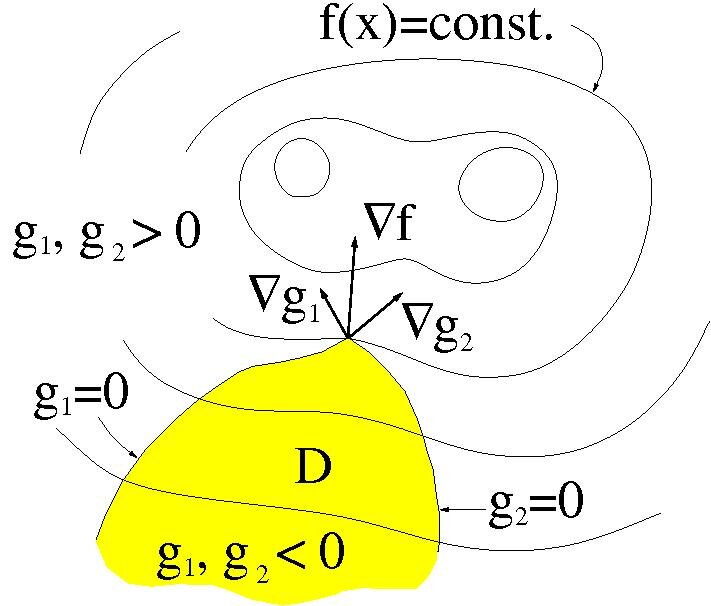
These constraints define a "feasible region"—the set of all possible solutions that satisfy the rules. Our goal is to find the best solution within this region.
Constrained optimization is about finding the best solution from the choices that are actually possible.
Consider a factory that produces two products, tables and chairs. They want to maximize profit. The decision variables are the number of tables () and chairs () to make. But they have constraints:
- Limited Wood: They only have a certain amount of wood available.
- Limited Labor: There are only so many hours their workers can put in.
- Non-negativity: They can't produce a negative number of tables or chairs.
Their task is to find the combination of tables and chairs that makes the most profit without violating any of these constraints. This is a classic constrained optimization problem.
Understanding these fundamental ideas—objectives, variables, extrema, and constraints—is the first step toward solving complex optimization problems in any field, from engineering and finance to logistics and machine learning.
In an optimization problem, what are the two main components you need to define?
A hiker climbs to the top of a hill and can see it's the highest point in their immediate vicinity, but not the highest in the entire mountain range. In optimization terms, what has the hiker found?