Kubernetes Networking Essentials
Pods
The Smallest Unit
In the world of Kubernetes, the most basic building block you'll work with is called a Pod. Think of it like a pea pod: it’s a small wrapper that holds one or more related items—in this case, containers.
A Pod is the smallest deployable unit in Kubernetes.
Everything in Kubernetes revolves around Pods. You don't run a container directly on the cluster; you run a Pod, and that Pod runs your container. While a Pod can contain multiple containers, it's most common to see a single container per Pod. The key idea is that a Pod represents a single, cohesive instance of an application.
Life Inside a Pod
What makes a Pod special is that all containers inside it share the same environment. They act as if they are running on the same single machine. Most importantly, they share the same network namespace. This means they share a single IP address and port space.
Imagine a Pod with two containers: a web server and a helper container that fetches data for it. The web server can talk to the helper container by simply making a network request to localhost on a specific port. They don't need to know each other's IP addresses, because they share one.
This setup is very useful for patterns where a secondary, "sidecar" container needs to support a main application container. Examples include logging agents, data synchronizers, or network proxies. Because they share the same network space, the sidecar can augment the main container without the main container even knowing it's there.
Pods on the Network
One of the core principles of Kubernetes networking is that every Pod gets its own unique IP address across the entire cluster. This creates a flat, clean networking model where any Pod can communicate with any other Pod directly using its IP address.
You don't have to worry about mapping container ports to host machine ports or figuring out how to connect different applications. If Pod A needs to talk to Pod B, it just uses Pod B's IP address. This eliminates a huge amount of complexity.
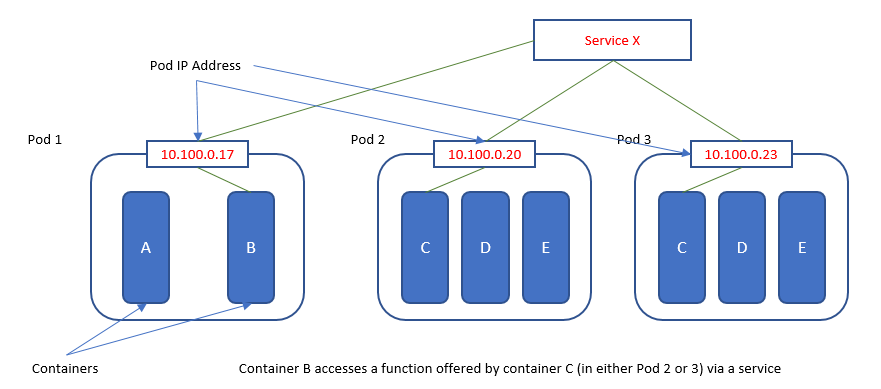
This model means there's no need for Network Address Translation (NAT), a technique used to modify IP address information in packet headers. The source Pod and the destination Pod can see each other's true IP addresses, making communication straightforward and easier to debug.
This simple but powerful concept—a group of containers sharing a network space, each group with a unique, routable IP address—is the foundation for all communication within a Kubernetes cluster.
What is the most fundamental, deployable unit of computing in Kubernetes?
What is the key advantage of running multiple containers in the same Pod?