Kubernetes Cluster Services Explained
Introduction to Kubernetes
Managing Fleets of Applications
Imagine you're running a popular website. As more users visit, you need more servers to handle the traffic. If a server crashes, part of your site goes down. Managing all this manually—adding servers, replacing broken ones, updating software—is a huge headache. This is the problem that containerization and Kubernetes solve.
Container
noun
A lightweight, standalone, executable package of software that includes everything needed to run it: code, runtime, system tools, system libraries, and settings.
Containers are like standardized shipping containers for software. Just as a physical container can be moved from a ship to a train to a truck without unpacking it, a software container lets you move an application between different computers and cloud environments without changing the application itself. It bundles the application and all its dependencies into one neat package.
This is great for a single application. But what happens when you have hundreds or even thousands of containers running a complex service? That's where Kubernetes comes in.
Kubernetes, often referred to as K8s, is an open-source container orchestration platform that automates the deployment, scaling, and management of containerized applications.
Think of Kubernetes as the conductor of an orchestra. Each container is a musician. The conductor doesn't play the instruments but ensures every musician plays the right part at the right time, creating a harmonious performance. Kubernetes (often shortened to K8s) orchestrates all your containers, telling them where to run, how to communicate, and what to do if one of them fails.
The Power of Automation
So, why go through the trouble of setting up Kubernetes? The main benefit is intelligent automation that makes applications more resilient and easier to manage. Kubernetes provides a framework to run your systems reliably, even when things go wrong.
Kubernetes provides you with a framework to run distributed systems resiliently.
Here are some of its key advantages:
Automatic Scaling: Imagine your website is featured on the news. Suddenly, traffic spikes. Without Kubernetes, your servers might overload and crash. With it, you can configure your application to automatically create more container instances to handle the load. When traffic dies down, Kubernetes scales back down to save resources and money.
Self-Healing: Servers fail, and software has bugs. Kubernetes constantly monitors the health of your containers. If a container crashes, Kubernetes will automatically restart it. If the server (or "node") it's running on goes down, Kubernetes will reschedule its containers onto healthy nodes, keeping your application online without manual intervention.
Service Discovery & Load Balancing: In a dynamic environment where containers are constantly being created and destroyed, how do they find each other to communicate? Kubernetes gives each container its own IP address and a single DNS name for a set of containers. It can then load-balance traffic across them, ensuring requests are distributed efficiently and reliably.
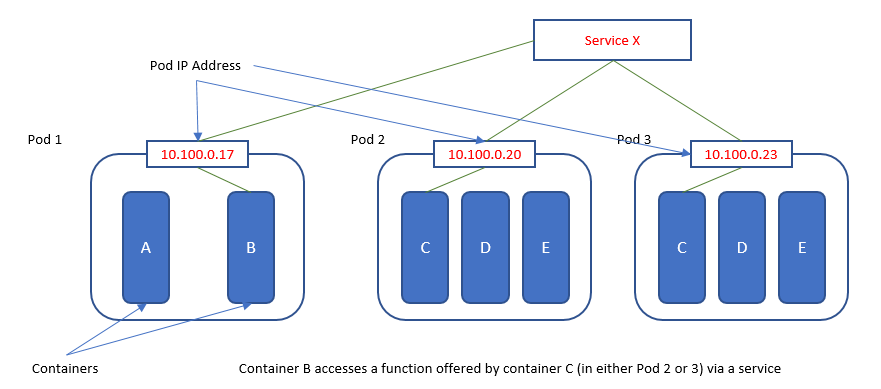
A Look at the Ecosystem
Kubernetes isn't just a single program; it's a whole ecosystem of components working together. While we won't dive deep into the architecture, it's helpful to understand the basic structure. A Kubernetes setup is called a cluster.
A cluster consists of two main types of machines:
-
The Control Plane: This is the brain of the operation. It makes all the global decisions about the cluster, like scheduling containers and detecting and responding to cluster events.
-
Worker Nodes: These are the machines (which can be virtual or physical) that run your applications. They are the workhorses of the cluster, and the Control Plane manages them.
You interact with the Control Plane, telling it what your desired state is—for example, "I want three copies of my web server container running." The Control Plane then works to make that state a reality and keep it that way, assigning the work to the various worker nodes.
The power of Kubernetes lies in its declarative model. You declare the state you want, and Kubernetes works to achieve and maintain it.
Kubernetes is the core of a much larger movement called cloud-native computing. It's supported by the Cloud Native Computing Foundation (CNCF), which hosts many related projects for monitoring, security, networking, and more. This vibrant ecosystem provides tools that integrate with Kubernetes to build powerful, modern applications.
Ready to test your understanding of these core concepts?
What is the primary problem that containerization and orchestration tools like Kubernetes are designed to solve?
Using the analogy of an orchestra, what is the role of Kubernetes?
By automating the complex tasks of deploying and managing applications at scale, Kubernetes allows developers to focus on writing code and delivering value, rather than getting bogged down in infrastructure management.