Krita PBR Texturing
Introduction to PBR
The Goal of Realism
In computer graphics, the ultimate goal is often realism. We want the metal to look like metal and the wood to look like wood. Physically Based Rendering, or PBR, is a method that gets us closer to that goal by simulating the real-world physics of light.
Older rendering techniques were more like artistic approximations. An artist would create textures and tweak settings to make a surface look shiny or rough under specific lighting. If the lighting changed, the effect might break. PBR is different. It's a holistic approach. Instead of faking it, PBR models how light actually interacts with a surface's properties. This means materials look correct and consistent under any lighting condition, from a dim candle to the bright sun.
With PBR, the properties of lights and surfaces stay separate.
This separation is key. You define a material's physical traits—like its roughness and metallic quality—and the rendering engine uses the laws of physics to figure out the rest. It’s a more predictable and principled way to create lifelike images.
How Light Behaves
When a light ray hits a surface, it does one of two things: it either bounces off (reflection) or it enters the surface (refraction).
For opaque objects, we mostly care about reflection. Light that hits these surfaces scatters in different ways. Some of it reflects in a uniform, mirror-like direction. This is called specular reflection. The rest of it penetrates the surface just a little, bounces around inside, and exits at a random angle. This is called diffuse reflection, and it's what gives a surface its color.
A perfectly smooth surface, like a mirror, has mostly specular reflection. A matte surface, like chalk, has mostly diffuse reflection. Most materials are somewhere in between.
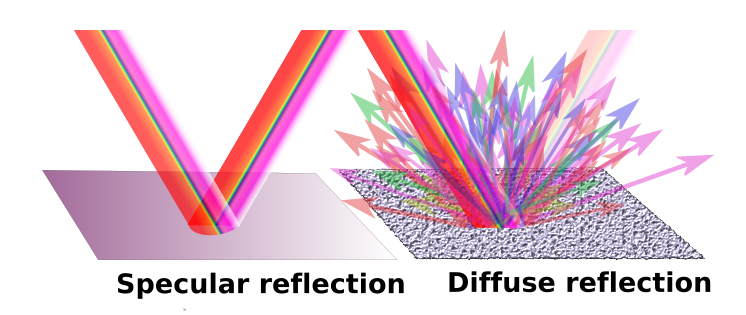
If a material is translucent or transparent, like glass or water, the light that enters it—refraction—becomes much more important. The light rays bend as they pass through, changing their direction.
A core principle of PBR is energy conservation. The total amount of light reflecting from and refracting into a surface can never be more than the amount of light that originally hit it. A surface can't create light out of nowhere. This simple rule prevents materials from looking unnaturally bright and helps maintain realism.
The Math of Light
To calculate the final appearance of every point on a surface, PBR systems use a master formula known as the rendering equation. It looks complex, but its idea is simple: the light leaving a point is the sum of the light it emits on its own plus all the light it reflects from other sources.
The most important part of that equation for defining a material is , the Bidirectional Reflectance Distribution Function (BRDF). This function is a mathematical model that describes how a surface reflects light.
The 'bidirectional' part simply means it considers two directions: the incoming light direction and the outgoing viewing direction. The BRDF answers the question: for a given amount of light coming from one direction, how much of it will reflect off toward the viewer?
By changing the BRDF, we can describe almost any material. A BRDF for steel will reflect light differently than a BRDF for plastic or fabric. This function is where physical properties like roughness and metallicness are mathematically defined, allowing the rendering equation to do its work.
Ready to test your knowledge on the foundations of PBR?
What is the primary advantage of Physically Based Rendering (PBR) over older, more traditional rendering techniques?
When light hits the surface of an opaque material like chalk, it penetrates slightly, scatters internally, and exits at a random angle. What is this phenomenon called?
Understanding these core principles—how light behaves and how we can model it with math—is the first step to creating truly believable and consistent 3D assets.