Korean Musical Heritage and Science
Defining Gugak Basics
What is Gugak?
Gugak (국악) is the term for traditional Korean music. The word itself translates simply to "national music." It's a tradition that stretches back thousands of years, yet it's not a museum piece. Gugak is a living art form, with roots in ancient rituals and court life, that continues to be performed, reinterpreted, and enjoyed today.
Two Sides of the Same Coin
At its core, Gugak is divided into two major streams. Think of them as two distinct personalities that together form a complete picture of Korean musical expression.
The first is Jeongak (정악), or "proper music." This was the music of the royal court and the scholarly upper class. It's slow, deliberate, and highly refined. The goal of Jeongak isn't to stir up strong emotions, but to encourage contemplation, discipline, and harmony. It's the sound of meditation and ceremony.
The other stream is Minsokak (민속악), or "folk music." This is the music of the common people. It’s the soundtrack to everyday life: work, festivals, and storytelling. Unlike the controlled calm of Jeongak, Minsokak is bursting with life. It can be fast, loud, and intensely emotional, often featuring improvisation.
| Feature | Jeongak (Court Music) | Minsokak (Folk Music) |
|---|---|---|
| Origin | Royal court, aristocracy | Common people |
| Pace | Slow, meditative | Often fast, energetic |
| Feeling | Controlled, peaceful | Emotional, expressive |
| Purpose | Ceremony, contemplation | Work, celebration, ritual |
The Feeling Behind the Music
To truly understand Gugak, you need to know the cultural ideas that shape it. One key concept is Pungnyu (풍류). This describes a way of life that values artistic pursuits, nature, and leisure. It's about finding elegance and enjoyment in things beyond the mundane, a mindset perfectly reflected in the refined sounds of Jeongak.
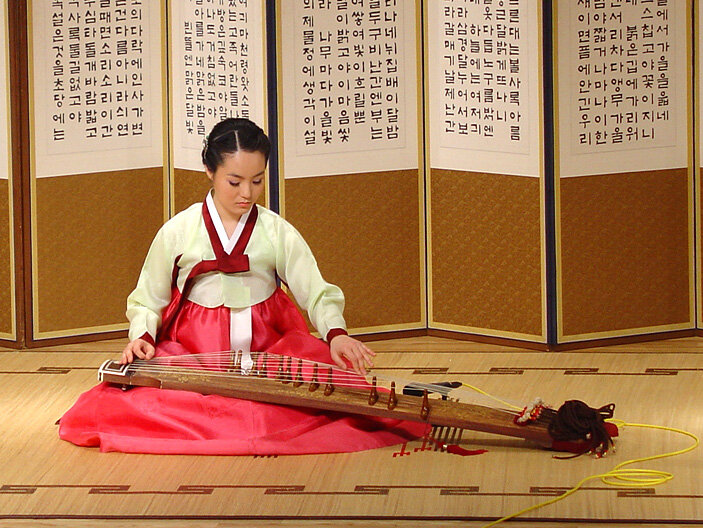
Even more central are two powerful emotions: Han (한) and Heung (흥).
Han is a uniquely Korean concept, a kind of deep-seated sorrow, grief, or resentment. It’s often described as a collective feeling, born from the nation's long history of invasion and hardship. In music, Han is expressed as a profound melancholy.
Heung is the polar opposite: pure joy, excitement, and a spontaneous energy that makes you want to dance. It’s the feeling of a lively festival or a shared moment of celebration.
What makes Gugak, especially Minsokak, so compelling is how it blends these two feelings. A song might begin with a slow, sorrowful expression of Han, but as the music builds, it transforms into an explosive release of Heung. This emotional journey from sorrow to joy is at the very heart of the Korean musical spirit.
Gugak offers a window into the Korean soul. It balances the calm refinement of the court with the raw, vibrant emotion of the people, creating a rich and timeless musical tradition.