Korean Language Fundamentals
Hangul Basics
A King's Gift
Before the 15th century, writing in Korean was a challenge. Koreans used classical Chinese characters, which were a poor fit for the sounds and grammar of their language. This system was so complex that only the elite could master it, leaving most of the population illiterate.
King Sejong the Great wanted to change this. He believed everyone deserved the ability to read and write. So, he and a team of scholars secretly developed a new alphabet designed specifically for the Korean language. It was simple, scientific, and easy to learn.
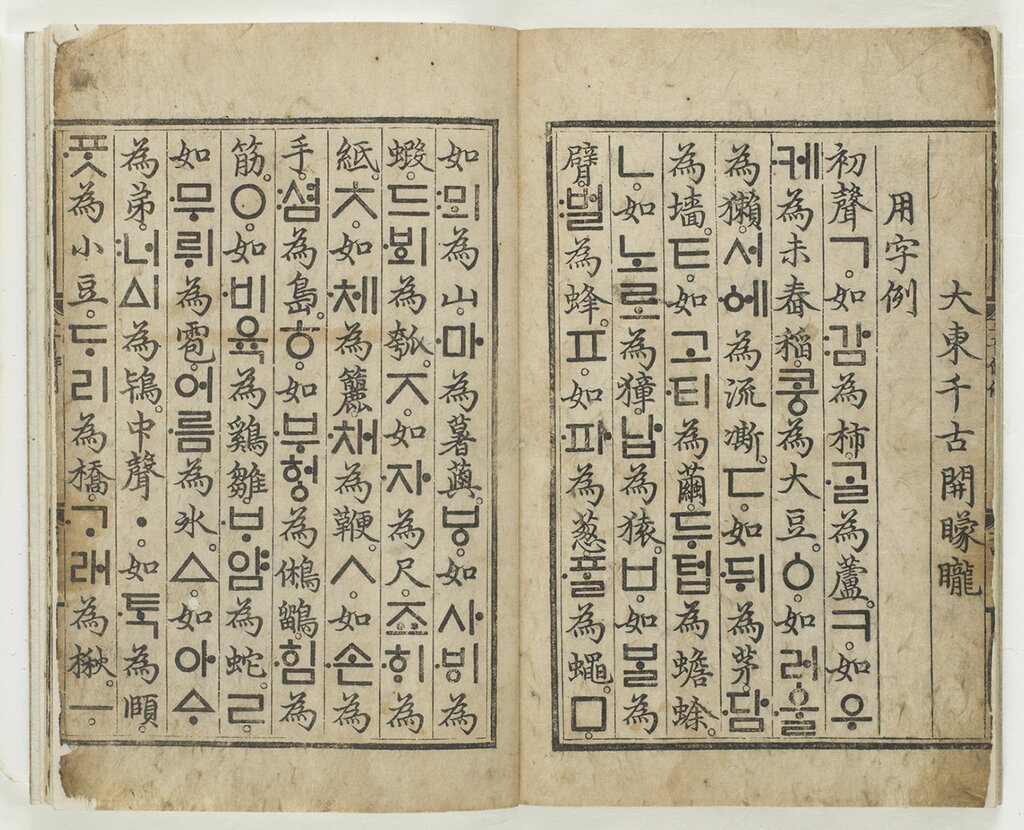
In 1446, the king introduced this new script, calling it Hunminjeongeum, or "The Proper Sounds for the Instruction of the People." Today, we know it as Hangul (한글). Its genius lies in its design. Vowel shapes are based on the philosophical concepts of heaven (a dot •), earth (a horizontal line ㅡ), and humanity (a vertical line ㅣ). Consonants are even more intuitive—their shapes mimic the position of the mouth, tongue, and throat when you make the sound.
Letters as Building Blocks
Unlike English, where letters are written in a straight line, Hangul characters are grouped into syllabic blocks. Each block represents one syllable and is read from left to right, and top to bottom. A syllable block must contain at least one consonant and one vowel.
Think of it like building with LEGOs. You have different shaped pieces (consonants and vowels), and you snap them together in a square space to create a sound.
The simplicity of Hangul can be attributed to its format of syllabic blocks: rather than written linearly, vowels and consonants are grouped into syllables that consist of letters arranged in a square block.
Let's meet the basic building blocks. There are 14 basic consonants and 10 basic vowels.
| Consonant | Name | Sound |
|---|---|---|
| ㄱ | giyeok | g/k |
| ㄴ | nieun | n |
| ㄷ | digeut | d/t |
| ㄹ | rieul | r/l |
| ㅁ | mieum | m |
| ㅂ | bieup | b/p |
| ㅅ | siot | s |
| ㅇ | ieung | silent / ng |
| ㅈ | jieut | j |
| ㅊ | chieut | ch |
| ㅋ | kieuk | k |
| ㅌ | tieut | t |
| ㅍ | pieup | p |
| ㅎ | hieut | h |
Now for the vowels.
| Vowel | Sound |
|---|---|
| ㅏ | a |
| ㅑ | ya |
| ㅓ | eo (like 'uh' in 'but') |
| ㅕ | yeo |
| ㅗ | o |
| ㅛ | yo |
| ㅜ | u (like 'oo' in 'moon') |
| ㅠ | yu |
| ㅡ | eu (like 'u' in 'put') |
| ㅣ | i (like 'ee' in 'see') |
Assembling Syllables
Every syllable block starts with a consonant. If a syllable starts with a vowel sound, you must use the silent consonant ㅇ as a placeholder. Let's combine some letters to see how it works.
To make the sound "ga," we take the consonant ㄱ (g) and the vowel ㅏ (a). We place them side-by-side to form the block 가.
To make the sound "no," we use ㄴ (n) and ㅗ (o). Since ㅗ is a horizontal vowel, the consonant goes on top: 노.
What about a word like "i," as in the number two? It starts with a vowel sound. So we use the silent placeholder ㅇ with the vowel ㅣ (i) to create the block 이.
Some syllables also have a final consonant, called a batchim, which sits at the bottom of the block. For example, the word for "mountain" is 산 (san). It's built from ㅅ (s), ㅏ (a), and a final ㄴ (n) at the bottom.
With these simple rules, you can start to read and write any word in Korean.
Now, let's test your knowledge on the foundations of Hangul.
Before the invention of Hangul, what writing system was primarily used in Korea?
The design of Hangul consonants is based on the shape of the writer's brush.
By understanding these core principles, you've taken the most important step in learning Korean. The rest is just practice.