Kodokan Shodan Mastery for Senior Judoka
Nage-no-kata Fundamentals
Ritual and Movement
Your Nage-no-kata performance begins the moment you step onto the tatami. The opening ritual, or , isn't just a formality; it establishes the seriousness and mutual respect required for kata. It demonstrates your control and state of mind before a single throw is executed. Both Tori (the thrower) and Uke (the receiver) must be perfectly synchronised.
The kata starts with a standing bow (ritsu-rei) as you enter the performance area. You then advance to your starting positions and perform a kneeling bow (za-rei) to Joseki (the place of honour), followed by a mutual bow between you and your partner. Every movement is deliberate. Your back is straight, your gaze is focused, and your breathing is controlled. This initial exchange sets the tone for everything that follows.
Once the bows are complete, you and your partner rise and walk towards each other to establish Ma-ai, the engagement distance. For Nage-no-kata, this is precisely four large steps. This spacing is critical and must be maintained throughout. The walking patterns are specific and non-negotiable for grading.
- Ayumi-ashi: This is a normal, gliding walk. Your feet do not cross, and your posture remains upright and stable. This is used to advance and retreat over longer distances, such as approaching the starting position.
- Tsugi-ashi: This is the 'following foot' walk, used for shorter, more combative adjustments. One foot leads, and the other quickly follows to the same ready stance, never passing the lead foot. This is how you and Uke will adjust distance just before engaging for a technique.
Your movement should be silent and smooth, keeping your centre of gravity constant. There is no bobbing up and down. You are gliding across the mat, always balanced and ready.
Te-waza: The First Set
The first set of Nage-no-kata consists of three hand techniques, or Te-waza. This is your first opportunity to demonstrate your understanding of the core principle of judo: . Unlike in randori (free practice), where these phases can be explosive and blurred, in kata they are distinct, deliberate, and clear. Uke is not a passive participant but an active partner, responsible for attacking with intent and providing the correct reaction for Tori to exploit.
The entire set must have a certain 'breathing' or rhythm. There's a moment of focused stillness (kamae), followed by Uke's committed attack, Tori's decisive action, and a return to awareness (zanshin). It is a controlled, intense exchange, not a pre-rehearsed dance.
| Technique | Tori's Action | Uke's Action |
|---|---|---|
| Uki-otoshi | Kneels on the left knee, pulling Uke forward and down with both hands. | Steps forward to strike Tori's head; is drawn forward into a forward breakfall. |
| Seoi-nage | Steps and turns deeply, loading Uke onto the back and executing a shoulder throw. | Attempts to strike Tori's head; is unbalanced and thrown cleanly over the back. |
| Kata-guruma | Steps in deeply, drops under Uke's centre of gravity, lifting onto the shoulders. | Pushes Tori's chest; is lifted and guided into a controlled side breakfall. |
Let's break down the key points for each throw.
Uki-otoshi (Floating Drop): This technique is all about timing and redirection, not strength. As Uke advances to strike, you use their momentum against them. Your pull should guide them downwards into the empty space created by your kneeling movement. The action is smooth and continuous. Uke must commit to the attack to provide the necessary energy for the throw.
Seoi-nage (Shoulder Throw): Precision is key. For the grading, this is typically an ippon seoi-nage. Your turning action (tsukuri) must be sharp and place you deep inside Uke's guard, with your back making full contact. The throw comes from the legs and hips, not by pulling with the arms. Uke's role is to maintain posture during the attack, allowing for a clean, high-arcing throw.
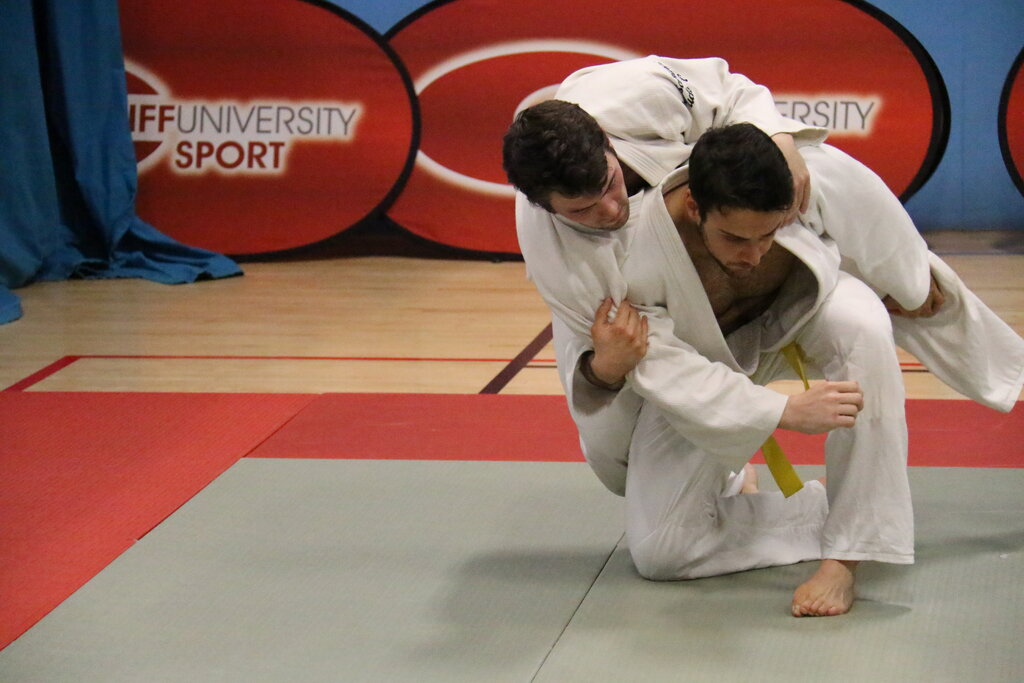
Kata-guruma (Shoulder Wheel): This is often the most challenging throw of the set. Unlike the sport version, the kata version requires Tori to drop underneath Uke and lift them across the shoulders in a continuous motion. It is vital that Tori gets low enough and maintains a straight back. Uke assists by controlling their own body, keeping it taut to allow for a clean lift and rotation, landing safely in a breakfall.
Uke's Critical Role
A common mistake among candidates is viewing Uke as a compliant dummy. For a high score, Uke must be a skilled and active partner. Uke's attacks must be credible and committed. Their posture and reactions must be precise to allow Tori to demonstrate the principles of the throw correctly. When Uke is thrown, their breakfall (ukemi) must be clean, confident, and perfectly timed, absorbing the impact while demonstrating control.
The synchronicity between Tori and Uke is what examiners are looking for. It shows a deep understanding of the kata's purpose: a cooperative demonstration of judo's fundamental principles. Practice each role equally. A good Tori is often an excellent Uke, and vice-versa.
In the context of Nage-no-kata, what is the primary purpose of the opening ritual, or Rei-ho?
Which type of walk is described as the 'following foot' walk, used for short, combative adjustments in distance?
Mastering this first set requires attention to detail and countless repetitions. Focus on the spirit of the ritual, the precision of the movement, and the clarity of the principles in each throw.