Knowledge Only Epistemology
Defining Knowledge
What Does It Mean to Know?
Philosophers have long wrestled with a seemingly simple question: What is knowledge? It's one thing to say you know that Paris is the capital of France, but it's another to explain what 'knowing' itself is. The field of philosophy dedicated to this is called epistemology.
Defined narrowly, epistemology is the study of knowledge and justified belief.
For centuries, the most common answer to this question was the Justified True Belief (JTB) model. It breaks knowledge down into three essential conditions. For you to know something, you must:
-
Believe it. You can't know something you don't believe. If you say, "I know the sun will rise tomorrow," you are also saying you believe it will.
-
It must be true. You can't know something that's false. You might believe the moon is made of cheese, but you can't know it, because it isn't true.
-
You must be justified in believing it. Your belief can't be a random guess. You need some good reason or evidence. You're justified in believing the sun will rise because it has done so every day of your life.
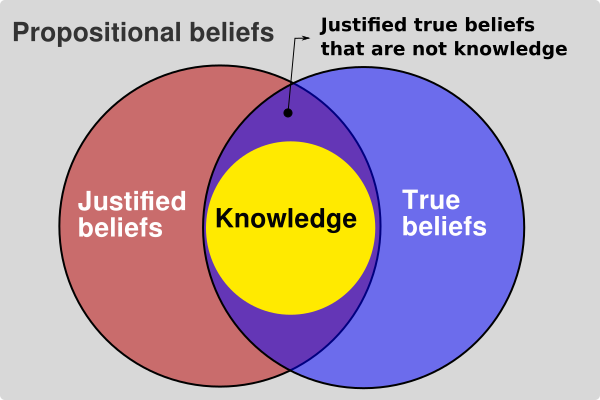
So, knowledge is a belief that is both true and backed by good reasons. This definition feels intuitive and worked well for a very long time. It seemed to cover all the bases.
A Crack in the Foundation
In 1963, a philosopher named Edmund Gettier published a short paper that poked a hole in this long-standing definition. He proposed thought experiments, now called Gettier problems, that showed it's possible to have a justified, true belief, but still not have what we would call knowledge. The issue often comes down to luck.
Imagine this scenario: Smith and Jones are applying for the same job. Smith has strong reasons to believe that Jones will get the job. The company president told him so. Smith also happened to see Jones count ten coins into his pocket a few minutes ago. So, Smith forms a belief: "The man who will get the job has ten coins in his pocket."
His belief is justified. The president's word is strong evidence, and he saw the coins himself.
But, there's a twist. The president was mistaken, and Smith actually gets the job. And, by sheer coincidence, Smith also has ten coins in his pocket.
Now, look at Smith's belief: "The man who will get the job has ten coins in his pocket." Is it true? Yes, because Smith got the job and has ten coins. Is it justified? Yes, based on the evidence he had about Jones.
So, Smith has a justified, true belief. But did he know it? Most people would say no. His justification pointed at Jones, not himself. He arrived at a true conclusion by accident.
Gettier's insight was that justification and truth can be disconnected. You can have a good reason to believe something, and that something can turn out to be true, but for completely different reasons than you thought. This lucky coincidence is not knowledge.
Gettier Problem: A challenge to the JTB account of knowledge, presenting situations where someone has a justified true belief but still seems not to know.
This simple idea threw epistemology into a frenzy. Philosophers realized that the three conditions of JTB were necessary, but maybe not sufficient. The challenge ever since has been to figure out what fourth condition, if any, could be added to the definition of knowledge to account for Gettier's critique and finally solve the puzzle.