Knowledge Assessment and Concept Mastery
Complex Systems Integration
Beyond the Building Blocks
You already know the pieces. You can define an economic system, a technological stack, or a social network. The real work begins when these systems collide. The critical question isn’t what they are, but how they interact, often in unpredictable ways.
A change in one domain doesn't just add a new variable; it sends ripples across the entire landscape. Think of a city introducing a new fleet of autonomous delivery drones. This isn't just a technology upgrade. It's an economic shift for local couriers, a new regulatory challenge for airspace, a social change in how people receive goods, and a logistical strain on urban infrastructure. The systems are interdependent.
We move from a linear mindset of cause-and-effect to a world of non-linear causality, where a small nudge in one area can trigger a massive, seemingly unrelated outcome elsewhere.
Feedback Loops and Runaway Trains
At the heart of system interaction are feedback loops. These are the engines that drive change, stability, or collapse. They come in two main flavors.
Reinforcing loops amplify change. They are the source of exponential growth or decay. A viral video is a perfect example. The more views it gets, the more algorithms promote it, leading to even more views. The process feeds on itself.
Balancing loops seek stability. They are goal-oriented and corrective. A thermostat is the classic model: when the room gets too hot, the system kicks in to cool it down, and vice-versa. It constantly works to maintain equilibrium.
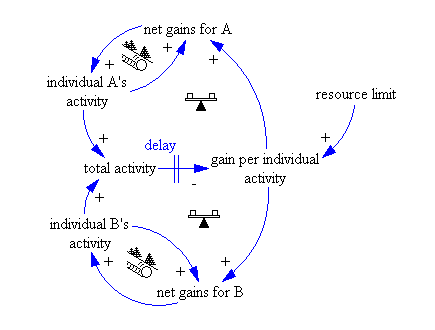
In complex environments, these loops are tangled together. A policy intended to create balance (like a subsidy to help a struggling industry) might inadvertently create a reinforcing loop of dependency that stifles innovation. The challenge is identifying which loops are dominant and how their interactions will play out. This is the essence of interdependency mapping, a crucial skill for navigating complex systems.
The Ghost in the Machine
When simple components interact, they can produce behaviors that are impossible to predict by studying the parts in isolation. This is the concept of emergence—the whole becoming greater than, and fundamentally different from, the sum of its parts.
A flock of starlings is a powerful example. No single bird acts as a leader or has a blueprint of the flock's mesmerizing patterns. Each starling follows a few simple rules: fly in the same direction as your neighbors, don't get too close, and avoid predators. From these local, simple interactions, the complex, coordinated dance of the murmurration emerges.
In human systems, culture, market crashes, and traffic jams are all emergent properties. There is no central “traffic jam creator” orchestrating the slowdown. It emerges from the individual decisions of thousands of drivers reacting to the cars immediately around them. Understanding emergence means shifting focus from individual agents to the patterns of interaction between them.
Applying the Concepts
Let’s analyze a real-world scenario: the rise of remote work. This isn't just a change in office policy; it’s a systemic shock with cascading effects.
-
Identify the Interdependencies: The shift to remote work directly impacts commercial real estate (demand plummets), urban economics (less foot traffic for downtown businesses), and residential housing markets (people move to suburbs, driving up prices). It also affects technology infrastructure (demand for cloud services and broadband soars) and social structures (changes in community engagement and work-life balance).
-
Map the Feedback Loops: A reinforcing loop emerges in suburban housing. As more people move out of cities, demand increases, prices rise, and the incentive for even more people to leave the expensive city grows. A balancing loop might be a company's attempt to restore culture by mandating a few days in the office, trying to pull the system back toward a hybrid equilibrium.
-
Look for Emergent Properties: An unexpected emergent property could be the creation of new economic hubs in smaller towns that were previously dormant. No single company or person planned this; it emerged from the collective actions of thousands of individuals making independent choices enabled by the new remote work reality. The very definition of a “workplace” has been altered, an outcome far beyond the initial system of a single company's policy change.
A city's decision to implement a new public transport system leads to changes in housing prices, local business revenue, and air quality. This scenario best illustrates which concept?
A thermostat maintaining a set temperature in a room is a classic example of a reinforcing feedback loop.
By analyzing the interplay of feedback, interdependency, and emergence, we can begin to understand why standard definitions and linear models often fail. They describe the parts, but the real story is in how they connect.